Mathematics /4. Applied
mathematics
Doctor of science, professor Alekhina M.A., student Ilyina J.D.
Penza State University, Russia
About complexity of asymptotically optimal on
reliability
circuits with inverse faults on the outputs of
the elements
We consider the realization of
Boolean functions by combinatorial circuits with unreliable gates, realizing
functions from an arbitrary complete
finite basis B={e1,...,em}. A positive
number v(Ei) (call it the weight of the element) is assigned to
each element of the basis Ei
(i = 1, ..., m) with the function ei.
The circuit S complexity is defined as the sum of
the weights of all its elements, and it’s denoted L(S). Let  where
the minimum is taken for all basis elements Ei
such that n(Ei)> 1 and n(Ei) is the number of essential
variables of the function ei, realized by the element Ei .
where
the minimum is taken for all basis elements Ei
such that n(Ei)> 1 and n(Ei) is the number of essential
variables of the function ei, realized by the element Ei .
It is supposed
that all circuit elements are unreliable and independently of each other are prone
output inverse faults with probability ε (εÎ(0,1/2)). The inverse fault at the output is characterized by that the
functional element realizes the function e,
ascribed to him, in good condition and the function  in failure. The circuit of unreliable
elements is assumed to realize the function
in failure. The circuit of unreliable
elements is assumed to realize the function 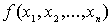 , when entering of the set
  =(a1,a2,…,an) at the circuit inputs implies
supplying for a set of circuit inputs
=(a1,a2,…,an) at the circuit inputs implies
supplying for a set of circuit inputs  =(a1,a2,…,an) with no faults at the output value appears
  .
.
Let  be an arbitrary Boolean function and S be any circuit, realizing the function
  . Denote
  the probability of the value
  at the output of the circuit S, realizing the Boolean function
  for the input set
  . Unreliability P(S) of the circuit S is defined as the maximum of numbers
  for all possible input sets
  . Reliability of the circuit S is equal 1−P(S).
It’s introduced Shannon function  , characterized complexity of
circuits, realizing the functions of n
variables in the basis B, where the
minimum is taken for all circuits S
of unreliable elements, that realize the function
, characterized complexity of
circuits, realizing the functions of n
variables in the basis B, where the
minimum is taken for all circuits S
of unreliable elements, that realize the function 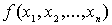 with unreliability
  , and the maximum is taken for all
Boolean functions f of n variables.
, and the maximum is taken for all
Boolean functions f of n variables.
Denote  the minimum number of reliable elements required to realize the function
g by a circuit in the basis B. D. Uhlig [1] proved Theorem 1 for
output inverse faults with a fault probability e.
the minimum number of reliable elements required to realize the function
g by a circuit in the basis B. D. Uhlig [1] proved Theorem 1 for
output inverse faults with a fault probability e.
Theorem 1 [1]. For any arbitrary small
numbers b and h (b, h> 0) there exists
the number e¢ (e¢ Î(0, 1/2)) such that for
any eÎ(0, e¢), and anyone p, satisfied the inequality 


 , there is the relation
  d
d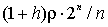 , where
  is the minimum number of
reliable elements required to realize the function of voting
is the minimum number of
reliable elements required to realize the function of voting 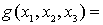
 in this basis B.
Circuits, satisfied
conditions of Theorem 1, are asymptotically optimal on complexity and work with
some level of reliability 1–p.
Boolean function
of the form  (
( ,
,  ) is called a generalized function
of voting.
) is called a generalized function
of voting.
Let G be a set of Boolean functions of
variables  (n ≥ 3), such that
each of them is congruent to some generalized function of voting. Obviously that
(n ≥ 3), such that
each of them is congruent to some generalized function of voting. Obviously that  ÎG.
ÎG.
REMARK 1. Theorem 1 is true, if instead of the voting function we take any
function from the set G. Therefore (for a given basis),
instead of  it is advisable to take a number
 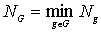 .
.
Lemma 1 [2]. In the basis B there is the inequality  .
.
Lemma 2 [3]. Let f be an arbitrary Boolean function and S1 be a circuit,
realizing the function f. Let g Î G and A be any circuit, realizing the function
g. Then the function f can be realized by such circuit S2, that P(S2) ≤ P(A)+3P2(S1),
where P(S1) and P(A) are unreliabilities of circuits S1
and A respectively.
Let 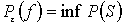 , where S is the circuit
of unreliable elements, realizing the Boolean
function f.
, where S is the circuit
of unreliable elements, realizing the Boolean
function f.
The circuit A of unreliable elements, realizing
the Boolean function f, is called asymptotically optimal on
reliability, if  for
for  .
.
We prove the main result of this article.
Theorem 2. Let B be an arbitrary
complete finite basis and Sg be an asymptotically optimal on
reliability circuit, realizing the function of voting. For any h> 0 there is
the constant ε0 Î (0,1/2) such that any Boolean
function 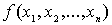 can be realized by the
asymptotically optimal on reliability circuit S, for which there are relations P(S) ≤ P(Sg)+196ε2 for any ε Î (0,ε0] and L(S) d 3(1+h)ρ×2n/n
for
can be realized by the
asymptotically optimal on reliability circuit S, for which there are relations P(S) ≤ P(Sg)+196ε2 for any ε Î (0,ε0] and L(S) d 3(1+h)ρ×2n/n
for  .
.
Proof. Let the conditions of the theorem are satisfied and 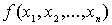 be any Boolean
function. We take an arbitrary number h>
0 and use Theorem 1, considering b =
0,01. Then there is a constant ε0 Î (0,1/2) , that for any ε
Î
(0, ε0] and p=1,01ε NG
the function f can be realized by the
circuit S1, for which P(S1)
≤1,01εNG and L(S1) d (1+c)ρ 2n/n. According to Lemma 1 we have
be any Boolean
function. We take an arbitrary number h>
0 and use Theorem 1, considering b =
0,01. Then there is a constant ε0 Î (0,1/2) , that for any ε
Î
(0, ε0] and p=1,01ε NG
the function f can be realized by the
circuit S1, for which P(S1)
≤1,01εNG and L(S1) d (1+c)ρ 2n/n. According to Lemma 1 we have . Therefore, P(S1) ≤
8,08ε. Take three copies of circuit S1
and connect their outputs with the inputs of the circuit Sg. Denote S2
this circuit. According to Lemma 2, for ε Î (0, ε0] we obtain P(S2) ≤ P(Sg)+3P2(S1) ≤ P(Sg)+3(8,08ε)2 ≤ P(Sg)+196ε2.
. Therefore, P(S1) ≤
8,08ε. Take three copies of circuit S1
and connect their outputs with the inputs of the circuit Sg. Denote S2
this circuit. According to Lemma 2, for ε Î (0, ε0] we obtain P(S2) ≤ P(Sg)+3P2(S1) ≤ P(Sg)+3(8,08ε)2 ≤ P(Sg)+196ε2.
Obviously, L(S2)=3L(S1)+L(Sg)
d
3L(S1) d 3(1+h)ρ 2n/n. ƒ
Using Theorem 2,
we can improve constant d in the previous
result of A.V. Vasin [4]: let the complete basis is B Í
B3, then for any h>0 there exist constants
cÎ{1,2,3,4,5}, ε0 Î (0, 1/2), d > 0 and the class of functions K, depending only on the basis, that for
all n ≥ 3, any Boolean function
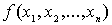 ÎK can be realized by the asymptotically optimal on reliability circuit S, for which P(S) ≤ cε+dε2
for all ε
Î
(0,ε0], d≤
2252 and L(S) d 3(1+h)ρ 2n/n for
ÎK can be realized by the asymptotically optimal on reliability circuit S, for which P(S) ≤ cε+dε2
for all ε
Î
(0,ε0], d≤
2252 and L(S) d 3(1+h)ρ 2n/n for  .
.
Corollary 1. Let the complete
basis B Í B3. For any h>0, there exist constants c Î{1,2,3,4,5}, ε0 Î (0, 1/2) and the class of functions K, depending only
on the basis, that for all n ≥ 3 any Boolean function 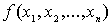 ÎK can be realized by the
asymptotically optimal on reliability
circuit S, for which P(S) ≤ cε+360ε2 for all
ÎK can be realized by the
asymptotically optimal on reliability
circuit S, for which P(S) ≤ cε+360ε2 for all
ε Î (0,ε0] and L(S) d 3(1+h)ρ 2n/n for  .
.
Theorem proof
follows from the fact, that [4] in the complete basis B Í
B3 the voting function can be realized
by the asymptotically optimal on reliability circuit Sg, for which P(Sg) ≤ cε+161ε2 for all εÎ (0,1/960].
Circuits,
satisfied the conditions of Corollary 1, are asymptotically optimal on
reliability for functions from class K, and their complexity differs from
complexity of minimal circuits of absolutely reliable elements in 3(1+h) times, where h is an arbitrary small positive number. Note that the class K
contains almost all Boolean functions.
References
1.
Uhlig D. Reliable networks from unreliable gates with almost minimal comlexity
// Fundamentals of Computation Theory. Intern. сonf.
FCT'87 (Kazan, June 1987). – Proc.
Berlin: Springer-Verl., 1987. – P. 462 – 469. (Lecture Notes
in Comput. Sci.; V. 278).
2. M.A. Alekhina: About number of gates of circuits,
realized generic function of voting // News of higher education institute. Volga
region. Physic-mathematical sciences. – Penza (in Penza),
2013, in press.
3. M.A. Alekhina:
Synthesis of the asymptotically optimal on the reliability combinatorial
circuits (Monograph), Penza (in Penza), 2006. – 156 p.
4. Vasin А.В. Asymptotically optimal circuits on
reliability in complete final basis of three-input gates. – Thesis … candidate of physic-mathematical sciences, Penza, 2010. –
100 p.