D.A. Pervyshin, O.V. Afanasjeva
National mineral
resources university, Russia
INTERRELATION a lifecycle
phase and PURPOSES COMPLICATED SYSTEMS
A
characteristic feature the present stage of of development of science and
technology is the creation of complex systems.
It is
known that a class of complex systems can be broken down into the following
types [1]: technical, economic, biocybernetical and social.
For
system studies of the condition of all these types of systems, there is the
theory of the management of complex information systems, pioneered by Dr.-Ing.
Sci. Martyshenko L.A [1].
Structure
of modern engineering systems are very diverse and complex. In this connection,
the developers of systems meet a number of serious problems with the conduct of
the early stages of design and quantitative analysis of system performance.
In
addition, the increasing demands for effective functioning different types of
systems lead to improvements in their service.
An important role is played by the
means performance monitoring and troubleshooting, based on the methods of
modeling of complex systems and their diagnosis.
The
length of time from the appearance of public need and the emergence of the idea
of a technical system before its withering away of (forgetting the
system) is called life-cycle (LC). The life cycle of any technical object, such
as moving objects, consists of four main stages (Fig. 1) [2]: conceptual
design, engineering design, production and operation.
Each of
these stages in turn, consists of several stages. Stages of engineering design
and content work operated by on them are strictly defined state standard, which
is not on other stages. Vital
functions of technical systems takes place within organizational systems, and
some of its stages, and even the steps, sometimes provided by different
organizations [2].
At the
stage of conceptual design identifies the need and possibility in principle
(feasibility) to create particular system; are produced the objectives and
criteria its application and design, the decision on the external appearance of
the system, substantiated basic performance characteristics and evaluated
resources needed for further work; is formalized and agreed upon with the
technical task for executor the system design.
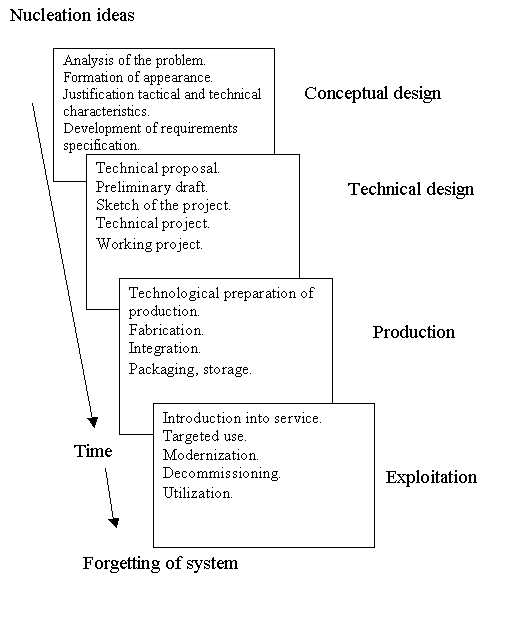
Figure 1: The life cycle of a
technical object
Stage
of technical design includes such steps as technical requirements, technical
proposal, a preliminary draft (pilot project), a sketch of the project (draft
project), technical project and working draft. The most time-consuming step is
a working draft, during which are manufactured prototypes and to hold test,
with subsequent correction based on their results of technical documentation.
This cycle (operational development products) repeated until long as the test
sample will not meet the requirements technical task (TOR).
Stages
of technical and detailed design adopted are collectively called development
work (R & D). They terminate trials
of the sample system. By results of these tests shall be made decision to
accept the system and its production.
At the
manufacturing stage performed Technological preparation of manufacture,
manufacturing, assembly, configuration, production tests and warehousing.
At the
operation stage performed delivery, implementation of the system, its use,
modernization (further operation), and finally decommissioning.
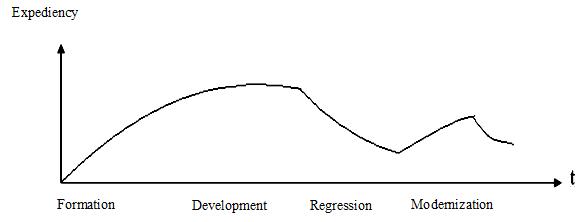
Рис.2. Графическое представление
жизненного цикла технической системы
Thus,
during the lifecycle reasonableness or practically attainable purpose of
establishing system (Fig. 2) increases at first, passing successive periods of
establishment and development, and then falling sawtooth, is undergoing a
period of regression and modernization. In the process of modernizing for some
time can lift expediency up to some acceptable level, but then the system is so
becomes outdated that the upgrade costs are too little effect, and the system
dies (is removed from service and disposed). We observe that the above,
concerning the life cycle, relate to any systems.
List of
sources used
1. Ивченко, Б.П. Теоретические основы информационно-статистического
анализа сложных систем/ Б.П. Ивченко, Л.А. Мартыщенко, М.Л. Монастырский. – СПб.: Лань,
1997. –320с.
2. Лямкин, А.А. Концептуальное
проектирование комплексов управления подвижными объектами как сложными
техническими системами: Учеб. пособие/ А.А.
Лямкин, Д.А. Первухин, О.В. Афанасьева.– СПб.: СЗТУ, 2004. –173с.