Way
of air-conditioning of interior of the automobile
V.I. Sarbaev,
Y.V.Garmash, I.I.Ponomareva
Key words: system of
heating, ventilation and air-conditioning of interior of the automobile, speed
of evaporation, temperature of boiling, power efficiency, dynamics of the
automobile.
The summary: the cheap
and simple way of reception of cooled air is offered, at decrease power, and
also increase of reliability of a central air of air. In a basis of a principle
of action of the conditioner known dependence of temperature of boiling of
water on pressure sated water gas above its surface lays.
Introduction. Work concerns to area of
transport mechanical engineering, in particular, to system of heating,
ventilation and air-conditioning of interior of the automobile.
The interior of the vehicle, as well as other places of stay of the person,
should provide comfortable conditions. In the hygienic relation as a
microclimate understand a complex of physical factors (temperature, humidity,
speed of movement and a dust content of air, intensity of thermal radiation),
capable to influence a condition of an organism and him reactions. Conditions
at which the driver managing the automobile do not test overcooling, overheating,
"drafts" or other unpleasant sensations, consider comfortable. Creation
of comfortable conditions in interior of the automobile assumes presence of the
appropriate means which work also meets the requirements on a level of vibration,
noise etc., connected with comfort.
It is accepted to count, that to comfortable conditions correspond(meet) temperature
of air in interior 18 - 25 0С, relative humidity 40 - 60 % and speed
of movement of air no more than 0,1 m/s.
These conditions should provide two subsystems of management with a climate
of interior of the automobile:
- Passive (sun-protection devices and thermal screens), a problem which -
to lower heat exchange with an environment;
- Active (in particular, devices of heating, air-conditioning and
ventilation of air), which problem - creation and maintenance of the given
parameters of a microclimate.
Let's consider existing domestic systems of heating and ventilation of
interior of the automobile. For heating interior of the vehicle the heat
removed from the engine of internal combustion with the help moved by the pump
of cooling liquid is usually used. Acting in a radiator of a heater, it heats
up air environmental it, further heat is distributed in interior or natural air
конвективными by streams,
or compulsorily - with the help of the fan. Thus, the typical system of
ventilation and heating of interior contains pipelines for submission of
cooling liquid, a radiator of a heater, elements of management of an air
stream, the fan, and also pipelines of an air stream. As the mode of operation
of such devices is determined by a condition of object, they should enter into
system of automatic control with a feedback on adjustable parameter.
Urgency
of research. For example, the microclimate in
interior of the automobile in the elementary case is supported by the driver
who acts as similar "automatic device". He switches speed of rotation
of the fan of a heater and changes position of the mechanical crane regulating
speed of course of cooling liquid on a radiator of a heater. With the help of
unitary action such operations can not provide an expected end result as he is
predicted intuitively. Therefore the common level of comfort is reduced, as
numerous actions with stage-by-stage approximation desirable result here are
necessary. It distracts attention of the driver and by that reduces safety of
traffic. The similar systems [1, 2, 3] are well-known. Lack of similar devices is
the impossibility of reception of temperature of interior, lower, than an
ambient temperature. Automatic control of a microclimate in interior in modern
automobiles is provided with conditioners. However their cost is rather great
(about 1500 $ USA) in this connection the problem of air-conditioning of
interior a simple and cheap way appears actual.
Similar central airs of air in interior of the automobile [4], contain the
condenser, a receiver - drier, a reducer, the evaporator, the compressor and
the dust filter. Lack of similar systems is rather high capacity consumed from
the engine of internal combustion that results in deterioration of dynamics of
the automobile, and also the increased complexity of a design and, accordingly,
cost.
Besides there are thermoelectric systems of
cooling of air [5], working on effect Peltier.
Lacks of such systems are high consumption of electric energy from an onboard
network of the automobile at reception of cooled air, and also the lowered
reliability of the circuit caused by its complexity. The conditioner, basically,
we use in a hot season, and practically we do not use it at negative
temperatures. For this reason as a coolant water can be used.
The purpose of the
given work is: to offer cheaper and simple way of reception of cooled air, at
decrease power and increase of reliability of the circuit.
The basic part. The
technical result is achieved by that the contour of circulation containing
tight capacity, a radiator and the electric pump is in addition entered into
system of heating and ventilation of interior of the automobile that allows to
receive a mode of cooling of air, i.e. air-conditioning. In a basis of a principle
of action of the conditioner known dependence of temperature of boiling of
water on pressure sated water паров above its surface lays (table 1) [6].
Table 1
|
Temperature,
0С |
Pressure,
KPa |
|
0 |
0,606 |
|
20 |
2,32 |
|
40 |
7,37 |
|
60 |
20,2 |
|
80 |
47,5 |
|
100 |
101 |
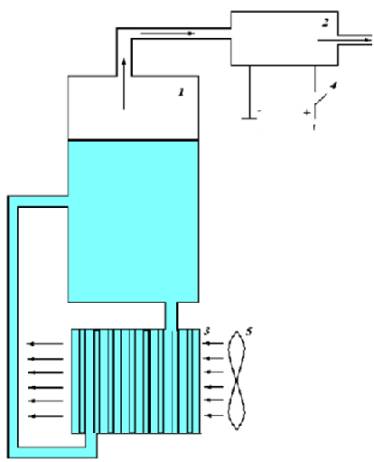 The device
as follows works. The electric pump 2 pumps out air above a surface of the
water filled in tight capacity 1. At pressure decrease in capacity the temperature
of boiling of water goes down, the temperature of the radiator 3 blown by the
electric fan 5 is accordingly reduced also, in result in interior of the automobile
air moves cooled in relation to external. Obvious lack of the device is
presence only natural circulation of the cooled liquid that reduces productivity
of cold air.
The device
as follows works. The electric pump 2 pumps out air above a surface of the
water filled in tight capacity 1. At pressure decrease in capacity the temperature
of boiling of water goes down, the temperature of the radiator 3 blown by the
electric fan 5 is accordingly reduced also, in result in interior of the automobile
air moves cooled in relation to external. Obvious lack of the device is
presence only natural circulation of the cooled liquid that reduces productivity
of cold air.
Heat of steam formation of water makes 2255 Dg/g [6], that at capacity of a
supply of heat from an environment in interior of the automobile in some watt
and capacities of tight capacity in some liters provides continuous work of the
conditioner within several hours of movement of the automobile. In figure 1 the
functional electric circuit of the offered device is submitted.
1 - tight capacity, 2 - the electric pump, 3 - a radiator, 4 - the switch
of the electric pump, 5 - the electric fan
Figure 1 - the Functional electric circuit of the device of
air-conditioning of interior
Conclusions. We shall
note, that application of the offered principle of an air conditioning allows
to improve dynamic properties of the automobile as from the engine of internal
combustion capacity for work of the compressor (some kw) is not selected, that,
as is known, positively influences performance data of the engine of internal
combustion.
Besides application of devices of management by electric motors of the
direct current, used in the electric drive [7,8,9], will allow, adjusting
characteristics of the engine of a direct current of the electric pump 2 to
operate work of the conditioner in an automatic mode.
THE LITERATURE
1. А.с. СССР МПК В 60 H 1/08, SU 1468777A1, 1989, БИ
№2.
2. А.с. СССР МПК В 60 H 1/08, SU 1593988А1,
1990, БИ №35.
3. Техническое описание автомобиля ВАЗ 2108.
4. Все, что необходимо знать о
кондиционерах. www.peugeot.ru/service-home <http://www.peugeot.ru/service-home>
5. Термоэлектрический кондиционер. / Гармаш
Ю.В., Пономарева И.И./ Патент РФ № 2336184,
МПК B60H1/03, Опубл.
20.10.2008. БИ № 29.
6. Лободюк
В.А., Рябошапка К.П., Шулишова О.И. Справочник по элементарной физике. -
Наукова думка: - Киев. - 1975. - 448 с.
7. Гармаш,
Ю. В. Анализ применения импульсных преобразователей напряжения в электроприводе
вспомогательного оборудования автомобильной техники. Монография [Текст]/ Ю.В.
Гармаш. - Рязань: РВАИ. - 2007. - 99 с.
8. Гармаш Ю.В., Сарбаев В.И. Управление
электроприводом постоянного тока. Lambert academic publishing. - GmbH Saarbrücken, Germany. ISBN:
978-3-659-15763-9. - 2012.
9. Сарбаев В.И., Гармаш Ю.В., Пономарева И.И.
Управление электроприводом постоянного тока автотранспортных средств. Мир
транспорта и технологических машин./Орел, Госуниверситет-УНПК, - № 1 (36)
- 2012. - с. 59-64.