About speed of
electromagnetic atomizers in systems of injection of fuel
V.I. Sarbaev, J.V. Garmash,
T.S. Valova
Introduction. Application of systems of injection of fuel provides increase of fuel
profitability and decrease of toxicity of fulfilled gases, optimizes process mixing
of a fuel - air mix [1, 2]. With the purpose of increase dynamics the
automobile, reliability of start-up, increases of capacity of the engine apply
systems of the coordinated injection of fuel which in comparison with the
central injection have more error of batching of fuel because of small cyclic
submissions. Identity of structures of a gas mixture on cylinders in the
greater degree depends on non-uniformity of batching of fuel atomizers, than
from a design of inlet system. The quantity of air acting in the cylinder for a
cycle, pays off the block of management according to the gauge of the charge of
air and frequency of rotation of a cranked shaft of the engine. Atomizers
should have nonlinearity of the characteristic of batching of fuel within the
limits of 2 - 5 % during all service life (about 600 million cycles of operation).
They work in a pulse mode at frequencies from 10 up to 200 Гц and even above in conditions of vibration of the engine and the
raised(increased) temperatures [1, 2].
Statement of a problem. In the case of an
atomizer the locking element of the valve pressed to a saddle by a spring is
located. When on a winding of an electromagnet from the electronic block of
management the electric pulse of the rectangular form of the certain duration
moves, locking element moves, overcoming resistance of a spring, and opens an
aperture of a spray and fuel acts in the engine. After the discontinuance of an
electric signal locking element under action of a spring comes back in a
saddle. The quantity of injected fuel for a cycle (at a constancy of pressure
in bringing pipeline) depends on duration of managing pulse.
In a real atomizer time of an open condition of the
valve does not coincide with its duration. After submission of managing
electric pulse on an atomizer in a winding of an electromagnet there is the
current of a self-induction interfering increase of a magnetic stream in
system. At a stopping delivery of managing pulse as a result of a
self-induction the kept magnetic stream will interfere fast stop locking element. To
increase speed of an electromagnetic atomizer it is possible due to reduction
of inductance. However thus resistance of a winding decreases and the current
consumed by it is increased, questions of reduction of operation of time of an
electromagnetic atomizer now completely are not developed also their research
is actual and yet the not decided problem [1-5].
The basic part. With the purpose of an estimation of an opportunity of regulation of
time of operation of an atomizer, we shall consider some common questions of
calculation of transients on an example of inclusion of a consecutive contour
(rLC - circuits) to a source constant voltage forces (E).
It is accepted to count, that transitive the process
occuring in a circuit, it is possible to consider consisting of two processes
imposed against each other - established, and free, having a place only during
transient. During operation tср an electromagnet accept duration of action from the moment
of submission of a pulse of operation up to the moment of the ending of moving
of an anchor from one extreme position in another. This time can be divided
into two components: move time tтр - a time interval from the moment of submission of a
pulse on a winding of an electromagnet up to the moment of the beginning of
movement of an anchor (it is the greatest part tср) and time of movement
tдв - an interval from the
moment of the beginning of movement of an anchor up to its full stop.
At inclusion of a winding of an electromagnet
transient will be determined by the equation:
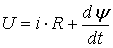 , (1)
, (1)
Where
U - a voltage of the power supply of a circuit, V; i - value of a current in a
winding, A; R - resistance of a
circuit of a winding, Ohm; Ψ - instant value full stream coupling windings, Vb; t - time, S.
Deciding
the equation (1), we shall receive the known equation for a current at constant
initial inductance 
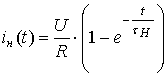 , (2)
, (2)
Where
 , s,
, s,  - Initial inductance, H - found at a reference value of a backlash in a magnetic circuit of an
atomizer.
- Initial inductance, H - found at a reference value of a backlash in a magnetic circuit of an
atomizer.
For
final inductance at final value of a backlash in a magnetic circuit of an
atomizer by analogy it is received:
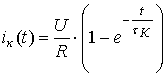 , (3)
, (3)
Where
 , s.
, s.
The settlement oscillogram of a
current for a nonsaturated electromagnet is shown in figure 1 by 1 continuous
line, the experimental oscillogram of a current of an atomizer has the same
kind.
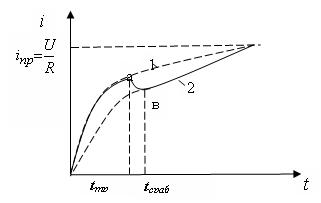
Figure
1 - Oscillograms of a current at
no
saturated magnetic circuit
Prior to the beginning of movement
of an anchor the current changes according to the (3) (on the oscillogram this
change corresponds to a curve 1) from a constant of time τн. On the expiration of move time movement of an anchor and a current
begins changes on a curve ав,
appropriate to movement of an anchor of an electromagnet.
In
the literature [6] it is marked, that at work on the impoverished mixes and on
high revolutions engine time of operation should be no more than 0,3ms. The
point in, laying on a curve 2, corresponds to full time of operation. Expression
for time  allows to receive the received
equations:
allows to receive the received
equations:
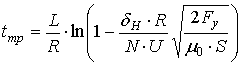 . (4)
. (4)
The analysis of this equation shows, that  depends both on a voltage of a feed,
and from resistance of a winding. And stronger dependence is observed from
active resistance in a circuit of a winding.
depends both on a voltage of a feed,
and from resistance of a winding. And stronger dependence is observed from
active resistance in a circuit of a winding.
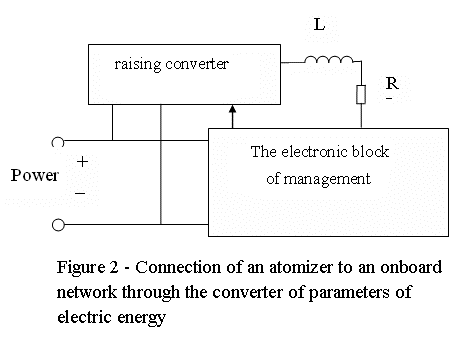 However at consecutive connection to an atomizer of additional
resistance alongside with reduction of time of operation it is reduced as well
its reliability that is caused by reduction of the established current. It is
obvious, that simultaneously with increase of resistance of a circuit, it is necessary
to raise and a voltage on it, that it is possible to realize, with the help of
raising converter of a voltage. The circuit of connection of atomizers to an
onboard network can be executed, for example, on figure 2.
However at consecutive connection to an atomizer of additional
resistance alongside with reduction of time of operation it is reduced as well
its reliability that is caused by reduction of the established current. It is
obvious, that simultaneously with increase of resistance of a circuit, it is necessary
to raise and a voltage on it, that it is possible to realize, with the help of
raising converter of a voltage. The circuit of connection of atomizers to an
onboard network can be executed, for example, on figure 2.
Thus it is necessary to mean, that the voltage on an
atomizer should maximal be direct at the moment of receipt of a pulse of management
is will allow to provide the greatest speed of increase of a current, and,
accordingly, to reduce time of operation of an atomizer. After end of process
of operation there is no need in the increased voltage - it should be such to
provide deduction of an electromagnet up to the moment of the ending of
managing pulse. Hence, the converter of a voltage should be controlled.
Moreover, the voltage on an atomizer should be adjusted depending on power
setting internal combustion [7].
Experimental part. With the purpose of
check of the assumption of dependence of time of operation on a voltage and
resistance of a circuit of an atomizer we carried out experimental researches. Time
of operation was determined on the location of characteristic change of a
current on the oscillogram (figure 1).
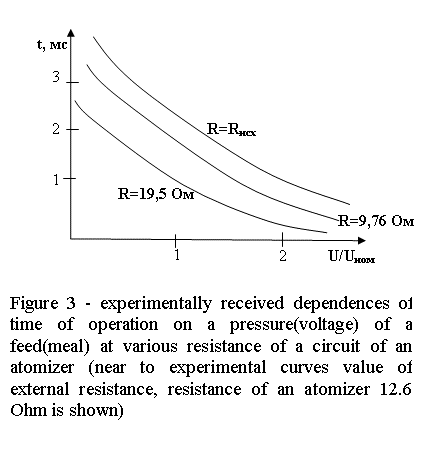 In figure 3 experimentally received dependences of time of operation of
atomizers on a voltage are given at the various resistance in addition included
in a circuit of an atomizer.
In figure 3 experimentally received dependences of time of operation of
atomizers on a voltage are given at the various resistance in addition included
in a circuit of an atomizer.
From experimental data follows, that at additional resistance
in a circuit of an atomizer 19,5 Ohm time of operation decreases, in comparison
with initial, approximately in 5 times and makes about 0,5 ms.
Conclusions. We offer rather simple
way of reduction of time of operation of the electromagnetic atomizer, allowing
without essential expenses smoothly to adjust speed of its operation. There is
an opportunity at change of power setting by the given image to adjust time of
operation, not changing a mode of operation of electronic blocks of management
of systems of injection and ignition.
The literature
1.
Автомобильный
справочник «Бош» [Текст]: Пер. с нем. - М.: За рулем. - 1999. - 895 с.
2.
Будыко, Ю. И. Аппаратура впрыска
легкого топлива автомобильных двигателей. [Текст]: учебное пособие/ Ю.И. Будыко. - Л.:
Машиностроение. - 1975. - 192 с.
3.
Любчик, М. Н. Расчет и проектирование
электромагнитов постоянного и переменного тока [Текст]: учебное
пособие/ М.Н. Любчик. - М.: Госэнергоиздат.
- 1959. - 98 с.
4.
Любчик, М. Н. Силовые
электромагниты аппаратов и устройств автоматики постоянного тока [Текст]: учебное пособие/ М.Н.
Любчик. - М.:
Энергия. - 1968. - 123 с.
5.
Пеккер, И. И. Физическое моделирование
электромагнитных механизмов [Текст]: учебное пособие/ И.И. Пеккер. -
М.: Энергия. -
1969. - 106 с.
6.
Bosh. Системы управления бензиновыми
двигателями. Перевод с немецкого [Текст]/- Первое русское издание. – М.: За
рулем. - 2005. - 432 с.
7.
Гармаш, Ю. В. О регулировании времени
срабатывания электромагнитной форсунки [Текст]/ Ю.В. Гармаш, Т.С. Валова//Международная научно-практическая
конференция «Наука и образование XXI века». – Рязань. –
2007. - С. 238-243.