Биологические
науки/1. Систематика и география высших растений
Master's Degree Student Petrova
K., Candidate of Biological Sciences
Sultangazina G
The Kostanai State University named after A.
Baitursynov
The current state of trees and shrubs in the State National Natural Park
"Burabai" (North Kazakhstan)
For solving the global problem of our time – exploration and preservation
of biological diversity it is necessary to receive data based on science
about the present state of the plant cover in general and dendroflora in
particular. Floristic investigations are one of the main methods in studying of biological diversity.
The materials for
this article is based on research carried out by us on the territory of the State National Nature Park (SNNP)
"Burabai" in the period from 2010 to 2013.
The total area of the park is 129. 935 hectare.
Forests occupy a
significant part of the park – 57%. [1]
The study of tree
and shrub flora was conducted with the help of route-reconnaissance method in
10 forestries: Akylbayskoe, Borovskoe, Katarkolskoe, Zolotoborskoe, Mirnoe,
Barmashinskoe, Priozernoye, Bulandinskoe.
The State National
Nature Park (SNNP) "Burabai" is located on the territory of Akmola
region, in the most elevated part of the northern margin of Kazakh Hummocks.
The mountain
relief is represented mostly in the western part. Here there is the Kokshetau
mountain range in the form of the arc, which is bounded by large lakes on all
sides. In the northern part it reaches the maximum height. The top of the
mountain uplift is Mount Kokshetau (Sinyukha) which reaches a height of 947. 6
meters above sea level. Further to the south, there is Mount Burabay (690,0
m.a.s.l and Mount Zheke-Batir (826,2
m.a.s.l.) In the southern part of the mountain chain the height of the
mountains goes down to 400 – 500 m.a.s.l. The large lakes such as Borovoe, Shchuchye, Small and Large
Chebache, Maybalyk and Katarkol are situated in its territory.
The climate in
this area is sharply continental, with hot summers and hard and dry winters.
The annual precipitation is 250 – 295 millimeters in the lowland, up to 400 mm
in the hilly part. The stable period with average daily temperatures higher
than 5 °C lasts from late April to early October. The average temperature in
June is 18 – 20 °C, maximum 38 – 40 °C. The average temperature in January is
17 – 18 °C, the absolute maximum – 30 °C. The average degree of air saturation
is 50%.
Soils and soil
cover is characterized by considerable heterogeneity, due to the strong
roughness of the relief, a variety of parent rock materials, the differences in
climate and vegetation. In the belt of plains and nipples ( at the 280 – 400 m elevation) they
point out medium-humic and southern low-humic black soils. In the
mountain-forest zone (400 – 700 m) are formed the following major soil types:
pine forest primitive petromorphous, pine forest forest petromorphous, pine
forest soddy petromorphous, gray forest, meadow-forest, meadow-black soil,
ordinary and thin black sols, flood meadows, peaty marsh. Steppe areas form
complexes with birch groves on gray forest soils and solods [3].
The area of the park
is characterized by a high level of biodiversity, which is determined by a
number of objective reasons: the great variety of environmental, climatic and
other conditions, the genesis of the flora and vegetation, the situation on the
border of two climatic zones: steppe and forest-steppe, landscape features. All
this gives the specificity and originality to the flora of the region. The
predominant forest formations are Pinus
silvestris L.,Betula verrucosa Ehrh., Betula pubescens Ehrn., and Populus
tremula L.
Tree and shrub
flora of the park is of great interest because up
to the present day its species composition, ecology and distribution of
selected species weren’t fully found out.
The basis of
dendroflora constitute angiosperms – 89 species (94,5%) and only 6 species (5,5%)
accounted for gymnosperms.
The tree and
shrub flora of the State National Natural Park is represented by 30 families,
54 genera and 94 species. According to the number of genera and species they
distinguish the following families: Rosaceae;
Salicaceae; Grossulariaceae; Pinaceae; Asteraceae (Table 1).
Table 1. Systematic structure of dendroflora in SNNP
"Burabai"
|
№ |
Family names |
Number of genus |
Number
of species |
|
1 |
Rosaceae |
11 |
18 |
|
2 |
Salicaceae |
2 |
12 |
|
3 |
Grossulariaceae |
4 |
9 |
|
4 |
Pinaceae |
4 |
5 |
|
5 |
Asteraceae |
1 |
5 |
|
6 |
Betulaceae |
2 |
3 |
|
7 |
Caprifoliaceae |
2 |
3 |
|
8 |
Elaeagnaceae |
2 |
3 |
|
9 |
Fabaceae |
2 |
3 |
|
10 |
Aceraceae |
1 |
3 |
|
11 |
Lamiaceae |
1 |
3 |
|
12 |
Ulmaceae |
1 |
3 |
|
13 |
Chenopodiaceae |
2 |
2 |
|
14 |
Pyrolaceae |
2 |
2 |
|
15 |
Еriсасеае |
2 |
2 |
|
16 |
Berberidaceae |
1 |
2 |
|
17 |
Nitrariacea |
1 |
2 |
|
18 |
Rhamnaceae |
1 |
2 |
|
19 |
Solanaceae |
1 |
2 |
|
20 |
Boraginaceae |
1 |
1 |
|
21 |
Brassicaceae |
1 |
1 |
|
22 |
Celastraceae |
1 |
1 |
|
23 |
Cornaceae |
1 |
1 |
|
24 |
Cupressaceae |
1 |
1 |
|
25 |
Ephedraceae |
1 |
1 |
|
26 |
Frankeniaceae |
1 |
1 |
|
27 |
Polygonaceae |
1 |
1 |
|
28 |
Sambucaceae |
1 |
1 |
|
29 |
Tiliaceae |
1 |
1 |
|
30 |
Viburnaceae |
1 |
1 |
|
Total: |
54 |
94 |
|
The most diverse
species composition is observed in Barmashinskoe and Borovskoe forest areas (Table 2).
Table 2. Species diversity of trees and shrubs in SNNP
forestries
|
The name of the forestry |
Number
of Species |
|
Akylbayskoe |
41 |
|
Borovskoe |
52 |
|
Katarkolskoe |
33 |
|
Zolotoborskoe |
32 |
|
Mirnoe |
39 |
|
Barmashinskoe |
56 |
|
Priozernoye |
38 |
|
Bulandinskoe |
33 |
Vital status (LS) of woody plants was assessed visually on the 5-point E.
Andreeva scale [2002].
Following this method the trees belonging to one or another category of
vitality, is assigned with a score: healthy – 1.0 ; damaged – 0.7 ; heavily
damaged – 0.4 ; suppressed – 0.1; fresh and old dead-tree – 0. Index
calculation of stocking state is figured
out according to the formula  , where ln is the index of the stocking
vital status toward the number of trees , n1 – the number of healthy trees, n2 – of damaged trees,
n3 – of heavily damaged trees, n4 – of dying trees ; n –
the total number of trees (including dead wood) on the growth plot ; 0 , 7 ,
0.4, and 0.1 – the points of damaged, heavily damaged and dying trees.
, where ln is the index of the stocking
vital status toward the number of trees , n1 – the number of healthy trees, n2 – of damaged trees,
n3 – of heavily damaged trees, n4 – of dying trees ; n –
the total number of trees (including dead wood) on the growth plot ; 0 , 7 ,
0.4, and 0.1 – the points of damaged, heavily damaged and dying trees.
With the index from 1.0 to 0.8 of living condition of the stand is rated
as "healthy" with 0,79 – 0,5 forest stand is considered " damaged
" with 0,49 – 0,2 – "highly damaged
" and with 0.19 and below – "destroyed" or "fully
degraded."
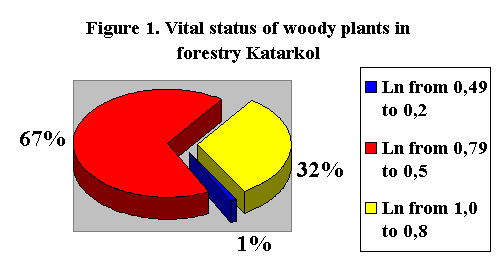
In
Katarkolskoe forestry vital status indexes were defined according to the data
obtained in the evaluation of the vital state of woody plants. Figure 1 shows
that more than 30% of trees and shrubs species go through all stages of
development, vegetate and fructify very well. 67% of species have crown and
trunk damages, 1 species (1,1%) – Betula pendula Roth.
has substantial barrel distortions caused by the appearance of growths –
wounds, tumors (Figure 1).
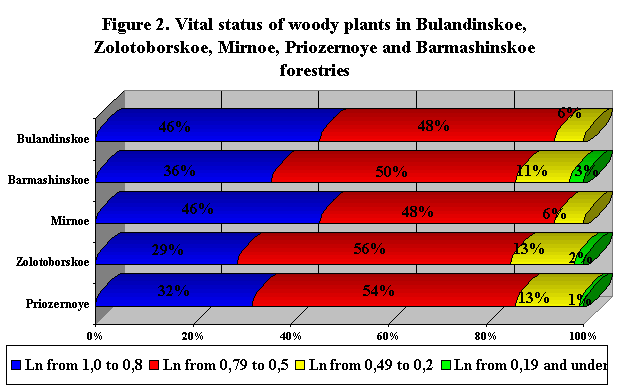
In Zolotoborskoe, Barmashinskoe, Priozernoye, Bulandinskoe, Mirnoe forestries the most
part of trees and shrubs is classified
as "damaged" having external features of crown and trunk damages
(Figure 2).
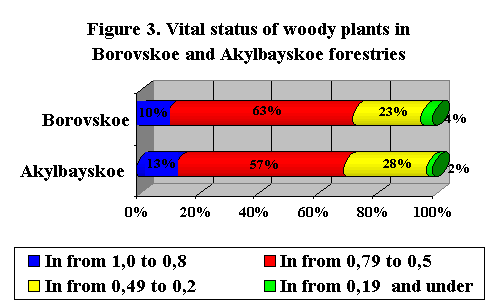
Vital status of 97% of all trees in Akylbayskoe and 96% in Borovskoe forestries corresponds to the categories “damaged”
and “heavily damaged”. In this context it is necessary to take measures to
improve and rejuvenate these areas (Figure 3).
The assessment of
the aesthetic state (AS) was made on a 4- point H. Yakubov scale [2005]. Based
on the results of the assessment performed 31 % of all trees and shrubs are “highly
aesthetic”, 57.1% belong to the category of “aesthetic”, so you can see the degradation
of these qualities. About 10 % are reversibly non-aesthetic plants having developmental
disorders and not performing their functions in plantations, 2.5 % of trees and
shrubs are irreversibly non-aesthetic.
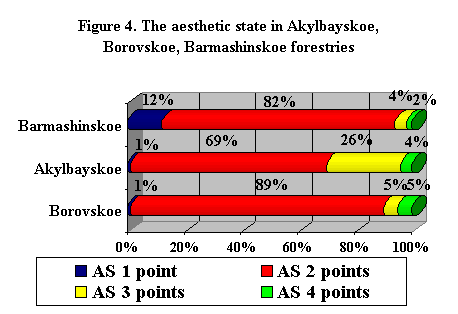
In Priozernoe ,
Zolotoborskoe , Bulandinskoe , Katarkolskoe forestries most trees are aesthetic
(AS – 2 points). In Akylbayskoe – 95%, in Borovskoe – 94% , in Barmashinskoe – 86 % of the trees have degradations of
aesthetic qualities (AS – 2 to 3
points), among them the slope of the trunk and crown asymmetry (Figure 4) .
Overall the condition
of trees and shrubs in the forestries of SNNP "Burabai" is
satisfactory. However, 67.2% of woody plants have the first sings of degradation
in vital status and 57.1% have aesthetic degradations. In this context, it is
recommended to take measures to reduce the impact of negative factors.
List of reference:
1. Nature records of SNNP Burabai". Burabai 2010.
2. Governmental decree of the Kazakhstan
Republic "About the State National Nature Park " Burabai " from
12.08.2000 № 1246.
3. Bobrovnik V, Whitman R. The
soil covering of treeless valley-hilly surface of Kokchetav upland / / Kazakh
Research Institute of Forestry and
Agroforestry . – 1975 . – T. IX. – S. 31 – 41.
4 . Andreeva E.N. Study methods of forest communities. St. Petersburg:
Chemistry Research Institute of the State University, 2002. 240 p.
5. Yakubov H. Environmental monitoring of green spaces in Moscow. M.
Stagirite – H, 2005. 264 p.