Butenko Eleonora, Kapustin Alexey
Azov State Technical University, Mariupol, Ukraine
Changes in
the structure of layered double hydroxides during the adsorption of organic
compounds
Keywords: MgxAly(OH)z layered double hydroxides, polycrystal X-ray diffraction,
specific surface area.
Layered double
hydroxides (LDHs) are used as sorbents, catalysts, and carriers for catalytic
species. In general, they are natural or synthetic minerals with part of their
cations being replaced isomorphically with cations of higher oxidation states,
which results in the formation of positively charged two-dimensional layers
containing solvate molecules and counterions capable of anion exchange [1]. LDHs are
solid bases [2]. Since there are both
Brønsted
and Lewis sites, anion exchange processes occur in the interlayer internal
space of LDHs [3]. The interlayer
distance depends on the nature of anions and solvate molecules as well as the
degree of isomorphic substitution. When the interlayer distance changes, LDH
properties also change (for example, sorption capacity changes because of the
changing number of available active sites). A study of the LDH structure and
its changes during the sorption of various compounds provides conclusions about
the mechanism of these processes and prospects of creating new materials with
desired properties.
This work reveals regular
changes in the structure of synthetic MgxAly(OH)z hydrotalcites of various composition, which occur
during the adsorption of amyl alc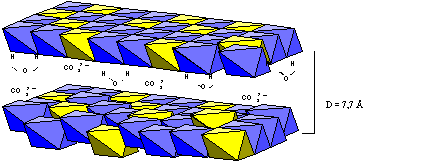 ohol, naphthalene, and b-naphthol. The hydrotalcite structure is shown in Fig.
1.
ohol, naphthalene, and b-naphthol. The hydrotalcite structure is shown in Fig.
1.
Fig. 2. –
Structure of LDHs
Experimental. MgxAly(OH)z
samples were prepared according to the procedures described in [4,5].
X-ray diffraction was performed
on Siemens D-500 (СоKa1-radiation,
l = 1.789 Å) and DRON-UM1 diffractometers (СuKa-radiation, Ni-filter).
The specific surface area of
the samples was determined from the low-temperature nitrogen adsorption
measurements followed by the processing of the obtained data using the BET
method.
Results and Discussion. A study of the sorption of С5Н11ОН amyl
alcohol on MgxAly(OH)z samples has shown that the sorption process consists
of two stages. At the beginning, apparent dynamic equilibrium is established
rapidly (in tens of minutes). However, on long keeping (48 hours) the degree of
sorption increases significantly, and, what is more important, it is
accompanied by structural transformations of the samples. Let us divide them
according to their duration and nominally call them dynamic and static periods.
As table 1 shows,
at the first stage of the sorption there are no structural changes in the
samples.
Sorption capacities (C) and interlayer distances (d) in MgxAly(OH)z during the sorption of amyl
alcohol at dynamic and static periods
|
Mg/(Mg+Al) |
0,52 |
0,72 |
0,81 |
0,86 |
|
Cdyn., meq./g |
0,075 |
0,081 |
0,041 |
0,036 |
|
Cstat.., meq./g |
0,38 |
0,41 |
0,10 |
0,08 |
|
dorig., Å |
3,038 |
3,036 |
3,045 |
3,058 |
|
ddyn., Å |
3,038 |
3,038 |
3,042 |
3,060 |
|
dstat., Å |
8,515 |
8,477 |
8,644 |
8,832 |
However,
after the second stage the interlayer distance increases by about 2.8 times.
So, at the initial moment of the penetration of amyl alcohol molecules they
seem to be adsorbed physically; they are parallel to the main plains, thus,
blocking the neighboring active sites. At the second stage, due to the chemisorption
(ionic exchange processes) the intercalated molecules are reoriented, and they
expand the hydrotalcite inner space. This property is typical of many organic
compounds, and the extent of changes in the LDH interlayer distance depends on
the length of the hydrocarbon radical, its configuration, and orientation in
the interplanar space [6].
In order to study
the effect of the structure and size of the adsorbed molecules on the
structural characteristics of LDHs, aromatic compounds were used: С10Н8 naphthalene and С10Н7ОН b-naphthol.
The main difference between them is the nature of the sorption. Physical
adsorption is typical of naphthalene, while in the case of b-naphthol, the sorption causes the anion
exchange reaction due to its active hydroxyl group. In the first case, the
activity and selectivity of the sorption is determined by the sorbent specific
surface area and pore sizes, while in the second case, by the concentration of
active sites on the sorbent surface and their accessibility to the substrate
molecules.
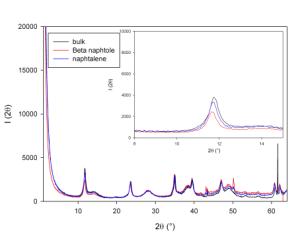
Fig. 2 shows typical X-ray
patterns of starting hydrotalcite and the samples with sorbed naphthalene and b-naphthol.
If we compare these X–ray
patterns, it is evident that when both naphthalene and b-naphthol are sorbed, the hydrotalcite structural
parameters change, as it could be seen in the highlighted inset. For b-naphthol there are larger changes in the structural
parameters, which is not surprising because of its possible chemisorption.
Changes that are caused by the physical adsorption of naphthalene are likely to
be attributed to a large size of its molecules.
Along with the changes in the
crystal structure parameters during the sorption of naphthalene and b-naphthol, there are also changes in the
microstructure of the samples. Namely, their specific surface area changes. As
Table 2 shows, though this value has a non-monotonic dependence on the composition,
it generally increases as aluminum isomorphically substitutes for magnesium.
Table 2
MgxAly(OH)z specific surface area
Mg/(Mg+Al)
|
Specific surface area of samples, m2/g |
||
|
original |
with b-naphthol |
with naphthalene |
|
|
0,52 |
162,4 |
155,7 |
156 |
|
0,72 |
14,4 |
14,4 |
14,4 |
|
0,81 |
9,2 |
12 |
19,59 |
|
0,86 |
22 |
28 |
34,7 |
On the contrary, after the
sorption of naphthalene and b-naphthol the most evident relative changes
in the MgxAly(OH)z specific surface areas occur in the samples with a low
concentration of aluminum.
Conclusions. It is
shown that there is a difference in changes in the structure of LDHs during the
sorption of organic compounds with regard to the ionic exchange and physical
sorption. Moreover, it is established that the structure of the organic
molecule depends on changes in the size of the
interlayer distance in LDHs.
REFERENCES
1. Vaccari
A. Layered double
hydroxides: present and future. – New York: Nova Science Publishers Inc., 2002
2. Duan
X., Evans D.G. Layered
Double Hydroхides. Structure аnd bonding. – Berlin, Heidelberg: Springer-Verlag,
2006
3. A.E. Kapustin, Uspekhi Khimii, 1991. – 60,
No. 12. – p. 2685-2717.
4. Bolongini
M., Perego C. // Microporous and Mesoporous Materials. – 2003.- 66.- P.77.
5. Reichle
W.T. // Solid State
Ionics. – 1986. – 22. – P.135.
6. A.E. Kapustin, Heterogeneous Basic Catalysis [in Russian], Renata, Mariupol
(2008).