Экономические науки/2. Математические
методы в экономике
PhD, Professor Azarova A. O., PhD
student Bondarchuk A. V.
Vinnitsa National Technical University
Analysis of existing methods for innovations attractiveness evaluation advantages and disadvantages
The development and realization of
enterprise’s innovation potential is impossible without
its adequate evaluation,
dynamic analysis and prediction of trends [1]. Today a
significant number of different methods
for innovation’s attractiveness evaluation are offered in scientific literature. Most of them demonstrate the complexity of this process in relation to the problem of qualitative information quantitative description
[2]. Below we will consider the advantages and disadvantages of the most widely used of them.
The percentage ratio method. The point of this method is to compare the innovation
potential of different objects using simple mathematical techniques, which show
how each value differs from the other one. The advantages of this method are possibility
of displaying results in tables, graphs and diagrams; simplicity of use, and
mobility, which allows changing parameters while evaluating the object’s
development. The main disadvantage of this method is a problem of parameters
compatibility for all the investigated objects [3].
The graphical method of innovation potential analysis is based on using
the radar plot, where the number of rays stands for the number of structural
components of innovation attractiveness, and each ray corresponds to the results
received. The advantages of this method are flexibility (number of evaluation
parameters may vary); possibility to analyze innovations attractiveness not
only in general, but to compare its components as well; simplicity of
calculation; visualization of results. The disadvantages of this method are:
data availability problems; simplified problem solution approach, which may not
give an adequate results; inability to take into account the weights of
components or parameters and their correlation; inability to evaluate absolute
and relative parameters at the same time [2].
Competitiveness evaluation
method was developed under the auspices of
the USA National Science Foundation. Four integrated parameters have to be
calculated to identify the competitiveness level by using this method, which
namely are national orientation (HO), socio-economic infrastructure (CI),
technology infrastructure (IT) and productivity (P). Advantages of this method are
ability to use a large amount of statistical data and expert estimates, and to evaluate
the innovation attractiveness of national economies. The disadvantages of this
method are complicacy and expensiveness; a need to survey a large number of
experts; long duration and high labour intensity needed to develop questionnaires
and conduct a survey; inability to evaluate enterprise’s innovation attractiveness
[4].
Method of innovation attractiveness
estimation through comparing components of parameters between each other or with their limit values are widely
used in the innovation potential evaluation systems at the level of industry,
region and enterprise. Comparison of innovation attractiveness parameters of
enterprises can be carried out by the following methods: comparison of the actual
value of the parameter with its limiting value; comparison of the actual values
of some parameters with their medium or best complex values for related
enterprises; determination of the parameter dynamics (parameter comparison over
time); comparison of the separate interconnected parameter values [5].
Integral evaluation method is based on the fact that
enterprise’s potentials are compared as
something general. To use this method it’s necessary to
merge selected parameters in a comprehensive
(integral) one. One of such approaches
allows determining the components of the
innovation attractiveness as follows:
 , (1)
, (1)
where Рі is an attractiveness of the і-th component;
Sij is a weight coefficient of the j-th parameter of innovation attractiveness of the i-th component (determined by experts, here equals to  );
);
mi is a number
of parameters used for evaluation of innovation attractiveness of i-th component.
nij parameter is calculated according to the formula:
 , (2)
, (2)
where kij is a j-th parameter of innovation attractiveness
of the i-th component;
kij* is a corresponding averaged parameter of the economic systems’ group (static model) or the economic system’s parameter in the previous
period (dynamic model).
The integral parameter of innovation attractiveness is evaluated according to the formula:
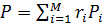 , (3)
, (3)
where ri is a weight coefficient of innovation attractiveness of the i-th component (determined by experts, here equals to  ),
),
М is a number of innovation attractiveness components of economic system.
P is a result innovation attractiveness function, varying from zero to one. P-value > 0.5 indicates a positive dynamic of innovation attractiveness potential [5].
The integrated assessment of innovation attractiveness based
on a mathematical method of distances can be provided according to the following
algorithm:
 , (4)
, (4)
where Рі is an assessed value of the i-th’s innovation attractiveness component;
n is a number of parameters;
bі is a weight coefficient of
the і-th parameter;
αі is a relative value of the і-th parameter.
αі is calculated according to the following rules:
αі = Пі/Пmax, if a higher parameter value is better;
αі = Пmin /Пі, if a lower parameter value is better;
where Пі is a value of the і-th parameter;
Пmin is the smallest value from the compared plurality
of parameters;
Пmax is the biggest value from the compared plurality of parameters [5].
The advantages of the integrated assessment are: synthesis of the effects made by all
parameters and coefficients included in research; innovation
attractiveness evaluation comes down to
the one quantitative value greatly
simplifying the economic interpretation of the results. Disadvantage of this method lays in the fact that there is a single assessment algorithm
for those parameters, which value is
better while increasing, and
those, which value is better while
reducing. Another disadvantage is
an ability to use this method only
for positive non-zero parameter values.
Determination of the innovation attractiveness of enterprises can also be made through using expert survey approach, which is widely used for economic system’s qualitative parameters analysis [5]. The most important problem of this
method’s implementation is evaluation of the consistency
degree of all surveyed
experts. An expert method of pairwise comparisons or
T. Saaty hierarchy method is also used for parameter weight determination. Though, this approach is too comprehensive., subjective and inaccurate.
Provided analysis of existing methodological
approaches to innovation attractiveness evaluation
indicated that currently there are many
methods of economic system’s innovation attractiveness evaluation,
but all of them have numerous substantial
disadvantages, which significantly decrease the evaluation
accuracy in practice.
In the authors’ opinion, the assessment approach, which can
eliminate disadvantages listed above,
is based on the fuzzy-neural network technologies, allowing to appreciate
the powerful pluralities of
qualitative parameters that determine
the impact of both external
and internal environments on the
evaluation process, improve its accuracy and reduce final cost.
Literature:
1.
Innovation Potential of Ukraine: monograph / A.А. Mazaraki, T. М. Melnyk, V. V. Ukhimenko [and others]. - К.: КNТЕU, 2012. – 592 p.
2.
Innovation Potential of the enterprise [Text]: monograph / Fedulova І. V., Kundeeva G.
О.: National
university of Food Science.
– К.: [Medinform], 2010. – 346 p.
3.
Trifilova
А.А. Evaluation of
the enterprises’ innovation developments effectiveness. М. : Finance and statistics, 2005. – 304 p.
4.
Methods
of innovation
potential assessment for small and medium enterprises. . [Electronic resource]: http:www.rscme.ru. 2003. – 79 p.
5.
Fedulova І.
V. Research
of methodologies
of innovation
potential assessment of industries / І.
V. Fedulova // Countries and regions. Series: Economics
and Business. – 2008. – №
4. – p. 240-244.