Geological-structural conditions of distribution
and formation of Pyazbashi gold orefield (Lesser Caucasus, Azerbaijan).
V.
G. Ramazanov1, M.İ
Mansurov1, B. H. Galandarov1, Mehdi Safari2, U.I. Kerimli1, A.I. Huseynov,1
Baku
State University1
Deparment of geology Payame Noor University, İran2
The article
discusses the specific features of formation of the Pyazbashi field. It is
established, that the process of ore formation was long and multistage.
Quartz-serisite, quartz-pyrite-molibdenite, quartz-pyrite-gold,
quartz-polymetallic and carbonate stage of minera¬lization have been allocated.
P-T conditions of ore formation are investigated. It happened under the
temperature of 140-3900C and the pressure of 0,7-2,5 kbar. It is
established, that ore-forming fluids were mostly of a magmatic and partly
metamorphic origin.
Key
words: gold, deposit, distribution regularities, isotopic content, temperature,
pressure, ore, mineralization.
In
endo-and exocontact zone of Meghri-Ordubad pluton (V. A. Hassanof, R. U.
Hassanof, I. I.Larin, M. A. Hassanof et al) are fount out numerous gold ore
deposit which spatially from on entire goldbearing zone. these are – Pyazbashi,
Munundari, Bashyurt, Uchurdag, Agyurt, Shackardari and other deposits (Fig.1).
Ore bearing and hosting them ore zones is these areas differ from each other in
morphology, sizes and elements of bedding and often are distinguished based on
testing. More often are met orebearing zones of hydrothermally altered rocks
with quartz-sulfide vein and zones of quartz-sulfide veinlets in endocontacts
of Meghri-Ordubad batholit intrusives (Agyurt, Bashyurt, Munundara and etc.),
rarely are present vein bodies, lenses and
interveins zones in exocontacts
of intrusive massifs in volcanigenic-sedimentary rocks of Lower and midlle
Eocene, folder into folds of NE strike (Pyazbashi, Shakardari end etc.) On some
objects (Uchurdag and etc.) a small part of mineralization is related to
hydrothermally altered dikes of diorite porphyries. Morphogenetic types of all
these deposits first of all are caused by character of geodynamic conditions of
development of Daralgez block, during the injection of Meghri-Ordubad pluton
and development of the processes of mineralization, by sizes and shapes of
tectonic blocks that host the granitoid intrusive and gold deposits [1,2].
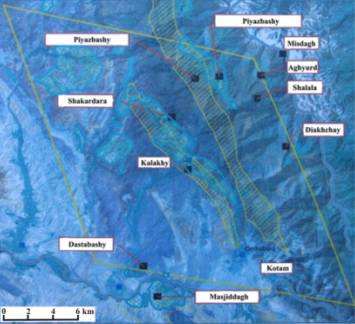
Fig.1. Map showing ore deposits distribution and
alteration zones at Ordubad orefield.
Among
the most perspective are considered Pyazbashi ore field, that unites deposit and ore manifestations (Pyazbashi,
Shakardara, Uchurdag and etc.) that have determined commercial value (Fig.2.).
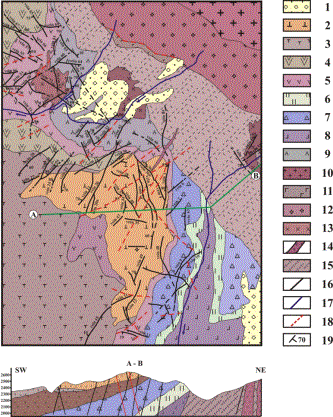
Fig.2.
Geological map of
the Pyazbashi gold deposit
Symbols: 1 Modern sediments (loam, sandy loam, gravel); Volcanic sequences: 2.
Andesitic tuff agglomerate; 3. Lavobrekchii andesites; 4. Plagioclase andesite
tuffs; 5. andesitic tuffs; Volcanogenic-sedimentary sequences: 6. calcareous
sandstones; 7. lime tuffites; Volcanic
sequences: 8. Andesite-basalt tuffs;
Intrusive rocks: 9. Diorite porphyries; 10. Porphyritic granodiorite; 11.
Gabbro-diorite; 12. Quartz syenite-diorite; 13. Adamellite diorite porphyries;
14. D ranodiorit porphyries;
Mineralization: 15. Alteration (silicification, sericitization, iron
accumulation, pyritization); 16. Gold-bearing quartz-sulfide veins; 17. Faults;
18. geological boundaries; 19. Dip and
strike.
Below
is given brief characteristic of the mentioned gold mineralization field and
the objects that represent this field.
Pyazbashi
deposit is located on the southwestern slope of the Zangezur range between the
rivers Duglanchai and Vanandchai. Shakardarine deposit is located to the
southwest from Pyazbashi deposit and occupies are of southwest framing of
Meghri-Ordubad batholite. The deposit is represented by goldbearing vein zones
and a wide zone of goldbearing metasomatites. Goldbearing vein zones are
represented by intensively silicified and Kaolinized rock with single quartz
veins and veinlets with pyrite-chalcopyrite mineralization.
Gold
content is irregular and varies within the limits from weak > to24g/t of
silver – from 4,7 to 85,7 g/t, copper – from 0,3 to 3,0%. the zone of
goldbearing metasomatites with veinlet-imprignated mineralization of pyrite and
chalcopyrite contain gold from 0,4-1,0 to 2,5-3,6 g/t.
In
distribution of gold mineralization on Pyazbashi deposit the dominant are endo-
and exo- contact zone of granitoid massif in combination with satellites of
these massifs and disjunctive structures, diversity of their systems was caused
by transformation of deformational plan on different stages of ore field
development. Are isolated ore transporting and ore localizing dislocations. The
former have NW (300-3400), rarely submeridional (350-100)
direction and dip according to the SW with inclination of 65-800 and
into both direction under the angle 65-800. Ore localizing
dislocations as a rule are feathering due to ore transporting ones, have NE
(10-500), rarely sublatitudal (70-1100) direction and dip
according to SE, rarely to NW under
angles 55-850 and SE and NW under angle 70-750. Ore
bodies and ore columns are developed on the crossing point and junction of two
and more systems of dislocations or on their crossing with the contact of the
intrusive.
Ore
bodies are significant by their diversity and complicative shapes – veins,
stockworks and columns with uneven lying elements, squeezing and blowing. In silicate rocks generate caused by
fracture tectonic quartz-sulfide (gold-quartz-pyrite,
gold-quartz-chalcopyrite), carbonate and quartz-carbonate-galena-sphalerite,
goldbearing quartz-sericite-hematite and quartz-molybdenite veins, simple and
complicated, with the length along the strike up to 1200m, along the dip
300-400m, with thickness 0,1-2,0m and more, with angles of inclination 60-90 0.
Vertical swing of mineralization reaches 350-450m. BY explorative drill holes
on Pyazbashi deposit is determined, that characteristic for the explored
horizons of geological-geochemical features of the mineralization together with
productivity on gold are distributed in the range of absolute marks 2550-2260m.
Within
the limits of Pyazbashi deposit are known 70 quartz-sulfide veins. The great
majority of them is of gold-quartz-sulfide nature. Are seen also
quartz-pyrite-chalcopyrite, quartz-carbonate-galena-sphalerite,
quartz-sericite-hematite, quartz-molybdenite, quartz-carbonate barite veins.
Because of spatial disconnection of the mentioned veins with various
mineralization was arisen an opinion, that Pyazbashi is a complex deposit and
unites gold-copper-molybdenum-lead-zinc deposit. Authors tend to consider that
all in all on the deposit exists entire ore zonality. Vector of mineralogical
zonality under the definite angle rises from the central part in the NW and SE
direction from the deposit flank and includes as vertical so horizontal
composite of an entire ore zonality. Analysis of the material of
searching-explorative and thematic works (R. U. Hasanof, A. A. Mamedov, Z. M.
Atakashiev, U. P. Zaruanov and etc.) shoved, that quartz-sulfide-veins are
concentrated on the are and in the cross-section in a regular way. The largest
scale of development and highest concentration of gold in quartz-sulfide veins
is exposed on the SE flank and especially in the central part of the deposit,
which northwest- ward along the strike fork info smaller zones and pinch out in
the zone of NW direction, built up by lavas and lavabreccias of andesites
andesites-basalts of middle Eocene age, mainly in the valley of the r. Metsget-
in the core of Pyazbashi anticline of NW direction and on the flank (wings) of
Metshet transversal anticline of smaller range. Trough on the NW flank in some
veins, in the areas of their junction with subvolcanic andesite-dacite,
transformed into secondary quartzites, are fixed high gold contents. Here is
singled out wedge-shaped block, trapped between quartz-sulfide veins 1 and 5.
This block contains vein with determined and hypothetical commercial gold
mineralization (NN 1, 5, 36, 36a, 38, 43). The most prolonged and
rich due to gold-content from the six mentioned veins is the vein 1,
investigated (R. U. Hassanof) in details from the surface and also partly
opened by two horizontal ad its in the depth.
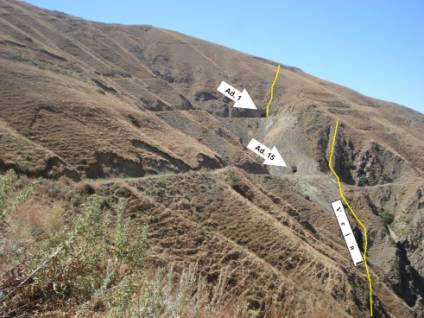
Fig.3. Photo shows vein 1 at the levels
adits 1 and 15 at the Pyazbashi deposit.
We
consider advisable to single-out the mentioned zone of intensive development of
quartz-sulfide veins as the most perspective area of Pyazbashi deposit (Fig.3).
Average length of quartz-sulfide veins is 600-800m, are followed by oxidation,
leucocratization and crumpling of the rocks. Along the strike the blowing zones
of quartz-sulfide veins in coulisse like way alternate with the zones of
contraction, in particular, the greatest width of the quartz-sulfide veins zone
is exposed in the region of the central part of the vein 1. Here, while
reaching the zone of crumpling and brecciation thickness of the vein increases
and are formed lenses of insignificant length and thickness, which in blowing
reaches 2,5m, and in squeezing 0,1m.
Ore
bodies are constructed by quartz-sulfide impregnated and intervein-impregnated
ores, often oxidized, ocherous, cavernous-striped formations. For some veins
(NN 1, 5 and etc.) is common breccia-like texture generated as a result of
repeated, intermineralization shifts, due to which are brecciated as host-rocks
so the minerals of early stages. Clasts are angular, cemented by grey
finegrained quartz and massive finecrystalline pyrite. Mineral composition of
ores in various. Major minerals of quartz-sulfide veins are quartz and pyrite,
minerals of the second order are virgin gold, electrum, chalcozine,
tetrahedrites (pole ores) and etc. Are typical impregnated, stripy, intervein
and massive textures. Ore structures are complete and crystalline-grained.
Among the mineral aggregates are common corrosional, crumbled,
emulsive-impregnated and skeletal structures.
Due
to types ores are subdivided into wretched (maybe miserable) sulfide,
impregnated sulfide and complete sulfide ones. The second type of ore is
dominant. In oxidation zone are developed moderately rich oxidized ores. The
average depth of secondary alterations on the deposit is 40-60m from the
surface along the dip of the veins. In oxidized ores are developed limonite,
lepidocrocite, hydrogoethite, goethite and etc. Among sulfides, total amount of
which is less than 5-10% of the ore, is strictly dominant pyrite (up to 90%). Gold
in fine, related to sulfides, contains admixtures of copper up to 1,27%, silver
within the limits 17,9-29,9% [10].size of gold particles is 0,001-0,01mm in
diameter and coarser, their shape is irregular, isometric, sometimes
oval-prolonged and dendrite-like Gold is present in all types of veins of the
ore field, but mainly is met together with pyrite 2. Distribution of gold in
the veins is irregular, in general it's of bushy (shrubby) type or columnar.
Based on experience of explorative activities (I. I. Larin) ore columns (poles)
are related to the areas of declivity of the veins. Gold content on the surface
of the veins 1 varies from "weak" to 500 g/t, its average content is
18,o g/t on the traced length 1200m, at average thickness 0,66m. Here, on the
level of horizone of adit N(2413m) along the traced length 465,7m, at average
thickness of the vein 0,52m gold content reaches 101,4 (average 11,0 g/t). Data
of superficial testing and testing of adit N1 enabled Hassanof R. U. (1970) to
calculate gold reserves on vein N1 due to C1 category in amount
0,9t.
Exposed
length of mineralized zones usually comprises 60-300m, rarely reaches 500-600m,
their thickness is 15-20m. Gold content in mineralized zones is significantly
lower than in quartz-vein zones, but its concentrations are sustained and vary
from 1 to 4 g/t, rarely reach 9 g/t.
Should
be mentioned that quartz-ore vein cross-cuts different horizons of the
andesitic xenotuffs and tuffs – agglomeratic xenotuffs, fine-medium-and coarse
grained and lapilli, tuffs of andesites. In the underground mines, in those
areas where is possible to trace
quartz-sulfide veins on a significant segment permanenty is observed their
forking (branching) into numerous apophysaes of the some mineral composition,
mainly on the hanging wall of the veins, obliquely oriented due to the strike
of the major vein and forming obtuse-angle with the shifting direction,
determined along the salbands. At the
some time significant part of apophizaes doesn't crop out on the surface and is
blind. This feature of the vein morphology is exposed on the entire ore field,
but the most well exposed is on Pyazbashi deposit including even the thinnest
forkings of the veins into numerous conductions. Together with the depth on the level of the horizon of adit N15-a
(2313m) vein-1 aquires clear construction with abundant blowings and squeezing
and is followed by feathering and parallel veinlets related to displacements of
NW and submeridional direction. It's interesting, that in those places, where the
veins is located within lapilli and agglomerate andesite tuffs, its thickness
decreases up to 5-15 sm, dip angles become gentle, breaks into numerous
veinlets of insignificant thickness and length.
Stages
of mineralization
Interrelations
of different veins and minerals that construct them enable to imagine the
succession scheme of hypogene mineral isolation in quartz-sulfide veins of
Pyasbashi ore field in following way (from early stages to later ones) (R. U.
Hassanof, A. A. Mamedov, 1971): 1 – quartz-sericite; 2-
quartz-pyrite-molybdenite; 3- quartz-pyrite-gold (Fig.4. ); 4- quartz-polymettalic (Fig.5); 5-
carbonate (Fig.6).
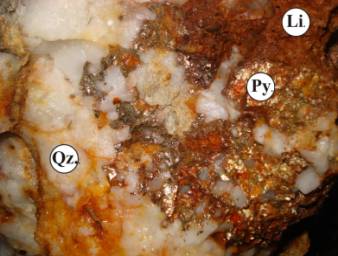
Fig.4.
Hand specimen shows quartz-pyrite-gold mineralization stage. (Qz.- quartz;
Py.-pyrite; Li.-limonite)
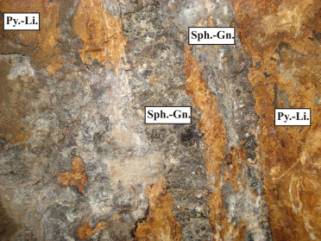
Fig.5.
Hand specimen shows quartz- polymetallic mineralization stage. (Sph.-
sphalerite; Gn.-galena; Py.-pyrite; Li.-limonite)
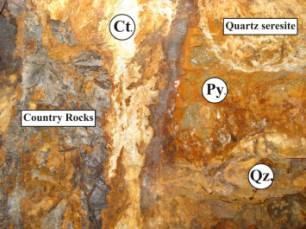
Fig.6. Photo shows the inter-relationships
between the different stages of mineraliziation. (Qz.- quartz; Py.-pyrite;
Ct.-carbonates)
Quartz-silicite
stage constructs the major part of vein mass of ore bodies. In paragenesis with
quartz are met sericite as the stripes 2-3 sm in thickness in subsalband parts
of ore veins.
Quartz
is whitish-grey, rarely grey, coarse crystalline, druse like and pectinate
(veins 1, 1a, 4, 5, 36, 36a and etc.). Druse-like and coarse-crystalline quartz
grows mainly along the walls of the cracks. Coarse crystalline character of the
quartz, number of druse cavities in it, sharp boundaries of vein with
neighboring rocks testify that took place an infill of open cracks in these
veins, which were formed as a result of lateral stress, which in the end caused
weakening along the contacts and numerous crocks along which orebearing
hydrotherms were entering.
Quartz-pyrite-molybdenite
stage is especially widespread on the northeastern flank of Pyazbashi deposit,
close to granitoid intrusive. Intensivity of mineralization of
quartz-pyrite-molybdenite stage in west-south-west direction gradually
decreases. In the veins, built up by mineral assemblages of the mentioned
stage, gold content varies from <weak> to 2-3 g/t. Apparently, gold in
pyrite is in finedispersive condition. Milky-white quartz with thin interveins
and disseminated impregnation of pyrite and molybdenite is strongly catalyzed,
cross-cut by numerous quartz-gold-sulfide veinlets of the following stage of
mineralization. Are observed fragments of quartz with pyrite-molybdenite
mineralization, cemented by quartz of quartz-pyrite-gold ore stage (Fig.7.)
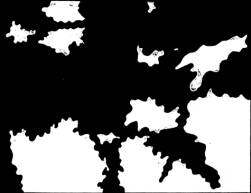
Fig.7
Cementation of quartz (white) quartz-pyrite-molybdenum stage by quartz (black)
of quartz-pyrite-goldore stage adit N15 vein N5.
Pyrit-1,
molybdenite and chalcopyrite from impregnations and rare thin veinlets in
milky-white quartz, virgin gold forms thin impegration in unmineralizedn(ore
free) mass. Lack of corrosive ration of minerals enables to unite them into one
paragenetic associacion. X-ray analysis show that gold-1 contains silver (table
1) [10]. Chrystallochemical formula of the gold based on the results of three
analyses accordingly are: Au118Ag82; Au142Ag58;
Au143Ag57;
Table 1.
Result of chemical analyses of virgin
gold of Pyazbashi ore field [10]
|
№ of analyze |
Compozition |
Formula |
|||||
|
Au |
Ag |
|
|||||
|
eight., % |
at. numb. |
eight. % |
at. numb. |
sum |
|||
|
1 2 3 4 5 6 7 8 9 10 11 12 |
82,15 79,3 82,1 80,4 78,8 75,7 82,2 79,8 82,2 75,6 80,4 70,0 |
0,419 0,402 0,417 0,408 0,400 0,384 0,417 0,405 0,417 0,384 0,408 0,355 |
17,9 29,9 18,2 19,7 22,1 24,1 18,1 21,1 18,2 25,1 19,7 30,0 |
0,166 0,277 0,169 0,183 0,205 0,223 0,168 0,196 0,169 0,233 0,183 0,278 |
100,4 99,8 100,3 100,1 100,9 99,8 100,3 100,9 100,4 100,7 100,3 100,0 |
Au1,43Ag0×57 Au1,18Ag0×82 Au1,42Ag0×58 Au1,38Ag0×52 Au1,32Ag0×68 Au1,27Ag0×73 Au1,43Ag0×57 Au1,35Ag0×65 Au1,42Ag0×58 Au1,25Ag0×75 Au1,12Ag0×88 Au1,42Ag0×58 |
|
In
quartz-pyrite-molybdenite stage are determined molybdenite-quartz and
molybdenite chalcopyrite-pyrite assemblages.
Quartz-pyrite-gold stage is
characterized by precipitation of medium – and finegrained quartz with dense,
but fine impregnation of pyrite, rarely chalcopyrite, gold and etc.
Before
this stage took place shifts along the cracks (fractures) of NW oriented veins
(300-3500), cracks of NE directions were corcked in favour of which
overlapping of goldore stage took place mainly along the veins of NW strike.
For example, along the vein 1 of Pyazbashi deposit is clearly observed how the
mediumgrained quartz infills the cracks in coarsegrained quartz of previous
stage, forming stripy texture (pic.8).
Should be mentioned, that onlapping of gold
mineralization stage was of the same rate not on all veins of NW directions.
This was depended on the rate of crack opening of different parts of the veins,
Virgin gold impregnations, tiny plates or veinlets with sizes 2-3 mm
paragenetically is associated with pyrites.
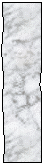

Fig. 8.
Stripy texture of ores. White – quartz veinlet, grey – veilets and
impegrantions of pyrite. (5x) (Pyazbashi deposit).
Ground
mass of gold is singled out on this stage. The major mineral of this stage is
pyrite-2, which builts up nests and stripes with thickness up to some
santimeters, parallel and subparallel contacts of veins and forms disseminative
impregnation and thin veinlets (up to 1 sm) in quarts mass. More often pyrite
is in close association with products of its oxidation by Fe oxide and
hydoxides, mainly by limonite and lepidocrocide. Single grains of pyrite within
quartz are rimmed by thin film of limonite along the peripheries, or are
crosscut by small veins also filled by limonite (pic.9).
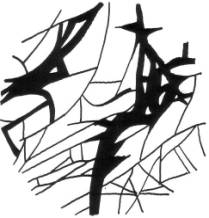
Fig.9. Net structure
of pyrite implacement (white) by limonite (black). (100x).
(Pyazbashi deposit)
Pyrite
– 2, arsenopyrite and chalcopyrite – 1 from early paragenetic association and
generate idiomorphic grains. Boundaries between them are even, without any
sings of corrosion and implacement, that points to their simultaneous
formation. Virgin gold -2 was crystallizing in the some stage but later than
sulfides as it completely fills small crocs in pyrite -2 and arsenopyrite. Gold
was precipitating together with quartz as observed inclusions of this mineral
captured by quartz grains during their growth. Gold, aside from virgin
isolations, is present also as admixtures in pyrite, chalcopyrite and
arsenopyrite. The major its concentrators is pyrite and chalcopyrite, and
bearer is pyrite. In pyrite – 2 (sample4-7) gold content is less and comprises 0,03-0,08%,
in chalcopyrite – 0,05% (table 2). Except gold in chalcopyrite as admixtures
are present silver (0,12%) and arsenic (0,15%). Christalochemical formula of
chalcopyrite-1 from Pyazbashi deposit is: (Fe1,01Cu1,00Ag12Au0,05)2.18
(S2.00As0,15)215. On quartz-pyrite-gold
mineralization, stage are singled out pyrite-arsenopyrite and
pyrite-chalcopyrite-paleore (tetrahedrite) associations.
Table
2.
Chemical composition of some ore forming
minerals of Pyazbashi ore field
|
Minerals |
№№ |
Composition,
weight % |
Sum |
Formula |
||||||||||
|
Fe |
Cu |
Zn |
Pb |
Ag |
Au |
As |
Sb |
Bi |
Te |
S |
||||
|
Pyrite |
1с. 2с. 3с. 4с. 5с. 6с. 7с. |
46,82 45,51 45,13 45,19 46,51 45,92 46,13 |
- 0,23 - - - 0.03 - |
0,45 - - - - - - |
- - - - - - - |
- - - - - - - |
- - 0,15 0,08 0,08 - 0,03 |
- 0,18 - 0,20 - - - |
- - - - - - - |
- - - - - - - |
- 0,02 - 0,04 0,03 - - |
52,02 53,98 53,80 54,64 53,48 53,94 52,75 |
101,29 100,10 99,08 100,07 100,10 99,89 98,91 |
(Fe1,00Zn0,07)1,007S2,00 (Fe0,98Cu0,06Au0,0004)1,02
(S2,00As0,0024Te0,0001)2,0025 (Fe
0,97Au0,008)0,98S2,00 Fe0,96(S2,00Au0,08As0,0023
Te0,0033)2,011 (Fe0,995Au0,0004)0,9954
(S0,998 Te0,002)2,00 (Fe0,98Cu0,0001)0,98S2,00
(Fe1,00Au0,0001)1,00S2,001
|
|
Chalcopyrite |
4c. |
30,46 |
34,51 |
- |
- |
0,12 |
0,05 |
0,15 |
- |
- |
- |
34,78 |
100,07 |
(Fe1,01Cu1,00Ag12Au0,05)2,18
(S2,00As0,15)2,15 |
Quartz
- polymetallic stage is characterized by precipitation of finegrained
Chalcedonlike quartz, pyrite, arsenopyrite-2, altait, hessite, tennatite. They
are represented as veinlest, that cross-cut precipitated earlies mineral
assemblages. Major ore minerals of this stage are sphalerite and galena. They
are observed as nests, thin veinlest, stripes and impregnations in quartz.
Before this stage latitudal and partly submeridional fractures had been opened.
Onlapping of mineral association of this stage on quartz-molibdenite stage is
observed on Djovuzludari manifestation of polymetallic ores. On Pyazbashi
deposit (in adit.N1 - 175m of head henger-on) polymetallic vein of latitudal
strike shifts gold-mineralization vein -1. Aggregates of sphalerite fill
interstitials among the grains of pyrite-2 and arsenopyrite-1. Simultaneously
with sphalerite were precipitating galena and tennantite, as in many cases
boundaries among these minerals are clear, without traces of corrosion and
emplacement. Together with galena were precipitating altait, hessite.
Crystallization of sphalerite outstriped all other minerals, precipitating on
this stage. This is proved by crosscutting of sphalerite by arsenopyrite
veinlent of growth and by emplacement of tennantite.
Quartz-polymetallic
stage also is goldbearing. Gold is found as in virgin type so as admixture.
Virgin gold-3 in association with sphalerite fill interstitials among the
grains of quartz and small cracks in arsenopyrite . On quartz-polymetallic stage are singled out
arsenopyrite-pyrite-sphalerite, chalcopyrite-pyrite-sphalerite and
quartz-galena assemblages.
To
the earliest assemblage are related massive coarse-crystalline aggregates,,
where pyrite and arsenopyrite have close rate of idiomorphism. The second paragenetic association of
quartz-polymetallic stage is represented by aggregates of tightly accreted
pyrite, chalcopyrite and sphalerite, which together fill intersfitions in
coarsecrystalline aggregates of arsenopyrite without clear signs of the
emplacement of the latter. This
testifies later precipitation of these minerals. With them associated gold of
the late generation, which differs by lower standard and also vrious in
morphology grains of tetrahedrites. Galena occurs in salbands of veinlets as
coarse (up to 5mm) grains, often corroding sphalerite and emplace it along cracks. Galena emplaces also pyrite,
which is present here as small grains (0.1-0.2mm). Also are present
arsenopyrite, altaite, hessite, tennantite. Though timing (age) interrelations
of mentioned minerals are not always clear as they are rare and don't contact
with each other. However, minerals that contain iron-sphalerite, pyrite, arsenopyrite
are obviously earlier due to corroding them galena.
Carbonate
stage is the final stage of hydrothermal process and is characterized by
calcite precipitation. On this stage took place shifts along latitudal
fractures as a result of which quartz-ore mass was broken and cemented by
carbonate material (veins 50,51 and etc.).NW fracture systems on this stage
were closed and that's why mineral assemblages of this stage are almost absent
in them. Calcite, which is the final mineral of ore process, cements fragments
as of hosting tuffogenic rocks of subvein space so sulfide minerals of
quartz-gold-sulfide veins.
Physical - chemical conditions of the
deposit formation
Physical-chemical
conditions of the deposit formation was studied by means of thermobarometry.
Methodology of the studies included the following. Micro inclusions were
investigated in transparent - polished sections (mainly from vein quartz of
different stages of ore process). Were studies sizes, shapes, phase composition
and number of inclusions. Homogenization temperature of gas-liquid inclusions
were determined on setting UMTK 3 [7].
As
its well-known, homogenization temperature by the majority of the researchers
is estimated as a mineral temperature for the mineral formation. To obtain a
real temperature of mineralization is essential to insert a temperatural
correction (always positive), stipulated by a pressure influence [21].
Salinity
of mineral generation solutions were calculated in weighs percents of NaCl
equivalent on freezing temperature of inclusions for which was taken the
melting temperature of the last smallest crystal [8].
Vein
quartz is characterized by micro inclusions of mineral forming solutions 2-3 to
10-15mkm in size. According to relative age are singled out primary,
primary-secondary and secondary inclusions [6]. Determination of the inclusion
generations of the same ages was carried out based on their morphology and
homogenization temperatures. In the investigated quartz primary inclusions
usually are "negative micro crystals" hexagonal singoony, distributed
on the growth zones. Gas bubble within them is usually isometrical and that's why it's not transparent because
of full internal reflection. Primary inclusions consist from water solution and
gas. Primary-secondary and secondary inclusions are characterized by irregular
flattened shape, as they as a rule are related to healed small cracks. Gas
bubble in flattened inclusions has high transparency. Mineralogical
characteristic of the material of plates enables to correlate temperatures of
homogenization of the primary and
primary-secondary inclusions in conditions of the formation of the given
stage of mineral formation. Secondary inclusions were used to characterize
temperature parameters of following stages. So, each quartz plate was examined
as a source of information about several stages of mineral formation exposed as
inclusions of different generations.
All
in all were examined 40 quartz plates from Pyasbashi and Shakardari deposits.
Were made 25 measurements of homogenization temperature. have been received
following major results.
Pyasbashi
deposit shows polimodal distribution of temperatures. Inside of wide
temperatural diapason are singled out 4 major maximums, that correspond mainly
to mineral formation stages. To the first quartz-sericite stage corresponds the
highest temperatural interval 270-3900C. To, the second quartz-pyrite-molibdenite
stage correspond medium temperatural
interval 250-3700C. The third one reflects temperatural
inversion during quartz-pyrite-gold ore stage - 270-3200C. The
latest quartz-polymetallic stage is characterized lowered temperatures 140-2600C.
Fluid inclusions were investigated by
means of thermometric methods in thermochamber. According to them were
determined homogenization temperatures results of which are shown on Fig.10 and 11. Histograms of homogenization
temperatures [5] in observed have
polymodal character, singled out generations of inclusions corresponds to above
described mineral assemblages. Is determined, that within the boundaries of
Pyazbashi ore field the same assemblages are characterized by close
temperatural intervals of homogenization in spite of their dominant or
subordinate productivity on the given object. Presumably the temperatures of
the formation of mineral assemblages are related to the level of erosive cut of
the ore field. As it's determined, inclusions of the first type are almost
totally homogenized in a liquid phase at temperatures 250-3900C with
maximum in the interval 300-3500C (Fig.10.). Gas composite of these
inclusions which mainly consist from carbon dioxide, homogenizes into liquid,
rarely into gas phase. This happens at 12.0-22.80C. The major of CO2
homogenized at 4-13,5оС. For
given case density of СО2 is estimated within the limits of 0,80 -
1,10g/sm3 . In gas phase of captured fluids aside of CO2
are present also methane and dissoluted chlorides. Is determined that presence
of methane in inclusions in general take place at the melting temperature of
gas hydrate over 10оС. Below
this melting temperature they contain dissolved chlorides. Concentration of
salts in the fluid, according to temperatures of gas hydrate melting (СО2
7,3 H2O) comprises 1015,3
mas% NaCl - eqviv. [3] calculated according to temperatures of ice melting
[19].
Temperature, 0C
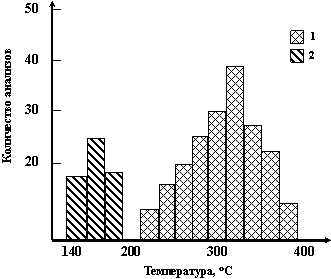
Fig.10. Histogram of
homogenization temperatures of fluid inclusions in quartz of Pyazbashi deposit:
1. inclusions of I-II types; 2.
inclusions of III type.
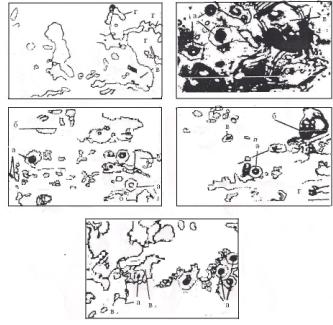
Fig.11.
gas - liquid inclusions in goldbearing quartz of Pyazbashi deposit
а) Primary 2 phase: gas-liquid (twophase); б) Substantionally gasiceous: primalry-
secondary; в) Substantionally liquid: secondary three pase; г) Liquid.
Fluid inclusions of the second type are represented
by substantionally gasiceous components, which correspond in composition CO2,
homogenise at temperature from 21.5 to 230C. In given temperatural
interval densign of CO2 is from 0.59- to 0.95 g/sm3.
Homogenization of fluid inclusions of the third
type in liquid phase takes plave at 140-2000C. These solutions are
characterized by relatively high concentration of salts (from 7,5 to 10,2 mas. % NaCl-eqv.). Aside of Na in the solution is dominat also
Mg.
Analisic o ontained data on thermometric
investigations shows, that during mineral cristallization on Pyazbashi deposit
were captured thre types of fluids different in composition: 1) aqueous fluid
with CO2, CH4 and Na and Mg chlorides; 2) gas fluids,
containing CO2 and admixtures of CH4 ; 3) aqueous fluid
of moderate salinity, containing Na and Mg chlorides. The first tub fluids are
contemporaneous and obviously are derivatives of the same fluid and were formed
during its exfoliation while falling of pressure and temperature or only of
temperature. As temperatures of homogenization of both types of inclusions in
many cases turned out to be similar, could be supposed that separation of
volatite components from fluids was caused by abrupt falling of pressure, but
not of the temperautre. Substationally aqueous fluid is characteristic for
final stages of deposit formation. It also could form while boiling up of the
fluid, which consisits of the mixture H2O+CO2 with chlorides.
Chemistry
of ore minerals. Gold in ores of
Pyazbashi ore field aside of its virgin nature, is present also in pyrite,
chalcopyrite, galena, sphalerite, tennantite (see tab.2.). Standard of virgin
gold is not stable and varies from high standard (82.13) to low (70.0). Is isolates
as clotted, paw like, wire like, filming, scaly, dendritic, irregular table
like etc. in vein quartz. Are present in paragenetic association with virgin
silver, electrum. Size of gold particles varies from 1 mkm to 0.2x0.5 mm, shapes
of isolation in growing's with silver is from thinnest hair like veinlets to
slightly prolonged, sometimes isometric ones. Bigger isolations of gold and
silver are related to mechanic features of mineral - bearings. So, veinlet
shapes of isolations of virgin gold and silver are determined in tenantite,
prolonged and isometric ones in chalcopyrite.
Pyrite is the major ore mineral of
Piazbashi deposit. It's present in several generations. its distinctive feature
is presence of admixtures of copper, gold, arsenic, zinc and tellurium, which
are regularly distributed as within the limits of one grain, so in grains of
different generations. Are singled out copper -, arsenic -, tellurium and gold
bearing varieties. In some samples (samp. 2 c; table 2) in the composition of pyrite
are simultaneously present copper, gold, arsenic and tellurium. In idiomorphic
crystals of pyrite is exposed zonality apparently caused by transformation of
habitus and composition.
Arsenic, tellurium and gold are
characteristic for pyrites of quartz - pyrite - gold ore association, which
contain maximum amount of gold - 0.08 mas%. Results of analysis of chemical
composition prove high goldbearing of pyrite in association with arsenopyrite
and tellurides. Concentration of arsenic in pyrite is 0.18-0.20 mas%, tellurium
- 0.02-0.04 mas%.
Arsenopyrite is the mineral of minor
importance in Pyazvashi ores. It's met as small shortprismatic grains. In
heneral it's exposed in ores of the second and third stages in association with
pyrite and sphalerite. In the first, case of association with pyrite it builts
up nests and stripes parallel and subparallel to vein contacts. It formed
disseminated impregnation and thin veinlets (0.5-1 sm) in secondary quartzites
of Shakardari deposit. Aggregates of pyrite and arsenopyrite underwent crashing
and are crosscut by veinlets of galena-sphalerite mineralization of
quartz-polymetalic stage. Arsenopyrite and pyrite usually form idiomorphic
grains. Boundaries among them are straight, without signs of corrosion and
emplacement. This enables to suppose their almost simultaneous formation in
early paragenetic association of the third stage. The main part of gold
including virgin one, was crystallized on the third stage, but later than
sulfides, as it fills cracks in them, in particular in pyrite and arsenopyrite.
Is investigated isotope composition of
sulphur of sulfide minerals, oxygen of quartz of Pyazbashi ore field. Results
are represented in tables 3 and 4 and on pic.6. Isotope composition of sulphur
is determined in pyrite, chalcopyrite, sphalerite and galena. Ratio of sulphur
isotopes in sulfides varies from +3.0 - +6.8 %о, in particular for pyrite
+3,2-+4,1 %о, galena +3,0-+3,3%о. As is clear from the results of measuring
δ34S values of sulfides, precipitated on different stages don't
differ a lot.
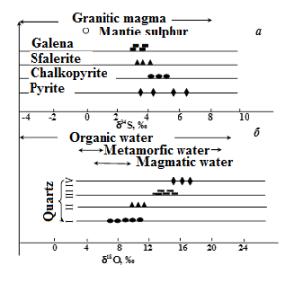
 Fig 12.
Isotope composition of the minerals from Pyazbashi ore field: a - isotope
content of sulphur of
Fig 12.
Isotope composition of the minerals from Pyazbashi ore field: a - isotope
content of sulphur of
sulfide minerals; б - isotope content of oxygen of quartz from different
stages of mineral
formation on Pyazbashi deposit.
δ18O isotopes of quartz from different stages of
mineralization of Pyazbashi deposit varie from +7.5 to 16.9‰. At the same time
quartz from the early qyartz-sericite stage is characterized by values of δ18O within the limits from +7.5 to 8.7‰. Quartz of
quartz-molibdenite stage is characterized by δ18O values from +9.9 to 11.0‰ and from productive
quartz-pyrite-goldore - +12.6 to 15‰. Quartz of the later quartz-polymetalic
stage is enriched by heavy isotope of oxygen and has δ18O values from +14.9 to 16.9‰ (Fig.12.)
Table 3.
Isotope composition of the sulphur of
sulfides from Pyazbashi ore field
|
Mineral |
δ34S%о |
Mineral |
δ34S%о |
Mineral |
δ34S%о |
|
Pyrite Pyrite Pyrite Pyrite |
6,8 3,5 4,2 5,4 |
Chalcopyrite Chalcopyrite Chalcopyrite Sphalerite |
4,1 4,4 4,8 3,3 |
Sphalerite Sphalerite Sphalerite Sphalerite |
4,1 3,2 3,1 3,0 |
Table
4.
Isotope composition of the oxygen of
quartz from Pyazbashi deposit
|
δ18О%о |
|||
|
Stages of mineralization |
|||
|
I Quartz-sericite |
II Quartz-molibdenite |
III Quartz-pyrite-gold ore |
IV Quartz- polymetalic |
|
+7,5 +7,9 +8,0 +8,5 +8,7 |
+9,9 +10,2 +10,4 +11,0 -- |
+12,6 +13,0 +14,1 +14,3 +15,0 |
+14,9 +16,2 +16,9 -- -- |
Correlation
of gained results with literary data [3,11] shows, that δ34S
and δ18O values of the minerals from the Pyazbishi ore field
are alike of the data, gained on numerous gold ore deposits.Distinctive feature
of Pyazbashi deposit is significant change of δ34S and δ18O
values while in most plutonogenic hydrothermal gold deposits these values
correspond to narrow intervals and are about 2-3%.
According to results of gained
isotope, data might be considered the source of ore forming fluid. Water-
carbon dioxide fluids with moderate salinity, which are alike of the fluid from
which precipitation of described ores took place, are thought to be the
products of magmatic activity [9] or of dehydration and decarbonatization
reactions, that take place during the metamorphism of terrigenous rocks [15].
In case of dehydration usually is
generated fluid with low concentration of salts (less than 6 mas % NaCl eqv.
[16]). Formation of highconcentrated brines is possible during of fluid
exfoliation, which consist of H2O and CO2 and NaCl, into
gas and water-salt phases [12].
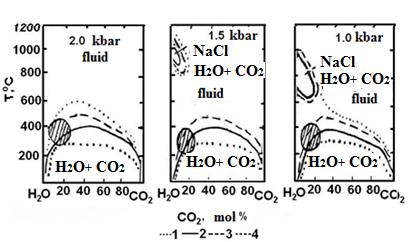
According to diagram of the condition of H2O - CO2
- NaCl system, presented by these authors (pic.13.), at content in it of 6 mas
% of NaCl, exfoliation of fluid on phase enriched by H2O - CO2
and liquid rich in NaCl, takes place within the temperature interval from 600
to 10000C at pressures 1-1.5 kbar. At higher pressures fluid slays
homogenous.
.
Fig13. Phase ration in the system. Hatched area
shows localization of ore formation on Pyazbashi
deposit. Phase boundaries correspond to
different compositions (1-4): 1-0; 2-6; 3-12; 4-20mas%.
Exfoliation of mineral forming fluid
during formation of gold veins of Pyazbashi deposit, as it was shown above,
took place at different parameters P=0.7-2.5 kbar and T=140-3900C.
Metamorphic processes, that took place in Ordubad ore field are characterized
by low steps and occurred at temperatures lower than 500 0C and
pressures 3-4 kbar. Fluid, equilibrium with these rocks should had been
characterized by the same parameters. Accordingly low temperature fluid, rich
in chlorite salts, couldn't be formed as a result of exfoliation of metamorphic
fluid, which was generated during dehydration and decarbonatization of the
rocks. Base on above mentioned it's considerable, that chemical composition of
mineral-forming fluid testifies its magmatic origin.
Involvement into ore precipitating
process of components, that have various origins is proved by data about
composition of stable isotopes. In favor of the fact, that impute of the components into the area of ore
precipitation from the deep seating chamber, indicate similar isotope ratios of
oxygen and sulphur in the veins from different flanks and horizons of Pyazbashi deposit and from the rocks of
different composition. This, in our opinion, indicates that isotope exchange
reactions with the host rocks didn't significantly influence on δ34SH2S and δ18ОH2O values.
Gained data about Pyazbashi deposit
show, that δ18О values of water in fluid are distributed in
the area of characteristic for water values, which was formed during
transformation of sedimentary rocks containing organic material and is close to isotope ratio, determined for
metamorphogenic waters and are lightened by isotope in comparison with primary
magmatic water, values of which are accordingly in intervals from - 7 to + 20‰, from +3 to 20‰, from 5.5 to +
10‰ [18,22]. (see pic.7).
Influence
of exchange isotope reactions of fluid with the rock on the ration of isotopes
of oxygen in it, in mezothermal mineralforming systems is not significant [14].
That is why primary magmatic fluid (δ18ОH2O
= +7 ‰) during interaction with volcanigenic
host rocks, at 400 and 3000C could be enriched by light oxygen
isotope up to 2‰. Based on this fact, couldn't be excepted involvement into ore
forming system of the water of magmatic origin. It's supposed, that calculated
isotope content of oxygen of the fluid is better to interpret as a result of
the shifting of two fluids different in values. One of them might have magmatic
origin, the second one was poor in heavy oxygen isotope and could formed during
formation of waters as a result of disintegration of organic material. In this
case are well explained δ18ОH2O
values and its lowering to - 1‰.
Sulphur,
as well as oxygen, during the ore precipitation could have different origin,
especially in that case, when its isotope content is distributed within the
limit of the values from +7 ‰. As possible sources are regarded mantle and
magmatic systems and sedimentary host rocks. δ34 SH2O values (+2) - (-7)‰ are related to fluid, generated from
granitoid melt where isotope ratio of sulphur changes from -3 to +7‰ [17].
Based on this is supposed, that sulphur, which took part in formation of
Pyazbashi deposit, was extracted from magmatic source. There's also possibility
of participation in the ore precipitation process of mantle sulphur, and also
of the sulphur borrowed from host rocks, isotope content of which is
accordingly within intervals from -3 to +3‰ and from less than +10 to +20‰.
That's why it's different to simply answer the question of the sulphur impute
into ore forming system took place together with fluid which separated during
crystallization of granitoid magma or it was borrowed from the rocks hosting ore bodies.
So, it's
possible to suppose, that while formation of the deposit, fluids were of
different nature. They contain products of magmatic and metamorphogenic origin,
shifting of which was rather quick in the area of ore precipitation or near it.
The dominant apparently was fluid of magmatic origin.
Conclusions
Results of
investigations enable to make following conclusions:
1.
The ore precipitation process was long and multistage.
Are singled out 5 stages of mineralization: quartz-sericite,
quartz-pyrite-molibdenite, quartz-pyrite-gold ore, quartz-polymetallic, and
carbonate, for which are determined molibdenite-quartz,
molibdenite-chalcopyrite-pyrite, pyrite-arsenopyrite,
pyrite-chalcopyrite-tetrahedrite, arsenopyrite-pyrite-sphalerite, quartz-galena
mineral associations;
2.
Temperature of ore formation, studied by method of
homogenization of gas-liquid inclusions in transparent minerals (quartz) of
different mineral associations, varies in interval from 1400 to 3900C.
mineral associations of early stages (I-III) were crystallizing at temperature
250-3900C, later (IV-V) - at 140-3000C. Pressure of ore
forming environment (medium) determined on crossing of isotherm in system H2O
- CO2 and isochrore CO2 [13] was 0.7-2.0 kbar.
Precipitation of minerals of quartz-pyrite-gold ore stage took place at
pressure 0.8-2.5 kbar, of quartz-polymetallic - 0.7 - 2.0 kbar.
3.
Taking into account that quartz veins carry fragments
of the host rocks, almost fully emplaced by quartz-sericite aggregate, could be
supposed that at temperatures 250-4000C and pressures 0.5-3.0 kbar
they might be formed in balnce with fluid with pH from 5.45 to 6.1. In
conditions of quartz-sericite-potassium-feldspar metasomatose fluids will be in
balance with surrounding medium ar pH from 5.2 to 6.1.
So gold mineralization of Pyazbashi ore field was formed within the
temperature interval from 390 to 1400C, pressure - 0.7-2.5 kbar,
pH=5±1. Activity of sulphur at the beginning was increasing due to mineral
precipitation, and was decreasing at the end of ore forming process. Volatility
of oxygen and hydrogen dioxide was lowering during precipitation of later
mineral associations.
4.
based on
investigation data of isotope composition of oxygen and sulphur in ore forming
fluids, might be supposed, that fluids have different nature, they contain
products of magmatic and metamorphic origin, where dominant were fluids of
magmatic origin.
Literature
1.
Baba-Zade
V.M., Makhmudov A.I., Ramazanof V.G. - Copper and molibdenum - porphyri
deposits. Baku, Azerneshr., 1990, 377p.
2.
Baba-Zade
V.M., Musaev Sh.D., Nasibov T.N., Ramazanof V.G. - Gold of Azerbaijan. Baku,
Azerv. Milli Enciclop. 2003, 424 p.
3.
Bortnikov
N.S. - About trustworthiness of arsenopyrite and arsenopyrite-sphalerite
geothermometrs. Geol. rud. mestorojdenii, 1993, N2, p.177-193.
4.
Husseinof
J.M. - Miberal composition and conditions of ore formation on Pyazbasji -
Shakardari ore field. Vestnik Bakinskogo Universiteta. Seria est. nauk 2002,
N4, p.113-128.
5.
Ermakov
N.P. - Stage nature of ore formation and rock alteration due to gas-liquid
inclusions in minerals. In Book: Problems of petrology and genetic mineralogy.
vol. II, M. Nauka, 1970.
6.
Ermakov
N.P. Geochemical systems of inclusions in minerals. M.Nedra, 1972, 240p.
7.
Ermakov
N.P., Dolgov U.A. - Thermobarogeochemicstry. M.Nedra, 1979.
8.
Melnikov
F.P. - Investigation methods of gas-liquid inclusions in minerals. Laboratory
methods of investigations of minerals, ores and rocks. M. MGU, 1979, p.120-174.
9.
Ryabchikov I.D. - Thermodynamics of fluidal
phase of granitoid magmas. M.Nauka, 1975, 278 p.
10. Suleimanov E.S. - Gold ore
formations of the Lesser Caucasus. Baku: Elm. 1982, 280p.
11. Berger B.R., Drews L.I.,
Goldfarb R.I., Snee L.W. Anepoch of gold riches: the cate Paleozoic in
Uzbek-island, Central Asia. Newsletter Soc.Econ.Geol. 1994, № 16, p.1,7-11
12. Bowers T.S., Helgeson G.H. Calculation of the termodinamic and
geochemical consequences of monideal mixing in the system H2O-CО2-Na2Cl
fluids of high pressures and temperatures. Geochim. et. cosmochim. Acta. 1983,
v. 47, p.1247-1275
13. Brown P.E., Lamb W.M. P-V-T
properities of fluids in the system H2O-CО2-Na2Cl
: New graphical presentations and iruplications for fluid inclusion studies.
Geochim.et. cosmochim. Acta. 1989, v. 53, p.1200-1221
14. Kerrich R. The stable isotope
geochemistry of Au-Ag deposits in metamorphic rocks. Mineral. Assoc. cau. Short
cource. 1987, v.13, p.287-336
15. Kerrich R. Mezothermal gold
deposits: A cririque of genetic hypotheses. Green stone gold and crystal
evolution. Val d,or. Geol. Assoc. camada, 1990, p.13-31
16. Nesbitt B.E. Phanerosoic gold
deposits in tectonically active continental marging. Gold Metallogeny and
Exploration. Gglasgow &. London. Blackie, 1991, p.104-132
17. Ohmoto H., Rye R.O. Isotopes
of sulfur and carbon. Geochemistry of Hydrothermal Ore deposits. N.Y: Wiley,
1979, p.509-567
18. Ohmoto H. Stable isotope
geochemistry of the deposits. Rew. Mineralogy. 1986, v.16, p.481-560
19. Potter R.W., Clynne M.A.,
Brown D.L. Freezing point depression of aqueous sodium chloride solutions.
Ecom. Geol. 1978, v.73, p.284-285
20. Roedder E., Bodnar R.J.
Geologic pressure determinations from fluid inclusion studies. Ann. Rew. Earth.
Rlanet. Sci., 1980, 8, p.263-301
21. Roedder E. Fluid inclusions:
Reviews in Minerology, v.12, Mineralogical Society of Amerika. 1984, p.644
22. Sheppard S.M.F.
Characterization and isotopic variations in natural waters. Rew. Mineralogy. 1986,
v.16, p.165-183