Modern
information technologies / 3. Software
Akmoldina Anara
Kostanay State University of
A. Baitursynov, Kostanay
Approximate
method for determining the coefficient of permeability of the layer at an
elastic mode of oil
The
general principle of non-stationary layers for study is that by changing the
work of wells in the reservoir of artificially generated transients filtering
and pressure is measured according to time in one or more wells. Based on data
from the wells and flow rates of pressure change at certain points in the
reservoir could receive information about the bed-permeability,
piezoconductivity, about the location of the boundary layer, etc.
The
easiest and most common way to create a non-stationary flow is stop one of the
wells. Pressure curve of time, which is the study of reservoir, can be charged
either in the hole, stopped or in another-a broken well (devices as well as
piezometric). This assumes that the remaining amount during the study Wells
change slightly.
Consider
the one-dimensional axially symmetric motion (flat-radial)with elastic mode. Pressure
distribution is defined as the solution to the heat equation in polar
coordinates  :
:
 (1.1)
(1.1)
satisfying the
initial condition
 (1.2)
(1.2)
and the boundary
conditions at  .
.
Applications
of particular importance is the task to which the borehole is constant flow.
This is used in the most common ways of definition of parameters of the
reservoir according to the observations of non-stationary flow to the wellbore.
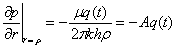
Suppose so
 , (1.3)
where  - the well's radius and
  .
.
Suppose that in the
cylinder  the pressure keeps a constant
value equal to
the pressure keeps a constant
value equal to
 (1.4)
(1.4)
This
condition is met if, for example, the region borders vast well of water
permeable layer. Let the set pressure, depending on the time at the well. That
is
 (1.5)
(1.5)
This
means that the character expression in the left side of the equal sign is the
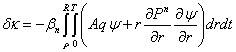
first integral right of equality (1.14). Intuitively,
it is clear that if