The study of antiradical
activity of Salvia officinalis
alcohol extracts
Authors: Nizhenkovska I.V. MD, Afanasenko O.V. PhD,
Bogomolets National Medical University, Kijev, Ukraine
In official medicine Salvia (Salvia officinalis L.,
family Lamiaceae) is known primarily for its anti-inflammatory and
antimicrobial properties. In addition, it has astringent, choleretic,
anti-spastic, vasodilating, stimulating and tonic properties. Sage is also used
to treat excessive lactation, night sweating, increased mucus secretion (as in
Parkinson's disease), profuse sweating (such as tuberculosis), during female
infertility and problems during menopause [1, 2].
Sage leaves contain up to 2.5 % essential oil, consisting of cineol,
foam, thujone, borneol and other terpene compounds as well as phenolic
compounds - flavonoids (apigenin and luteolin derivatives), tannins,
derivatives of hydroxycinnamic acids (rosemarinic, caffeic, chlorogenic,
ferulic), sugars and polysaccharides , vitamins B and PP, three terpene
saponins – derivatives of ursolic and oleic acids [3,4 ].
In nowadays environment, excessive consumption of synthetic drugs, food
additives and preservatives has a significant impact on biological production
of free radicals, which are the basis of some pathological conditions and
diseases, such as atherosclerosis, coronary heart disease, cancer and others.
To correct these states plant materials containing a large set of antioxidants:
vitamins, flavonoids and tannins are often used, as they have a mild effect on
the body and relatively low toxicity. Since the most of the currently known
antioxidants are phenolic compounds, it was decided to determine the
antiradical activity of extracts of sage-like substances with potential
antioxidant action due to the fact that sage leaves include a large number of
poly-phenols.
Purpose. To determine the antiradical activity of alcohol extracts of sage,
received with alcohol extraction of various concentrations.
Materials and Methods.
Extraction of Salvia
officinalis leaves.
Extraction was performed with ethyl alcohol of different concentrations
(96%, 90%, 70%, 50%, 40%, 20%) by maceration with raw-extractant ratio of 1:5.
[5].
Antiradical activity of sage leaves ethanol extracts was tested with
spectrophotometric method with the use of the dipenylpycrilhydrazyl
stable radical (DPPH) [6]. We determined the value of DРPH alcohol solutions optical density before (D0516)
and after incubation of studied extracts with alcohol solutions (Dt516) as well as the value
of (ΔDt516/D0516)x100%
ratio. Measurements were performed on a HP-845-2A spectrophotometer (USA) in
quartz cuvettes with optical path length of 1 cm at a controlled incubation
temperature of 25 ◦ C.
Tincture of walnut leaves (Kyiv FF) was used as a comparison.
Results and Discussion
The graph shows antiradical activity (ARA)
Salvia officinalis extract percentage.
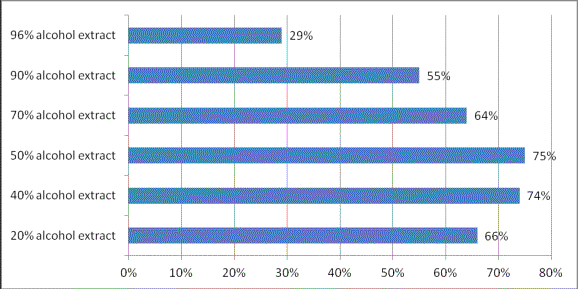
Figure 1. ARA activity
of Salvia officinalis extract in percentage
The obtained data shows that all the studied extracts of Salvia
officinalis significantly reduce the maintenance of DРPH radical form, i.e. they
reveal ARA. As we can see, 40% and 50% alcohol extracts are almost as good as
walnut tincture in the ability to detect anti-radical properties, while the 96%
alcohol extract is much weaker.
96% alcohol extract of sage leaves shows a very small ARA, that is 29%.
70% and 20% alcohol extracts are slightly inferior. They have 64% and 66% ARA
respectively.
The analysis of the interaction kinetics between the DPPH radical form
and alcohol extracts of sage leaves shows a rather quick response. We can see
that the addition of 40% and 50% alcohol extracts of sage leaves to the DPPH
alcohol solution leads to the decrease of its radical form concentration by 74%
and 75% respectively (in 2 minutes).
Conclusions: Thus, our in vitro studies
have shown that 40% and 50% alcohol extracts of sage leaves possess antiradical
properties which are as good as walnut tincture.
Literature
1.Baykova EV Rhode sage: morphology, evolution, prospects of an
introduction. - Novosibirskr: Nauka, 2006. - 248.
2.Vychkanova SA Antimicrobial activity of extracts of the roots of
plants of the genus Salvia L. / Plant Resources, 2000. - Vol. 3. - P. 389-394.
3.Zilfikarov J.H. diterpenes and polyphenols Salvia officinalis:
Prospects medical application (review) / J.N. Zilfikarov / / Magazine St.
Petersburg University Series 11. - 2007, Vol. 3. - P. 149 - 158.
4.Kosman V.M., Pozharitskaya O.N., Shikov A.N. Makarov V.G. The study of
active biological substances dry extracts Echinacea angustifolia and sage / Chemist plant material, 2012. - №
1 - p.153-160
5.Nіzhenkovska І.V., Turcan O.O., Sedko K.V. Selection of optimal conditions for
extraction of rosemary acid from Salvia officinalis leaf / Abstracts of
scientific papers involved. - International Scientific Conference, Kyiv - 2013.
- p.102-103
6.Gubskiy I.Y., LitvinovaN.V., Shnyrko-Tabakova E.V. Antioxidant and
antiradical activity of different classes of antioxidants / / Ukr. biochem.
journal. - 1994. - T.66, № 4. - P.114-117