Kazachkova
Maria
The
Institute of Corrective Pedagogy and Psychology
Pet’ko Lyudmila
Ph.D., Associate Professor,
Dragomanov
National Pedagogical University (Ukraine,
Kyiv)
LOUIS BRAILLE SYSTEM TODAY
Presently, 40 Million people know the Braille system
which provides the visually impaired with a means to read, write and express
themselves. All thanks to the innovation and determination of a ten year old
blind boy named Louis Braille [1].
Louis Braille invented
the raised dot system of reading and writing for the blind and visually
impaired. This tactile method permits the specially trained user to pass their
fingers over embossed dots and “decode” the corresponding letters or symbols.
Blind people around the world still use the Braille system today. The Braille
method has been adapted to most languages as well as math, music and even
computer programming.
Louis Braille was
born the son of a harness and saddle maker in France in 1809. At the age of
three, he was playing in his father’s workshop and accidentally stabbed himself
in the left eye with an awl. Subsequent infection and complications resulted in
his losing vision in both eyes by the time he was four [3; 1; 2].
In 1821 a soldier
named Charles Barbier came to give a talk at the school, where studied Louis
Braille. He told children about a system he had invented called 'night
writing', so that soldiers could pass instructions along at night without
having to talk and let the enemy know where 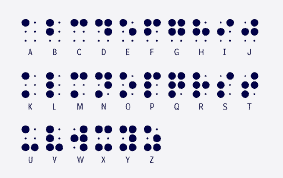 they were. Because they couldn't use a light, which would let the enemy
spot them, they had to feel the messages. Night writing consisted of twelve
raised dots which could be combined to represent different sounds.
Unfortunately, this system was too complicated and the army didn't use it.
However, Louis was quick to see the possibilities of the system. He worked over
the next few months and came up with a simpler version made up of 6 dots. For
several years he developed it further, adding maths and music codes [5].
they were. Because they couldn't use a light, which would let the enemy
spot them, they had to feel the messages. Night writing consisted of twelve
raised dots which could be combined to represent different sounds.
Unfortunately, this system was too complicated and the army didn't use it.
However, Louis was quick to see the possibilities of the system. He worked over
the next few months and came up with a simpler version made up of 6 dots. For
several years he developed it further, adding maths and music codes [5].
In 1827 the first book in braille was published. It
took a while for the system to catch on. Sighted people did not realise how
useful it could be, and it was not taught in
the school for the blind. Eventually, the benefits of the system were realised
and it was put into use. One major benefit was that at last blind people could
write, using a simple tool to make the dots. This was the beginning of true
independence for blind people [5].
Louis Braille became a teacher in the school where he
had been a student. He did not live to see his system widely used. He had
always had poor health, and he died of tuberculosis in 1852, at the age of 43.
Around
the same time Louis Braille was developing his code, other codes were also
being developed. Many blind students secretly learned Braille and other
dot-based tactile writing codes when their schools officially taught embossed
letters. Ultimately the dot-based letters of Braille became the most
widely accepted tactile reading code in English speaking countries, and most of
the world [10].
Braille was just
16 when he created the language that bears his name – the world's first binary
encoding scheme to represent written words. And though it took a century,
braille's simple elegance outlasted all other raised-dot reading systems
championed by rival educators [6].
The basic unit of braille is the cell. Many cells
have multiple meanings, depending on the language or notation being used and
other aspects of the surrounding text.
Standard braille characters (or "cells"),
are composed of up to six dots arranged in two columns of three dot positions
each. The dot positions are customarily numbered as follows:
1 • • 4
2 • • 5
3 • • 6
There are 64 possible combinations of raised dots within this pattern
(counting the space, where no dots are raised). A braille code is a system of
assignments of meaning to the various combinations, together with rules for
usage. For example, in English Braille, the dots 1–5 combination (that is, dots
1 and 5 raised, the others unraised, in the same cell) normally means the
letter "e," but in some circumstances it can also mean the digit
"5" and in others it can be a contraction standing for the word
"every." The rules of usage are such that the meaning in any instance
is clear.
Some braille systems employ eight dots in a cell, or some other number
or pattern of dots, typically for special uses other than general literary
material [4].
By 1990 Braille was being used in almost every
country in the world and had been adapted to almost every known language, from
Albanian to Zulu.
In 1952, Louis Braille was
officially recognised in France as one of the nation's heroes. His
body was moved to Paris and buried in the Pantheon, where the greatest French
achievers are honoured.
Bibliography
1. Magic Touch
– The Louis Braille Story (Video) !!! [Web site]. – Access mode:
http://www.youtube.com/watch?v=JO3S9lwJDgg
2. Louis Braille: Braille (Video) !!! [Web site]. – Access mode:
http://www.geniusstuff.com/video/clips/louis-braille-video/
10. Cooper
Holly L. A Brief History of Tactile Writing Systems for Readers With Blindness
and Visual Impairments [Web site]. – Access mode:
http://www.tsbvi.edu/seehear/spring06/history.htm For History !!!!!!!!!
3. Louis Braille [Web site]. – Access
mode: http://www.abcteach.com/free/32982.pdf
4.
About Braille [Web site]. – Access
mode: http://www.duxburysystems.com/documentation/dbt11.1/welcome_to_DBT/About_Braille_%28Brief%29.htm
5.
Louis Braille, Inventor of Braille
(1809–1852) [Web site]. – Access
mode: http://www.kidcyber.com.au/topics/braille.htm
6. Who was Louis Braille? [Web site]. – Access
mode:
http://assistivetechnology.about.com/od/ATCAT1/a/Who-Was-Louis-Braille.htm