PROCESS
INTENSIFICATION OF CONVECTION DRYING
USING
ELECTRIC FIELD
Dr. Ph. Of Technical Sciences,
Professor, Nikolaev N.S.,
Dr. Ph. Of Technical Sciences,
Academic IAR, Burlev M.Ya.,
Dr. Ph. Of Technical Sciences,
Professor, Kalnitskaya O.I.
Moscow State University of
Food Industry, Russian Federation
Introduction. One of the main tasks of the engineering of food is the intensification of production processes, which directly affects the performance of the equipment and its power consumption.
The most common ways to intensify relate to changes in the geometry of the product (a thin layer, dispersion, granulation, etc) and with an increase in the driving force in the process of (difference between the temperature, pressure and concentration), as well as the speed of movement of working environments (product and the coolant).
To
date, these ways of intensification in many processes, almost finished or have
serious limitations associated with technological regimes and requirements to
properties of the product. In these circumstances, the search and development
of new ways of intensification of technological processes, including the
physical and chemical properties of the product, is a challenge.
Abstract. Airflow and anybody by friction with the surface
drying biological object have the ability to accumulate electric charges. Water
is a weak electrolyte, the more it in the product, the higher its conductivity.
In the process of drying, the surface layer of the biological object is
transformed into thermal insulation layer, which prevents transfer of heat into
the depth of the biological object, that is, evaporation of liquid from the
deeper layers.
When
the surface layer of the biological object dries, it becomes the dielectric and
in during the friction with the air stream is charging. These charges are
accumulated and there may come a time when the electric current will be
significantly high for the emergence the process of the micro-electroosmosis.
Then
the liquid under the influence of an electric field to rise through the
capillaries to the outer surface of the particles of a biological object, and
these particles have overcome significant obstacles [2]. Thus, using this
effect or phenomenon, you can intensify the process of drying of biological
objects.
Method of drying process of low-fat milk in a thin
layer. The authors developed a method of drying of biological objects using
effect of weak electric impulses, apparatus design and control system [1, 4].
The main object of the study was selected the dairy product - low-fat milk.
Experimental
laboratory equipment, whose scheme is presented in Figure 1, consists from gas
pipeline (2), which is made in the form of a grounded metal pipe. In this tube,
electrode-emitter (5) coaxially mounted on insulators, which connected to the
high voltage impulse generator (3). The turbine (1) is connected to the gas
pipeline (2). On the right side of experimental laboratory equipment shows,
electronic weighing device (8) with a dielectric platform (9). The transformer
is designed to increase the voltage (4) (ratio of transformation – 0,06) and
has a connection with high voltage impulse generator (3). Overall, serial
control (monitoring) of all parameters is an electronic oscilloscope (6).
In
addition, experimental laboratory equipment additionally equipped with
electronic instrumentation: voltmeter, timer, liquid-pressure thermometer and
anemometer (Figure 2).
The
amount of low-fat milk in every experience dosed using the drip dispenser (the drip dispenser dosing
- US PROFI 117 – 129, USA). In Figure 2 does not show. This is to ensure that the amount of biological product (low-fat milk) each experience has not changed. The dielectric platform (9) installed on the electronic
weighing device (8), within, which fixed a circle.
Precisely on the perimeter of the circle occurs of
dosing product (low-fat milk) (10). That is low-fat milk by the drip dispenser (mass
= 500 mg) shall be sent to the dielectric platform (9) and bottled within the circle (d = 20 mm) drawn by the
platform.
1 2 5 6 7 8 Figure. 1. Experimental laboratory equipment for
drying of low-fat milk in a fixed position
on the platform (thin layer): 1
- turbine; 2 - gas pipeline; 3 - high voltage impulse generator; 4 -
transformer for increase the voltage; 5 - electrode-emitter; 6 - electronic oscilloscope; 7 - tripod; 8 -
electronic weighing device; 9 - dielectric
platform; 10 - sample of low-fat milk


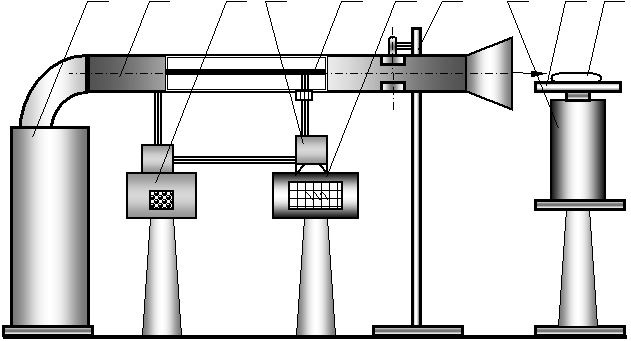
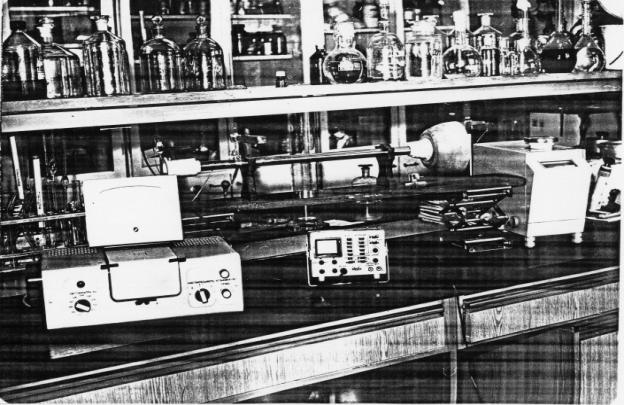
Figure 2. Photo of the experimental laboratory
equipment
At the generator high voltage impulses (3) for investigation are
determined of characteristics: voltage (amplitude) of the (U, Volt), impulse
frequency (f, Hertz) and (S) duty cycle (ratio of the impulse to their
duration). Before starting the turbine (1) marked the
initial reading of electronic weighing device (8) (500 VLKT) [3].
After switch on of the experimental
laboratory equipment, periodically after a certain
period of time (60 sec.) recorded measurement results. After all the necessary research, results were entered into
the table (Excel), followed by the analysis of these experiments.
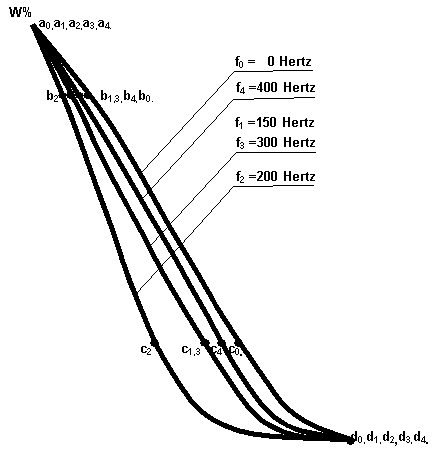
On the experimental results obtained graphs: “Drying kinetics of low-fat
milk in a thin layer at different frequency impulses” (Fig. 3), and “Change the
speed of drying of low-fat milk in a thin layer of moisture content at
different frequency impulses” (Fig. 4).
The moisture content of the product W counted
in relation to weight are absolutely dry substance, which in the process remains
the same, and indicated by the formula: [5,
6].
W = Gm – Gc/Gc·100% (1)
Gm –of the
total mass sample, changing in the drying process, kg;
Gc – the dry
matter weight, kg.
The
results of research. Research of drying parameters of low-fat
milk conducted without using effect of weak impulses and with using these
impulses.
Using effect of
weak impulses was carried out using a high voltage impulse
generator.
Constant
parametres: Voltage U
= 600 Volts, duty cycle S = 3.
On the scale of
the high voltage impulse generator, sequentially in each experiment changed the
impulse frequency f Hertz. According
to the results of the experiments received dependency graphs W = F(t). (Fig. 3)
|
150 |
|
|
|
|
|
|
120 |
|
|
|
|
|
|
90 |
|
|
|
|
|
|
60 |
|
|
|
|
|
|
30 |
|
|
|
|
|
Figure 3. Drying kinetics of
low-fat milk in a thin layer at different frequency impulses: “a – b” – 1 period of drying, “b – c” – 2 period
of drying, “c – d” – 3 period of drying 240 480 720 960 1200 t, sek.
The
correlation coefficient close to 1. Analysis of these
graphs shows that the greatest intensity of the drying process of low-fat milk,
we are observing by using effect of weak impulses with next parametres:
U =
600 Volts;
f2 = 200 Hertz;
S =
3 (duty cycle);
t =
660 sec.
Control
time without using effect of weak impulses is t = 1200 sec.
Drying speed – change of moisture content of low-fat
milk (dW) for infinitesimal time
interval (dt), and is indicated by
the formula (2) [5, 6].
V = dW/dt (2)
Speed of drying of low-fat milk was determined by
drying curve, by graphical derivation of V
= F(W) as the slope of the tangent line drawn through the point of the
curve. This corresponds to a specific of moisture content drying of the
product.
Analyzing
the charts according to V = F(W)
presented in Figure 4, have determined that the maximum speed of the drying of
low-fat milk in a thin layer of impulse frequency is f2 = 200 Hertz
and V2 = 0.220 sec-1 (optimal drying period t = 660
sec.). S = 3 (duty cycle).
V, sek.-1
The General conclusion, that with the optimal speed V0
= 0.220 sec-1, drying speed increased to 1.82 times.
|
0,25 |
|
|
|
|
|
||
|
0,2 |
|
|
|
|
|
||
|
0,15 |
|
|
|
|
|
||
|
0,1 |
|
|
|
|
|
||
|
0,05 |
30 40 90 120 150
W% |
|
|
|
|
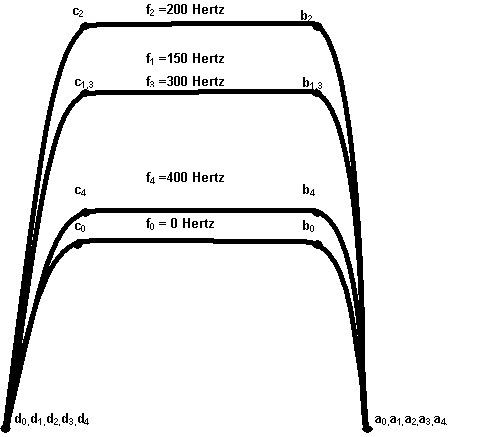
Figure 4. Change the speed of drying of low-fat
milk in a thin layer of moisture content at different frequency impulses: “a – b” – 1 period of drying, “b – c” – 2 period
of drying, “c – d” – 3 period of drying
Literature
1.
Burlev M.Ya. Nikolaev N.S. Playscheschnik P.I. Drying
of biological objects in the field of weak effective impacts. / The problem of
improving the refrigeration technique and technology: Collection of scientific
works V scientific-practical Conference with international participation. – M.
Moscow State University of Food Industry, 2012. - P. 189-192.
2.
Burlev M. Ya., Nikolaev N.S Induction of electrical impulses in
biological objects in the phase transition of the first kind / Scientific
research in perspective. // Sofia, Bulgaria. 07 – 15 February – 2013. – P. 48 –
52.
3.
Ivashov V.I., Yurkov V.I., Ilyukhin V.V., Dujdenko
B.N., Katuyhin V.A. Laboratory workshop - tutorial. / - Moscow Technological
Institute Meat and Milk Industry, 1987. – p. 60 - 75.
4.
Ilyukhin V.V. Burlev M.Ya. Production of skimmed milk
powder by using electrical impulse of weak impacts / Journal “The dairy
industry”. - 2001. – № 9. - p. 57 - 58.
5.
Ginsburg A.C. Basic theory and technology of drying of
food products. - Moscow.: 1973. - 664 p.
6.
Lurie, M.Yu. Drying process. - Moscow:
Gosenergoizdat, 1978. - 711 p.