NEW
VIEW ON DESIGN OF EQUESTRIAN COMPLEXES
The turn of the XX-XXI centuries is a transition period from the
post-industrial era to the information era which is characterized by change of
scientific and philosophical paradigms, deep penetration of equipment into all
spheres of life and formation of mass cornerstone at the heart of which lies
postmodernism and consumption philosophy. We observe the globalization period
together with growth of requirements of society, the role of external factors
promptly increases. High rates of development of the new technologies, the
fields of activity of people focused on expansion, stratification of life
priorities, mobility of the population, illegibility and vagueness of social
borders, in many respects define essence of science, economy, engineering, art
and architecture. There are actual new methods of design and construction where
research of an architectural form, first of all, considers changes of
requirements of society and allows to provide change and project adaptation
depending on the functional importance of object and its environment.
In modern architecture the transition tendency from construction of
monofunctional buildings multipurpose one is distinctly traced. Than buildings
and complexes becomes more increasing, their functional structure more and more
become complicated every year. In the first half of the 20th century various
functions of activity of the person were divided for the most full-fledged organization
of each of them. As E. Tsaydler in the book "Multipurpose
Architecture" writes: "… in this process a developing the main qualities
of city life - difference and contrast were lost. For completion of this losing
it isn't enough to connect again functions among themselves, it is necessary to
study each of main types of activity of the person —work and rest separately,
and then in interaction to understand how they can be connected in a
multipurpose construction".
So far in design and construction of various livestock architecture
including horse-racing, the main attention was paid to economy questions,
rationing, the equipment and questions of the general architectural image. The
general recommendations and norms on construction of equestrian complexes (as a
complicated structure), except separate reference information aren't present.
Now in Moscow there are some horse-riding clubs which use an hippotherapy. All of them aren't constructed
according to the separate projects, considering requirements for handicapped
groups of the population and doesn't consider the feature of a medical
component of a complex. Trainings for patients and disabled people in the
majority of the centers take place at arenas that were built only for healthy
riders as a result - experts work is complicated. Also the problem of access to
such complexes for handicapped groups of the population was clearly designated.
In most cases there are no ramps. Tribunes are arranged in calculation only on
the healthy audience, and the disabled person, come to look, won't be able to
make it. In opinion doctors involved in hippotheraphy besides convenient ways
of access, it is necessary to provide a restroom and massage offices.
Due to the saturation by new functions the planning structure of modern equestrian
complexes is chaotic. The most difficult for the architect is the
problem of definition of balance of interrelations of space where the horse
with space of activity of the person, in particular for handicapped groups of
citizens lives. The problem of creation
of concepts of the centers where creation of special complex rehabilitation
environment – integration into their structure of a Spa centers and the
rehabilitation centers will be fundamental idea is also important.
Architectural and spatial environment of equestrian complexes forming as
a result of interaction of the nature, social inquiries, biological features of
people and animals. As a whole, a number of the factors influencing on complex generation, it is possible to divide
into global KSK defining typology and local, forming KSK at the level of the
certain settlement. According to architectural typology all system of the
factors forming a complex, the author suggests to subdivide into aspiration
factors (public requirements); overcoming factors ( nature and climate);
originality factors (national features) and restriction factors (social
economics). Change of requirements of modern society (aspiration factors) – the
main reason for gradual transformation of production constructions of rural
type what horse-racing constructions, to multipurpose public buildings
historically were.
Development of hippotherapy allowed to unite sports and medical
components in one object. There was such direction as the medical riding. ParaOlympic
equestrian sport became the newest discipline of the International Federation
of Equestrian Sport. Now a ParaOlympic dressage – the only type of equestrian
included in the program of ParaOlympic Games; jumping and driving (races on
carriages) while only gain strength as it is types more difficult for the organization.
For people with deviations in intellectual development the Special Olympic
Games which purpose consists in helping such people to become the full members
of society who are actively participating in public life, to give them equal
opportunities for demonstration of the skills and talents in the conditions of
sports competitions and to inform the public on their opportunities and
requirements are held. Recently to this area go not only sponsor's, but also
venture investments that allows to assume and further development of a medical
orientation of modern horseriding complexes.
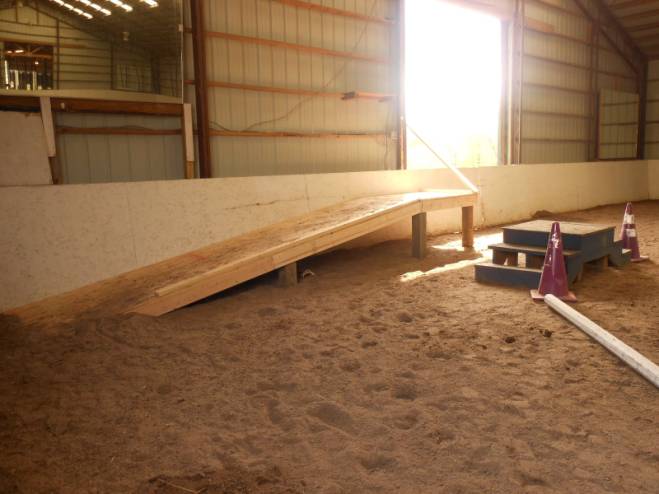
a wheelchair ramp so the
patient can be transferred to the horse
easily
Hippotherapy is a form of rehabilitation at which gymnastic exercises on
a horse practice. In the West a method of hippotherapy consider as one of the
best on complex impact on a physical and emotional condition of the person. In
Europe hippotherapy began to develop intensively in the last 30-40 years: at
first in Scandinavia, then in Germany, France, Holland, Switzerland, Georgia,
Great Britain, Poland. The centers for hippotherapy began to open in many
countries of the world. In the USA today works more than 1000, and in Great
Britain – about 700 groups in which more than 26 thousand people are revitalized.
In France are engaged in training of such specialists: the hippotherapy faculty
at the Parisian university of sports and health was open.
Carrying out horse-racing competitions in various directions (a
dressage, jumping, driving, etc.) and escalating popularity of horse theater
turns this kind of buildings into the spectacular building with the developed
spectator group. Broad development was gained by Horse theater. We will
consider change of a functional purpose of rooms in this buildings on the example
of Bartabas's academy in Versailles. Besides horse-barns of the last centuries,
there was the whole set of rooms directly not connected with the maintenance of
horses. Special educational rooms concern to them for training of equestrians
of choreography, to music, drawing and a sculpture. In Russia while analogs of
such complexes aren't present, for horse performances or tours arrange tents,
but it limits the period of work of horse theaters of Russia to the warm period
from April to October.
Ideas of sustainable design also added a number of new functions. The projects based on idea of maximum use of own resources, such as
application of biogas installations as a power source from environmentally
friendly waste of farms (the project in the settlement Catoire near Moscow) and
creation of own food supply (the project in Alekino's village) started
appearing.
The majority of horse clubs is removed from the cities owing to what,
there is a need for the housing device for it.
Most often the territory includes hotels, however practice shows that,
at all without looking at a ban according to sanitary standards, over stables
premises are arranged.
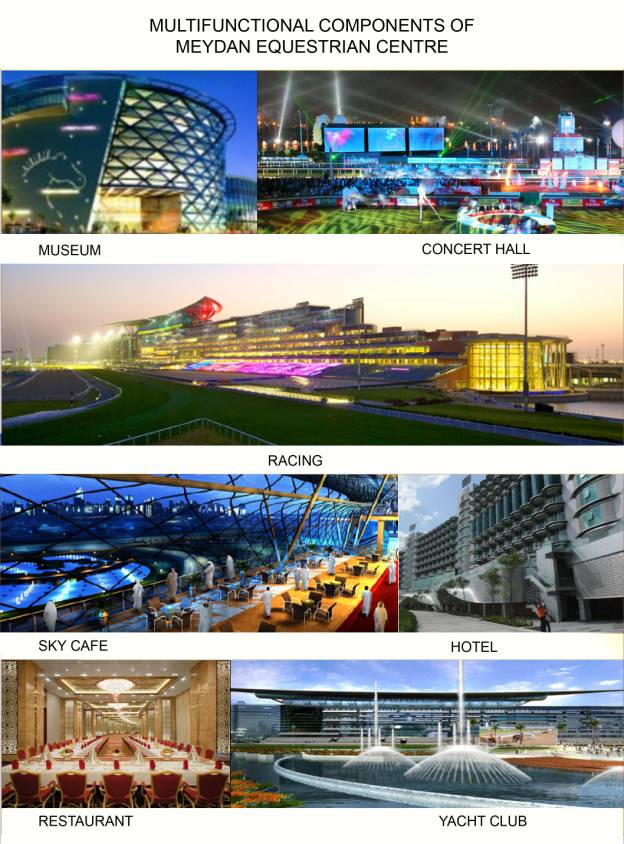
Equestrian club's arrangement far from the cities turns them into some
kind of regional leisure centers that also sates these objects with additional
functions. There are as a part of SPA centers complexes with pools, rehabilitational
centers, restaurants, conference centres, mini-zoos. Popularity of active
leisure became the association KSK reason with golf clubs, paintball clubs, ski
resorts (Leonid Tyagachev's Club).
Large complexes represent a
self-sufficient complex that causes the necessity of the structure of
veterinary clinics for their structure.
However, the veterinary clinic calculated only on treatment of horses,
doesn't pay back itself that causes the necessity of the device also a
reception for small animal.
When forming volume and spatial structure of KSK by the author the
following principles are revealed:
А). The principle of compactness of space-planning structure of blocks
of a basic purpose (horse barns, workout, arenas) which the energy expenses at
the expense of a minimize perimeter of external walls and the extent of
internal communication ways also.
B). The principle of minimization of extent of communications - in
placement of engineering rooms close to
the block of auxiliary rooms (a laundry place, drying, the feed-preparation house)
C). The principle of rational autonomy influencing extent of blocking of
groups architectural elements in creation of volume and spatial structures of the
main buildings of the complex.
D). The choice of methods of structure forming and composition on the
site depend on amount of horses. Change of composition scheme from simple to
difficult multivolume and further - multi objects, in process of increase in
power of the enterprises (20, 40 and more than 50 horses) is noted.
E). The principle of ecological positivity of design objects, which based
on forecasting of consequences of inclusion of new object on the urbanized environment.
Bibliography
1 . Norms of technological design of the Horse complexes NTP-APK 1.10.04.001-00; Moscow 2003
2 . Norms of technological design of veterinary objects for country
farms. Moscow 1995
3 . SanPiN 2.2.1/2.1.1.1200-03"; Moscow 2003
4 . Norms of technological design horse sport complexes NTP-APK
1.10.04.003-03; Moscow 2003
5. Sports constructions under L.V. Aristova's edition; "SportAcademPress"
Moscow 1999
6. Mezentseva N. B. The main tendencies in scientific researches and
design of sports constructions. Moscow, TsNIIEP of educational
buildings, 1990