Korniyenko B.Y.
National aviation university, Ukraine
Research the two-phase models of the dehydration and granulation
in a fluidized bed
Granulation process are varied on methods
for their implementation, and on the hardware design. One of the promising methods
is receiving a granular product in a fluidized bed apparatus. The essence of
this method is applying the liquid phase on the surface of fluidized bed.
Solution disperses inside fluidized bed or distributed over its surface
evaporation in the previous flare spraying or without him. This makes it
possible to combine a number of stages of the process (neutralization,
evaporation, crystallization, drying and granulation) in one device that
determines the significant technical and economic effect. It can maximize the
heat of chemical reactions, which further determines the economic feasibility
of the method.
It should be noted, that the granulation
in fluidized bed (particularly when multicomponent fertilizers is received) is
a complex physico-chemical process, during which the intensity depends on many
factors. These factors primarily include patterns of fluidized bed
hydrodynamics, regulation disperse composition of the finished product, and the
intensity of the flow of heat-mass transfer processes. The complex nature of
particle motion in the flow of coolant gas in a fluidised bed granulator can be
represented in the form of two-phase flow [1].
The purpose of this article is
researching a mathematical model for determining the temperature fields during
the intense heat and mass transfer processes in the production of mineral
fertilizers in a fluidized bed granulator.
Complex multifactorial process of solid
composites with liquid systems can be divided into two stages: the first -
transport processes in the interfacial contact and making mass crystallization
with simultaneous formation of solid composite as spherical granules and the
second - the organization of the process in dispersed systems using techniques
of fluidizing.
The main requirement in creating
composites with desired properties which contain mineral and organic matter, is
the uniformity of their distribution throughout the volume. In the case of
waste water solutions of ammonium sulfate production of caprolactam to create
granular nitrogen fertilizer humic new generation of the most appropriate mass
crystallization from liquid systems that simultaneously contain both chemical
substances. The intensity of the supply of heat to the liquid phase and the
colloidal particles of organic matter determine the size of the microcrystals
at 10-7-10-6 m.
The most effective way to implement the
mechanism of formation of mineral-humic solid composites are fluidized bed
apparatus. This device will combine a number of necessary technological stages
with a coefficient of thermal energy more than 60%.
The peculiarity of these processes is the
presence of a phase transition. That supply the required amount of heat to
evaporate the solvent, the formation of a layer of microcrystals and fixing
them on the surface of the particles.
The main
requirements of the process is the formation of superfine liquid film by
adhesive forces and sorption on the surface centers granulation.
In view
of the above, the physical essence of adhesively-sorption method dehydration
and granulation liquid composite systems is fine spraying liquid composite
systems inside fluidized bed, which achieved almost complete saturation pairs
of moisture agent (coolant) and heavy traffic hot particulates through this
area. As a result, the surface of the granules formed by the action of adhesive
forces and sorption ultrathin film of liquid.
Further transferred to the particulate
relaxation zone where distributed between dry granules. In this case heated dry
granules give warmth wet granules, accompanied by partial evaporation of
moisture. As a result, all the beads in contact zone of intense heat and mass
transfer at the gas-distributing device absorbs heat energy wasted by
evaporation and creating micro bed dry matter on their surface. This prevents
them from overheating. The described cycle is repeated repeatedly.
Consequently, the grain structure is a frame of microcrystals mineral
substances which are deposited on the surface of colloidal particles of organic
impurities.
For multivariate modeling processes of
dehydration and granulation in fluidized bed is used two-phase Euler-Euler
model [1]. For each phase account for mass transfer between phases,
availability and lift forces acting on a particle - friction, pressure forces,
gravity forces Archimedes adhesion of particles on the phase boundary.
Transport equation temperatures granules
taken into account convective heat transfer, solid phase voltage, flow
fluctuation energy scattering energy collisions, the energy exchange between
the phases. It is possible to determine the intensity of the interaction of the
gas (solid) environment and solid particles (dispersed phase) at different
hydrodynamic regimes and the corresponding temperature change granules during
dehydration and granulation [2].
Mathematical model [2] takes into account
the peculiarities of the process, but the large amount of calculation time
complicates its use in driving the process of dehydration and granulation in
fluidised bed in real conditions.
Therefore we propose a simplified mathematical
model, that is almost the same as model above, but significantly improves its
adaptation in driving the process of dehydration and granulation in fluidized
bed.
The mathematical model takes into account the Complex of the
process, which is accompanied by a phase transition, is complicated by the
formation of a liquid phase on the surface of the granules with the subsequent
release of the liquid phase and the formation by mass crystallization layer
microcrystals of soluble phase.
In this approximation, the two phases - solid and dispersed
- modeled as two interpenetrating solid. Phases interact continuously in time
and space. This principle is applied in the continuous averaging to local
instantaneous momentum and energy equations.
Energy equation for the temperature of the emulsion T1
and gas bubbles T2:
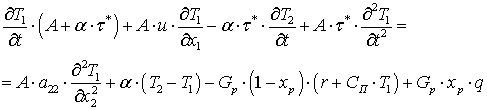 ;
(1)
;
(1)
 ; (2)
; (2)
where A - share volume of a layer occupied by emulsion
phase; B - share volume layer occupied by loops bubbles; u, v - speed emulsion
and gas phase, m/s; r - heat of vaporization, J/kg; q - heat released by
crystallization solution, J/kg.
Using equations (1) - (2) we are
calculated the main characteristics of the emulsion temperature dehydration
unit and fluidized-bed granulation. The height of apparatus H (x1)
and width device L (x2) is a dimensionless quantity.
Left and right wall of the apparatus
considered as adiabatic for both phases of fixed temperature 373 K for both
phases. At the top of the layer of emulsion phase adopted a continuous wall
with leak.
A mathematical model adequately describes
the dynamics of coolant temperature and the emulsion layer height during heat
mass transfer processes in moving granular material through the irrigation
zone, intense heat and mass transfer relaxation, in which a layer of dry matter
of microcrystals minerals.
The variation of
temperature can knit connection with physical and mechanical properties of
granules, which determine the quality of the resulting product. Therefore, this
mathematical model can be used to create an effective system of control in the
formation of mineral fertilizers in the fluidized-bed granulator.
Bibliography
1.
Korniyenko B.Y. Features modeling of transport processes in disperse systems / B.Y. Korniyenko // Journal
of the National Technical University of Ukraine "Kyiv Polytechnic
Institute" series "Chemical engineering, ecology and resource
conservation". – 2011, № 2(8). - P. 5-9.
2.
Korniyenko B.Y. The dynamics of the processes of dehydration and granulation
in fluidized bed / B.Y. Korniyenko // Journal of the National Technical
University of Ukraine "Kyiv Polytechnic Institute" series
"Chemical engineering, ecology and resource conservation". – 2012, №
1(9). - P. 15-19.