Isochoric Heat Capacity and Tρ Dependence of Cooling Agents along the Phase Equilibrium Line Alkhasov A. B., Dvoryanchikov V. I.,  Rabadanov G. A. and Ramazanova D. P.  Institute of Geothermal Problems, Dagestan Scientific Center, Russian Academy of Sciences, pr. Shamilya 39a, Makhachkala, 367003 RussiaE-mail:  vasiliy_dv01@mail.ru  Abstract: The entropy data were used to calculate the isochoric heat capacity along the phase equilibrium line. The rules governing the thermodynamic properties of cooling agents and possible alternative mixture variants were analyzed. Keywords: isochoric heat capacity; cooling agents.   Because of their toxicity, corrosion activity, and inflammability, ammonia, ethers, and sulfurous anhy dride do not suit consumers who use cold for domestic and industrial purposes. Transition cooling agents appeared; these are binary, ternary, and even quarter  nary mixtures of the known Freons that do not destroy ozone. New cooling agents with the required proper  ties were synthesized. They are largely based on R125, R32, R134a, R143a, etc. cooling agents. In certain cases, propane, butane, isobutane, and ethers [1] are added to them. One of the advantages of thermal pump units is their universality with respect to the power level, from fractions to dozens thousands kilowatt units. The use of thermal pumps offers much promise in combined systems together with other technologies for use of renewable energy sources (solar, wind, bioenergetic, etc.), because it allows the parameters of conjugated systems to be optimized and the highest economic performance to be attained. These advantages of ther  mal pumps explain their extensive use in developed countries and the world at large. In Russia, the introduction of thermal pump units encounters difficulties. Mainly, high power (100– 1000 kW) machines are installed. Currently, 20 MW aggregates are developed. The main problem of the introduction of high power thermal pump units is the absence of the required efficiency if the circuitry is not worked out fairly well and the source parameters are selected poorly [2]. Studies of the thermophysical properties of cooling agents that allow the effective ness of heat engines to be increased are therefore of considerable interest. The search for new mixtures is based on binary compositions whose components have substantially different normal boiling temperatures and ternary mixtures with intermediate component boiling temperatures. The appearance of new working substances required studies of their thermophysical properties, largely by numerical methods. There are very few experimental studies, especially for mixtures ([3,4,7-9] etc.). The data on liquid–vapor phase equilibria over the whole concentration range, liquid and vapor den  sities, p–V–T dependences, heat capacities of mix  tures, and the transfer properties of gaseous mixtures and solutions are of importance.  The purpose of this work was to analyze the rules governing the thermodynamic properties of cooling agents and possible alternative cooling agent mixture (two  and three component) variants. These rules are of importance for the selection of heat transfer agents, the construction of phase diagrams, calculations of cycle parameters, and the optimization of cooling machine (thermal pump) operation.
  CV,  kJ/(kg K)        
8        
6        
4        
2        
0        
300 320 340 360 380
        T,  K
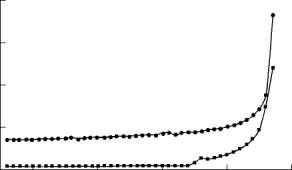
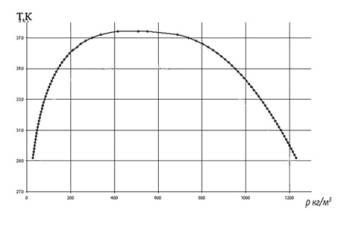
Fig. 1. Calculated heat capacities of Freon R134a along the phase equilibrium line.        Fig. 2. Phase equilibrium curves [5] for Freons (1) R134a

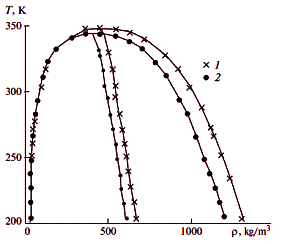
Fig. 3. Phase equilibrium curves [5] for Freons (1)R402A and (2) R404A. The literature entropy data were used to calculate the isochoric heat capacities C''v and C'v along the phase equilibrium line by equation:S2  S1     =  CV ln ( T2 / T1 ).


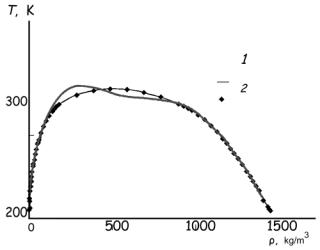
 The isochoric heat capacities C'v and C''v of Freon R134a along the phase equilibrium line were calculated over the temperature, density, and pressure ranges 290–374.18 K, 26.9–1229.2 kg/m3, and 0.064–4.06 MPa from the entropy data [5], respectively (Fig. 1).  The R134a Freon coexistence curves are shown in Fig. 2. The Tρ values close to the critical point of Freon R134а were determined graphically [6]. A similar procedure was used to determine the isochoric heat capacities of the R227ea, R401A, R404A, R402A, etc. Freons. The curves of the coexistence of the R402A and R404A Freons are shown in Fig. 3. The Tρ values close to the critical points of the R402A and R404A Freons were also determined graphically. Attempts to describe the phase equilibrium curve by polynomials of degrees n = 5 and 6 for Freon R402a gave very approximate results [7] (Fig. 4). Satisfactory results were obtained graphically. The critical parameters determined this way are listed in Table 1. It was found empirically that the γ(T) = (ρ' + ρ'')/2 function was a linear function of the temperature of saturation. The extrapolation of this experimental dependence to T = Tc c yields the corresponding ρc value (Fig. 3). Note that the critical densities obtained this way are as a rule exaggerated. This explains deviations from the “rectilinear diameter” rule (linearity of the γ(T) function) as we approach the critical point. This method only allows approximate ρc values to be obtained [8].


 Fig. 4. Phase equilibrium curves [5] for Freon R402A: (1) experimental and (2) calculated (n = 5)                                                                                                                                                                               

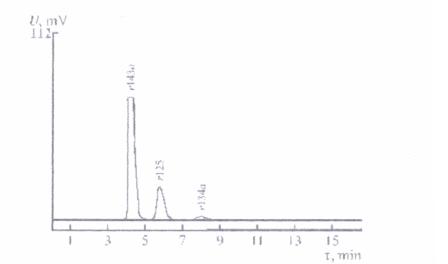
C:\Users\Admin\Desktop\111.jpg Fig. 5. Chromatogram of the   R404A  (Forane FX 70) cooling agent.     Studies of the thermophysical properties of cooling agents and possible alternative mixture variants   are of importance for the selection of heat transfer agents, the construction of diagrams and calculations of cycle parameters, and the optimization of heat engine or thermal pump operation. The data on  the isochoric heat capacity of Freons can be used for optimizing the operation of thermal pumpsthat use coolants as heat transfer agents in a secondary circuit for heat removal with the use of geothermal sources.     We studied samples of the R404A cooling agent (trade name Forane FX70) produced in Spain under license from Arkema (France) for the subsequent experimental determination of the CV heat capacity on an adiabatic calorimeter and a Khrom5 chromatograph with a flame ionization detector and a 3.7 m column packed with chromatron N-AW. The results obtained are shown in Fig. 5.     The composition of the samples was 52.410 wt % R143a, 43.700 wt % R125, and 4.322 wt % R134a. This closely corresponds to the GOST R certificate R404A (R125 (CF3–CHF2)/R134a (CF3–CH2F)/R143a(CF3–CH3)  =  44/4/52).    The appearance of new working substances required studies of their thermophysical properties  and the creation of a bank of data on the  properties of cooling agents. A large number of  binary, ternary, and quaternary cooling agent  compositions was suggested. These compositions  find wide applications in the creation of new  aggregates used in  industry and everyday life.    Table 1. Critical parameters of cooling agents that do not destroy ozone 
Cooling  agent Tb,  °С  [1] Тc ,  К ρc ,  kg/m3
       
R  134а 26.2 374.18  [5] 508.00  [5]
R  401А 33.1 381.25 510.60
R  402А 49.2 349.00* 500.00*
R  404А 46.5 345.20* 485.00*
R  407А 45.5 351.00* 500.00*
       
 Note:   The values obtained graphically are labeled by asterisks.  INTRODUCTION Analysis of the thermodynamic properties of refrigerants and possible alternative mixtures is an impor tant practical problem. The safe freons of the new generation of methane, ethane, and propane series are, along with their mixtures (Table 2), considered the most promising substituents of conventional chlorine containing freons [10].The aim of this work is to perform an analysis of the thermodynamic properties of refrigerants of a propane series.     EXPERIMENTAL Based on data on the entropy of HFC 227ea freon [11], we calculated the C''V and C'V values of isochoric  heat capacities on the line of phase equilibrium over the temperature range of 245.15 to 375.04 K and densities of 5.17 to 589.99 kg/m3 according to the isochore in the ТS coordinate system:

 Table.  2.    Ozonesafe  refrigerants  of  a  propane  series


Refrigerants

      Formula

Tboili,°C

 Tcritical, K

Pcritical, MPa

ρcritical,  kg/m3

R218

R227ea

R227ca

R236ea

R236fa

R245ca

R290

R1270

Ethyl methyl

ether

Trimethylamine


CF3–CF2–CF3

CF3–CHF–CHF3

CF3–CF2–CHF3

CF3–CHF–CHF2

CF3–CH2–CF3

CF3–CF2–CF2

C3H8

C3H6


C3H8O

C3H9N

–36.1

–17.3

–16.0

6.5

–0.7

25.0

–41.6

–47.73


7.45

     3.0

345.05

375.04

412.4

369.85

365.05


437.8

432.79

2.677

2.930

3.412

4.248

4.640


4.430

4.087

628.0

589.99

227  ± 2

230.0


272.0

232.7


Table.  3.    Thermodynamic  properties  of  HFC  227ea  Freon        


   T,  K    ρ' .  10 –3  kg/m3         ρ'' . 10 –3 ,kg/m3   C'V ,  kJ/(kg  K) C"V ,  kJ/(kg K)


245.15 1.5842   0.0051675   1.210 0.2669


250.15 1.5677   0.0064448   1.219 0.2893


255.15 1.5508   0.0079646   1.228 0.3093


256.728 1.5454   0.0084998   1.236 0.3229


260.15 1.5336   0.00975954   1.241 0.3308


265.15 1.5158   0.0118630   1.249 0.3431


270.15 1.4977   0.0143120   1.261 0.3398


273.15 1.4866   0.0159650   1.271 0.3695


275.15 1.4791   0.0171480   1.278 0.3743


280.15 1.4601   0.0204110   1.288 0.3843


285.15 1.4405   0.0241510   1.303 0.3969


290.15 1.4204   0.0284210   1.318 0.4091


295.15 1.3997   0.0332800   1.336 0.4203


300.15 1.3785   0.0387970   1.355 0.4317


305.15 1.3566   0.0450500   1.376 0.4419


310.15 1.3349   0.0521060   1.399 0.4510


315.15 1.3102   0.0601560   1.426 0.4596


320.15 1.2857   0.0692520   1.455 0.4670


325.15 1.2600   0.0795870   1.488 0.4737


330.15 1.2329   0.0913680   1.528 0.4784


335.15 1.2043   0.1048600   1.572 0.4810


340.15 1.1737   0.1204400   1.626 0.4815


345.15 1.1405   0.1385900   1.692 0.4770


350.15 1.1041   0.1600600   1.774 0.4663


355.15 1.0632   0.1860000   1.883 0.4458


360.15 1.0155   0.2184000   2.035 0.4049


365.15 0.9566   0.2613000   2.269


370.15 0.8739   0.3258600   2.714


371.15 0.8512   0.3258600   3.231


372.15 0.8243   0.3663200   3.555 0.4276


373.15 0.7905   0.3945300   4.058 0.8279


374.15 0.7417   0.4360300   5.039 1.7346


375.04 0.58999   0.5899900   14.215 6.6801


Table.  4.    Thermodynamic  and  thermal  properties  of  propane  (ρ,  kg/m3)          
               
T,  К P,  MPa ρ'  [14] ρ''  [14] ρ'  [13] ρ''  [13] СV ,  J/(g  K)  
     
[14] [13]  
             
                 
270.15 4.427 539.9       1.627    
270.67   531   1.645  
275.15 7.953 539.6       1.616    
280.15 11.458 539.3       1.617    
285.15 14.939 539.0       1.647    
290.15 18.398 538.7       1.666    
295.15 21.836 538.4       1.691    
300.15 25.251 538.1       1.692    
305.15 28.640 537.8       1.686    
310.15 6.561 490.3       1.691    
315.15 9.049 490.1       1.706    
320.15 11.532 489.8       1.727    
325.15 14.008 489.6 454.8     1.732    
330.15 16.475 489.3 454.6     1.738    
330.59 436   1.828  
335.15 18.934 489.1 454.3     1.744    
340.15 21.386 488.9 454.1     1.751    
345.15 23.827 488.6 453.9     1.731    
350.15 26.253 488.4 453.7     1.758    
355.15 28.668 488.2 453.5     1.756    
366.66 306   2.192  
369.86 229   3.323  
Tcritical  = 369.95 Ркр  =  4.200 ρcritic = 227 ± 2            
369.88     224 4.052  
368.28     159 2.903  
375.15 5.095 301.1       2.236    
380.15 5.744 301.0       2.110    
385.15 6.404 300.9       2.032    
390.15 7.072 300.8       1.952    
395.15 7.746 300.7       1.924    
400.15 8.425 300.6       1.824    
405.15 9.109 300.5       1.788    
410.15 9.795 300.4       1.814    
420.15 11.176 300.2       1.810    
425.15 11.869 300.1       1.854    
 

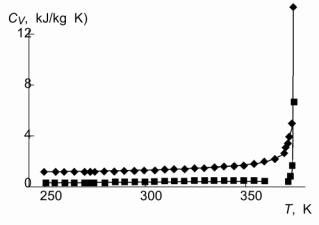
 Fig. 6. Calculated values of heat capacity of HFC 227ea freon

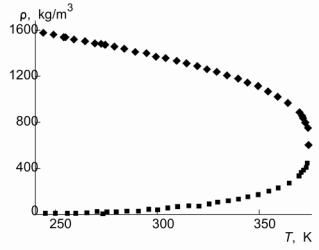
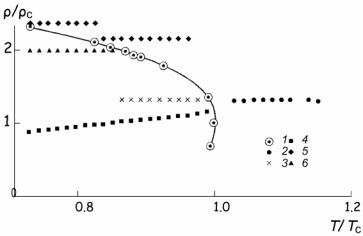
on the line of phase equilibrium.     Fig.7.    Line of phase equilibrium of HFC 227ea freon[6]. Fig.  8.  Line of phase equilibrium of R290 (propane) in the given coordinates: (1) the results from [13]; (26), the results from [14].


    The calculated values of C''V and C'V isochoric heat capacities on the line of phase equilibrium (Table. 3) are given in Fig. 6. The line of phase equilibrium of HFC 227ea freon is given inFig.7. The critical parameters of system are Тc = 375.04 К, and ρc = 589.99 kg/m3. Interest in studying the thermal and volume properties of propane remains strong [12–16]. Various ways of measuring are used that yield satisfactory results when compared. Of special interest are mixtures of propane with isobutene, propylene (as a heat carrier in heat pumps), and other refrigerants: R402A, R402B, R403A, and R403B (as a refrigerant in refrigerating equipment). Natural refrigerants can substitute for R404A, R134A, and R407C, while others can reduce the refrigerant load, thus saving electricity.Existing experimental data on thermodynamic and transfer properties of mixture refrigerants are limited and often contradictory [10]. Measurements of isochoric heat capacity СV for propane were performed by Anisimov et al. at the Gubkin Russian State University of Oil and Gas. The purity of the propane was 99.98%. The measurements of heat capacity were performed on six isochors: 0.159, 0.224, 0.229, 0.306, 0.436, and 0.531 g/cm3 in the temperature range of 80 to 374 K. The maximum relative error of the obtained heat capacity values were 0.48% far away from the transit point of the coexist ence curve and 1.5% nearer to it. At density ρ = 0.159 g/cm3, the maximum relative error of heat capacity values rose to 0.68%; near the transit point, to 2% [13]. In [14], the error of determining the heat capacity was ±3.2% on the line of phase equilibrium and ±4.8% in the critical range. The measurements of heat capacity were performed in the temperature range of 270 to 425 K. In Fig. 8, we see a comparison of the results on the dependence of density vs. temperature of propane, in the coordinates given in [13]. The results from comparing the measurements on isochoric heat capacity are given in Table 4.    CONCLUSIONS Studies of the heat and physical properties of refrigerants and possible alternative mixture variants are important in selecting a heat carrier, plotting diagrams and calculating the parameters of a cycle, and optimizing the functioning of refrigerators and heat pumps. Data on the isochoric heat capacity of freons can be used for to optimize heat pumps that employ refrigerants as heat carriers in the secondary heat line when using geothermal sources [6].  REFERENCES 1.     Tsvetkov O. B.  and  Laptev Yu. A., Khim. Komp. Modelir., Butler. Soobshch., Att.,       No 10, 54 (2002). 2.     Ermakov A. M., Extended Abstract of Candidate’s Dissertation in Technical Science        (Kazan, 2007).  3.   Magee J. W. Int. Thermophys. 21, 151 (2000). 4.   Baginskii A. V., Stankus S. V. and Kosheleva A. S, Teplofiz. Aeromekh. 11, 647 (2004). 5.     Sahverdiyev A. N. and Quliyev H. M.  Alternativ Soyuducu Agentler Veqarisiqlar (Baki,       2002).6.     Dvoryanchikov V. I., Thermal Field of the Earth and Methods of Its Study, Collected         vol. (2008), p. 79. [in     Russian].  7.   Demidovich B.P.  , Maron I.  A.    and    Shuvalova E.  Z.  , Numerical Methods of         Analysis (Fizmatgiz, Moscow, 1963) [in Russian]. 8.    Spielrein E.E. and Kesslman P.M.,  Fundamental Principles of the Theory of   Thermophysical          Properties of     Substances  (Moscow, 1977) [in Russian]. 9.     Dvoryanchikov V. I.  and  Rabadanov G. A., Zh. Fiz. Khim. 84, 1009 (2010) [Russ. J. Phys.         Chem. A 84,  010)]. 10.    Stankus S. V.,  Baginskii A. V.,  Verba O. I., et al., in Proceedings of the 12th Russian         Conference   on Thermophysical Properties of Substances (2008) p. 41.11.    Chen Z. S., Hu P., and  Cheng W. L., in Proceedings of the 15th Symposium on Thermophysical         Properties(Boulder, CO, 2003), p. 398.12.    Amirkhanov Kh. I., Levina L. N., and  Zakar’yaev Z. R., in Thermophysical Properties of           Substances and Materials (Izdvo Standartov, Moscow, 1982), p. 24 [in Russian].13.    Anisimov M.  A.  ,  Beketov V.  G.  , Voronov V.  P.  ,  et  al., in Thermophysical  Properties  of            Substances and  Materials (Izdvo Standartov, Moscow, 1982), p. 48 [in Russian].14.       Kitajima N., N. Kagawa, S. Tsuruno, J. W. Magee, and K. Watanabe, in Proceedings of the            15th  Symposium on Thermophysical Properties (Boulder, CO, 2003), p. 567.15.    Lim J. S., Ho Q. N., Park J. Y., and Lee B. G., in Proceedings of the 15th Symposium on         Thermophysical Properties (Boulder, CO, 2003), p. 3597. 16.    Higashi Y., in Proceedings of the 15th Symposium on Thermophysical Properties (Boulder,         CO, 2003),  p. 467.    
ФИО Дворянчиков Василий Иванович
Название статьи Isochoric Heat Capacity and T-ρ Dependence of Cooling Agents along the Phase Equilibrium Line
Рубрика Технические науки. Химическая термодинамика.
Телефон (с кодом) 89634115657
E- mail vasiliy_dv01@mail.ru
Адрес (домашний) г.Махачкала, ул. Карабудагова, 7.
Индекс 367000
 

Алхасов Алибек Басирович – доктор тех. наук, Институт проблем геотермии,  Дагестанский научный центр, Российская академия наук.

Дворянчиков Василий Иванович – доктор тех. наук, Институт проблем геотермии,  Дагестанский научный центр, Российская академия наук. E-mail: vasiliy_dv01@mail.ru

Рабаданов Гаджи Аппасович – кандидат  хим. наук, Институт проблем геотермии,  Дагестанский научный центр, Российская академия наук.

Рамазанова Динара Пашаевна – аспирант, Институт проблем геотермии,  Дагестанский научный центр, Российская академия наук.

Alkhasov  A. B. - Doctor of Technical Sciences, Institute sor Geotheemal Problems of the Dagestan Scientific Centre of Russian Academy of  Sciences.

Dvoryanchicov V. I. – Doctor of Technical Sciences, Institute sor Geotheemal Problems of the Dagestan Scientific Centre of Russian Academy of  Sciences.

Rabadanov G. A. – Candidate of Chemical Sciences,  Institute sor Geotheemal Problems of the Dagestan Scientific Centre of Russian Academy of  Sciences.

Ramazanova D. P.  - postgraduate,   Institute sor Geotheemal Problems of the Dagestan Scientific Centre of Russian Academy of  Sciences.


 Institute sor Geotheemal Problems of the Dagestan Scientific Centre of Russian Academy of  Sciences. Makhachkala, pr. Shamilya, 39a, 367030. Russian.