Ph.D. Sapa Vladimir, student Politayeva Irina
Kostanai State University A.Baitursynov, Kazakhstan
Phase
and antiphase interference
From interfering
in the wires may be considered as in-phase and anti-phase voltages and currents.
Antiphase
(transverse) interference occurs between the wires or wire line between the
input terminals of the electrical devices (see Figure 1).
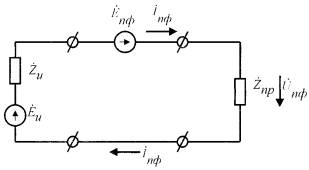
Figure 1. SSF-mode
interference in the circuit between the power of the desired signal receiver
Antiphase
interference occurs through galvanic or field communication or due to common
mode conversion in antiphase. Antiphase summed interference with the desired
signal and can cause erroneous operation of systems, and as they affect the
linear insulation between wires [1, 2].
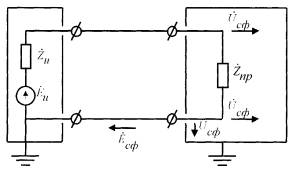
Figure 2. Esther common
mode circuit with grounded point
Common mode
(longitudinal) interference occurs between each wire and ground. Common mode
noise caused by the potential difference in circuits grounding devices (see
Figure 2).
Common mode noise
can be caused by currents in the ground (fault currents or lightning currents)
or magnetic fields. Common mode interference do not cause interference voltages
at the receiver, but the impact on the insulation of the wires relative to the
ground and can lead to breakdowns.
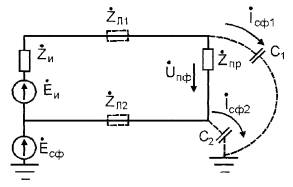
Figure 3. Conversion of
common-mode noise in antiphase
At high frequency
common-mode noise or for large values of capacitance with respect to ground
conductors common mode conversion occurs in antiphase (see Figure 2).
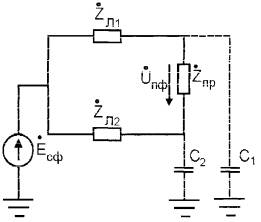
Figure 4. Experimental
determination of common-mode noise conversion in antiphase
Common-mode
voltage is in forward and reverse wire currents that through container and land
returned to power.
For different
values of the forward and reverse resistance of wires and different capacities
C1 and C, through capacity occur with different meanings currents
that create the voltage drop across the resistance of the receiver, and there
is a partial or complete conversion of common-mode noise in antiphase.
Measure the
degree of conversion to common mode conversion coefficient is antiphase
common-mode noise in antiphase [1, 2, 3, 4].
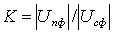 (1)
(1)
When complete
conversion of K = 1 and is symmetrical in the K = 0. Common mode conversion
coefficient in antiphase can be easily determined experimentally by removing
the source signal and submitting a short-circuited by the input common-mode
voltage system (see Figure 4).
Literature:
1. EMC Basics: a
textbook for high schools / edited by Doctor of Technical Sciences, Professor R
Karjakin, Altai State Technical University named after II Polzunova. - Barnaul:
JSC "Altai Printing Plant", 2007.
2. E. Habiger
Electromagnetic compatibility. The basis of its software in the art: Translated
from the German / I Kuzhekin; Edited by B Maximov. - Energoatomizdat, 1995. -
304.
3. Electromagnetic
compatibility in power engineering: Textbook / G Vagin, A Rags , A
Sevost'yanov. - Moscow: Publishing Center "Academy", 2010. - 224.
4. Usachyov A
Electromagnetic compatibility: Textbook / A Usachyov. - Ulyanovsk: 2001. - 44.