Dr.Sci.Biol. Arefjev Y.F.
Voronezh State Academy of Forestry Engineering, Russia
ECOLOGICAL-GENETIC
ASPECT OF SUPPRESSION OF THE PATHOGENIC FUNGI POPULATIONS IN FOREST
ECOSYSTEMS
Introduction
The urgency of
the given work is defined by necessary to radical restriction the application
of fungicides, and selective trees
cutting of the infected and died trees for protection of plantings against
pathogenic fungi. The purpose of these researches is to prove efficiency of the
ecological-genetic approach in radical preliminary protection of forest plants
against pathogenic fungi. It was established that survival rate of the
wildlings dropped with reduction gap size in forests. On the basis of results
of long-term researches in oak and pine forests of Central Russian
forest-steppe preventive measures on restriction of injuriousness of Oak
Powdery Mildew and a Annosus Root Rot are offered.
Materials
and methods
The research
was conducted in oak and pine forests of the Central Russian forest-steppe and in
forest cultures of educational-experiences forest enterprise of Voronezh State Academy of Forestry Engineering. Oak stands (age of 65 years) except an oak (Quercus robur) included an ash (Fraxinus
excelsior) – 20-50 %. Pine stands (age of 35-40 years) except a pine (Pinus sylvestris) included an oak (Q. robur) – 20-50 %. Mixed forest
cultures included pine (30-50 %), oak (30-50 %), birch (Betulae pendulae).
Response
of Erisiphe alphitoides Griff
& Maubl and Heterobasidion annosum L.
populations on isolation was studied in an mixed oak-pine and pine-oak-birch
forest. Quantitativ wildlings were estimated on 5 mark scale (Table 1).
Table 1. Estimation of wildlings placing on points
|
Points |
Average number of individuals on 1 m2 |
Indexes of occurrrnce |
|
4 |
> 5 |
Plentiful |
|
3 |
3 – 5 |
Average |
|
2 |
2 – 3 |
Rare |
|
1 |
< 2 |
Individual |
|
0 |
0 |
Absence |
Viability of trees and plantings was estimated
on 5 mark scale (Table 2).
Table 2. Estimation of trees and plantings
viability
|
Points |
State of tree health (on a crone and trunk condition), % |
Indexes of viability |
|
4 |
100 |
Total |
|
3 |
> 50, ср. 75 |
Heavy |
|
2 |
10 – 50, ср. 30 |
Moderate |
|
1 |
< 10, ср. 5 |
Llight |
|
0 |
0 |
Zero |
The basic test test object was the representative of an Ascomycota the Erisiphe
alphitoides Griffon & Maublanc, infecting oak with powdery
mildew. The additional test object was – representative of a Basidiomycota the Heterobasidion
annosum L., infecting pine with infecting pine.
Development illness rate was
defined under the following formula:
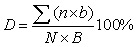
,
where
D – disease
development, %; N – total of the considered
plants; B – the highest
point on the accepted scale; n – number of plants of a certain point; b – a certain point.
Statistical analyses
Quantitative data examined by the one-way analysis of variance. Development
of Powdery mildew mycelium on the oak leaves was analyzed by means of χ2. The significance level used was P 0,05,
unless otherwise mentioned. The minimum necessary number (n) of concrete
estimations was defined under the formula:
0,05,
unless otherwise mentioned. The minimum necessary number (n) of concrete
estimations was defined under the formula:
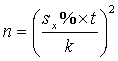 ,
,
where
sx % – Variation factor, t – Criterion of Stjudents, k
– accuracy of experience.
Результаты исследований и их анализ
It was established that survival rate of the wildlings
dropped with reduction gap size in forests. With respect to wildlings survival
and technologies of forest cultures creation the size of the open areas equal
≈ 0,25 hectare is optimum.
Response of wildling on ecological isolation occurs
through distinctions in development of Oak Powdery Mildew (Table 3).
Table 3. Development of the Powdery
mildew on oak in the conditions of opened and ecologically isolated oak
plantings
|
Conditions of
oak growth |
Development of the
Powdery mildew, % D ± |
Variability of an diseases development index, V % |
|
Open sites of oak plantings |
78,3±4,7 |
21,4 |
|
Ecologically isolated sites of oak plantings |
16,7±2,3 |
8,2 |
As appears from
the table 4, ecological isolation of sites of oak plantings by a pine, ash and
birch-tree on sites ≈ 0,25 hectares causes decrease in pathogen
development on the average in 4,7 times. Key parametres of generative
developments the E. alphitoides in
the conditions of isolation and open plantings of an oak are presented in table
4.
Table 4. Key parametres of generative organs
of the E. alphitoides in the conditions of isolation and open plantings of an oak
|
Conditions of oak growth |
Frequency of fruit bodies placing,
n/cm2 |
Average diameter of a
fruit body, µm |
Average length of
conidien, µm |
Average width of
conidien, µm |
|
Free infection |
64,3 ± 3,2 |
99,5 ± 5,3 |
32,7 ± 2,9 |
18,1 ± 0,9 |
|
Reproductive
isolation |
8,7 ± 0,6 |
74,4 ± 3,1 |
24,8 ± 1,6 |
13,7 ± 0,8 |
As appears from
the table 5, average values of key parametres of generative organs of E.
alphitoides by reproductive isolation is much less, than by free infection. This fact testifies to
easing of pathogen subpopulations in the conditions of reproductive isolation
on rather small spaces. It is effect of inbreeding depression. In this aspect,
the analysis of development of forest cultures in the forest cultures of the
Voronezh State Academy of Foresry Engineering is of interest.
In second half of 20-century, the
representative of basidiomycetes (H.
annosum) has intensively extended in pine cultures of
Central Russian forest-steppe. It was a great epiphytotic. Constant cutting
down of the sick and died trees upset the infected off H. annosum the pine cultures even
more. On the cut down sites of pine plantings there was a high infectious
background of the pathogen. It creates the big threat for the subsequent pine
cultures. With a view of overcoming of this threat in 1936 on the area of Voronezh State Academy of Foresry
Engineering, infected of pathogen, the mixed wood cultures in so-called ”chess
order” have been created. Since 1992 phytopathologic researches in these mixed cultures
and surrounding pure plantings of a pineare regularly conducted. The short characteristic
of investigated mixed forest culture is presented in table 5.
Table 5. The characteristic of investigated forest culture
|
Growth conditions |
Sandy dry soil |
|
Plantings surrounding object |
Сосновые насаждения с
высоким инфекционным фоном патогена H. annosum |
|
Structure of plantings |
In total 27 rectangular platforms have been
put. The size of each platform was 40 × 50
m (0,2 hectares). Pine platforms were adjoined directly by oak
platforms. Oak platforms were adjoined directly by pine
and birch platforms. Placing of trees in platforms was linear,
uniform. The sizes of row-spacings of 2 m, in rows -
0,5 m. |
|
The characteristic of plantings during the investigations |
Pine had bonitet I, completeness 0,7; birch
had bonitet I, completeness 0,6; oak
had bonitet III, completeness 0,6. |
|
Economic actions |
Intermediate cuttings down were carried out
regularly according to the ten year plans |
At inspections, in the mixed pine-oak-birch
plantings it was not revealed symptoms of H.
annosum development, in oak subpopulations E. alphitoides has been developed almost slightly. The surrounding
pure plantings of a pine and oak were strongly damaged.
Conclusions
1. Ecological
isolation of forest species on rather small areas of causes effect of
inbreeding depressions in
subpopulations of pathogenic fungi.
2. Ecological
barriers as ecosystem membranes in the conditions of Central Russian forest-steppe
are effective at width of 200-250 m.
3. The problem of
the future researches consists in, that for other conditions to optimise width
of ecosystem membranes.