THE
INVESTMENT ATTRACTIVENESS OF
THE AGRICULTURAL SECTOR ESTIMATION
PROCEDURE
A.B. Aidarova, Zh.N. Abeyeva
South Kazakhstan State University named after
M.Auezov, Shymkent, Republic of Kazakhstan
Information about the level of investment
attractiveness of a potential customer investment is very important for a
potential investor in an unstable development of agricultural production,
shortage of investment resources, investment high risk in agricultural
production. In connection with this, research developments in this direction
get particular importance and relevance. It should be mentioned from the
methodological point of view that the investment attractiveness of the
agricultural sector has a multi-level character. Potential investors may be
interested in the following levels:
- The investment attractiveness of the agricultural
sector in the area within the region (when the region has a large territorial
extent includes areas with different climatic and resource potential, different
specialization, etc.);
- The investment attractiveness of the agricultural
enterprises within the area, region;
- The investment attractiveness of the various
sub-sectors of agricultural production (within the region, the area, the
company).
We propose for research a method of complex
comparative rating of investment attractiveness of the agricultural sector. The
purpose of such estimation is
providing information to potential investors about the investment
attractiveness of regions, companies, sub-sectors of the agricultural sector.
The estimation is proposed to be carried out in four
blocks:
-
productive activity;
-
investment activity;
-
the efficiency of investment
activity subjects;
-
social development level of
investment activity subjects.
The constituent phases of the method of complex
comparative rating of investment attractiveness are: selecting the objects of
rating research; collection and analytical processing of source information for
the estimated period of time; justification of the indicators used for the
rating. During carrying out the rating the data from the annual reports of
companies and consolidated annual region areas reports are used.
Depending on the stated objectives of the research and
research levels scorecard on blocks can be varied.
For rating the agricultural sector of investment
attractiveness areas, we propose a system of indicators, demonstrated in Figure
1, and for the rating of investment attractiveness industries of the region
areas agricultural sector - a system of indicators is presented in Figure 2.
For each indicator, the objects of research are ranked
with private ratings, for example:
1. Rating by sales volume
2. Rating by implementation growth rate
3. Rating by agricultural concentration
4. Rating by from investing activities received net cash.
5. Rating by gross profit
6. Rating by from the all levels budgets receiving subsidies
7. Rating by the level of common enterprise profitability
8. Rating by per enterprise profits
9. Rating by management efficiency (the
share of profitable farms)
10. Social Rating (the level of the average wage, including welfare payment).
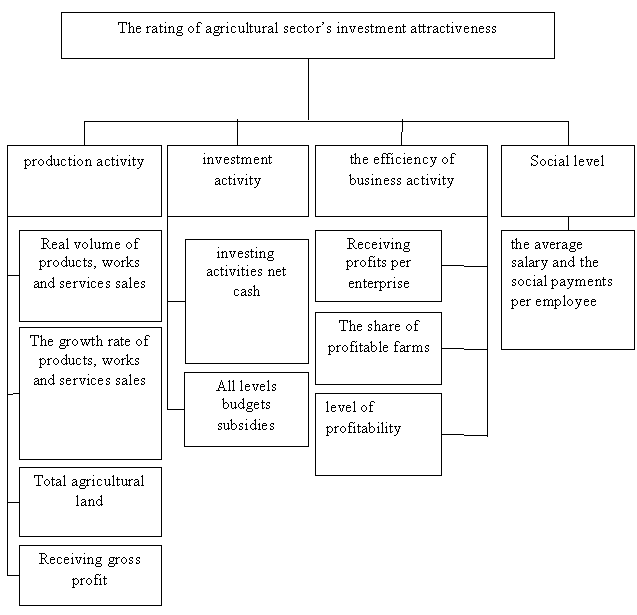

Figure 1 – Indicators
system of the rating of agricultural sector areas’ investment attractiveness
The
value of its total rating for each analyzed object determined by the formula:
Ri = 
Ri - ranking score for
i-th object;
х1i, х2i ,..., хni -
private ranking score for i-th object.
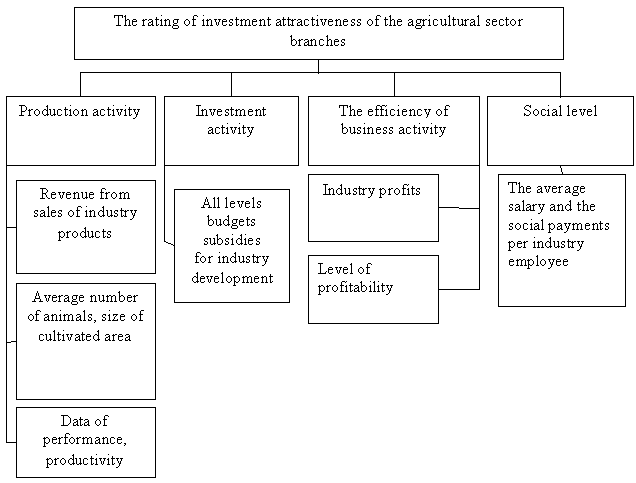

Figure 2 – The rating of investment attractiveness of the agricultural
sector branches
In
calculating the composite rating, we proceeded from the assumption of the
equality’s importance of each particular rating in the summary. In the
composite ranking objects of research are ordered (ranked) in descending order
of rating. The highest rating has an object with a minimum definitive estimate. The use of this
technique in the analysis of investment appeal of economy objects, all the
researching objects can be grouped into the following groups:
- Group A - objects with a high level of investment
attractiveness;
- Group B - objects with an average level of
investment attractiveness;
- Group C - objects with a low level of investment
attractiveness.
The main advantages of the proposed
method of investment attractiveness rating are: firstly, the proposed method is
based on a comprehensive, multi-pronged approach to the assessment of such
complex phenomena as investment attractiveness; secondly, the rating of
investment attractiveness is based on data for public reporting company, area;
thirdly, ranking score is comparative, it takes into account the real
achievements of all competitors.
Our proposed method of rating can be
used in the development of such a policy paper as “investment certificate”, which
provides a comprehensive assessment and comprehensive information about the
economic entity. Certification of investment activity allows carrying out an
objective analysis, make medium and long-term investment decisions and give
rating of regions according to their attractiveness. In addition, the
certification allows in the pre-investment phase to make economically
decisions, makes it possible to mitigate the undesirable economic and social
consequences against natural investment flows. Investment certificate includes
four sections:
1.
Production activity. It reflects the
achieved level of material and technical base of economic area and the state of
its use.
2.
Investment activity. In this section
the volume of capital investments, their provided sources of financing, the
degree of capital investments and the diversion of funds to construction in
progress are shown.
3.
The effectiveness of investment
activity is considered on two levels:
- effectiveness
in the production phase, which provides the definition of indicators such as
gross, marketable products and profit per unit of used resources;
- effectiveness
business activities of the individual investor, to govern the financial
condition of the subject of investment activity, his work with the assets and
securities. The indicators of this level may include asset turnover and capital
assets, the rate of profit, solvency, liquidity of the company. These criteria
are important in developing investment strategies.
4.
Social infrastructure - its present
and possible future. The inclusion of the fourth section caused by the fact
that regional systems are territorially detached formations, which solve and
will continue to solve questions of providing citizens with the full range of
social services. And for solving these problems as own free funds so budgetary
allocations can be used.
In order to organize the process of
certification of investment and ensure the reliability of ratings in making
long-term decisions in the Ministry of Economic Development and the Ministry of
Agriculture is advisable to create information-analytical center of investment
activity. Information-analytical center’s methodological basis work could be
the proposed information-analytical system, which includes the following
elements:
1. Goal determination of the investment policy
2. Justification of the priorities in agriculture.
3. Development the assessment criteria of investment activities.
4. Certification investment activity objects.
5. Generalization, systematization of information to the rating investment
attractiveness.
6. Making of investment decisions according with the results.
Establishing such center will require minimal
financial charges, as will be mainly connected with redistribution of
functional responsibilities in existing organizational structures.
In general, we offered methodological and methodical
approaches to the rating of the investment climate in the agricultural sector,
allow to the potential investor, both internal and external, in conditions of
shortage investment resources, make an objective decision about the location
and concentration of investment resources, reduce management risks, and improve
efficiency of investments.
Literature
1. The program for the development of agriculture in the Republic of Kazakhstan for 2013-2020 "Agribusiness 2020". Astana. 18.02. 2013.
2. Economics of agricultural industries .-M.:Edited Minakova. 2004.
3. L.L.Igonina. Investment. Proc. pos. Ed. Doctor of Economics, Professor V.A.Slepova-M.:Yurist.2002.
4. Investment activity in the agricultural sector. L.Yu.Piterskaya.M. 2007.