Анашева Д.К., Некрасова
Е.А., Губайдулина И.Е.
Евразийский национальный университет,
Астана, Казахстан
THE METHODS OF STYLISTIC MEANS TEACHING AT THE ENGLISH
LESSONS
Stylistic
means are integral parts of a language, they create authenticity and people can
convey all subtle meanings and fully comprehend all structures with their help.
According to Professor I.R.Galperin, all stylistic means of the English can be
divided into expressive means and
stylistic devices. Expressive means
of a language are “those phonetic, morphological, word building, lexical, phraseological or syntactical forms which exist in
language as-a-system for the purpose of logical and various dictionaries”. Inversion,
capitalization, italics refer to this group. Stylistic devices in their turn are defined as “a conscious and
intentional intensification of some typical structural and/or semantic property
of a language unit (neutral or expressive)”. This group compiles metaphor,
metonymy, simile, hyperbole and understatement.
Despite
the fact that stylistic means are not widely spread while teaching English,
they are great tools for improving the level and communication skills.
Therefore, the use of these stylistic means should be promoted and teachers
should take into account their efficiency while choosing activities for the
classroom.
In
general, stylistic devices and expressive means help in comprehending the
language means for the transmission of thoughts and emotions, contribute better
acquisition of language in the process of linguistic and cultural competence,
facilitate development of knowledge and improving skills of speech
practice.The benefits of the expressive means application are enormous; one of them
is improvement of language proficiency. When dealing with expressive means
students perceive real authentic material and they expand their knowledge as a
consequence. Students study the peculiarities of native speakers’ speech,
intonation, sentence structure. This fact in its turn helps them communicate
easier and motivate them to take part in social interaction. Moreover, these
devices are used to make an idea clearer, emphasize a point, or relate an
insight to the reader. As a result students enrich their vocabulary and make
their speech more sophisticated and rich. Furthermore,expressive means can
stimulate creative activity in students, they can use them while writing essays
or performing projects.Students have fun doing these kinds of exercises, and
the quality of the products suggests that they are learning something; and here
they understand how particular devices
cause particular effects as well.
One
of the important isssue here is to grade the level of material to the students’
level and choose relevant literary means while preparing exercises. Therefore
when choosing stylistic means to teach students’ peculiarities such as age,
level of development and communication should be taken into account.
Thus,
this article deals with the practical application of above mentioned means in
the classroom. All exercises, given below are aimed at clear explanation,
practice and real use in verbal communication.
For
instance, while using such expressive means as an inversion for emotional
effect, a teacher can start the lesson from writing an easy comprehensible
sentence on the blackboard.
“Never have I seen such
a beautiful rose!” can be a perfect example. After that teacher should elicit
students’ ideas about the reason for such reversed word order and ask them to
change the sentence so that it has an ordinary order. “I have never seen such a
beautiful rose” is undoubtedly an answer and the reason is to intensify the
emotional strength of the statement. Also you need to point out that this
expressive mean is called inversion.
Next step is a practice, during which teacher
should encourage students to reverse the normal word
order in sentences (or vice versa).
The
following sentences can be used:
I have never seen such a play!
I did realize
how wrong I had been (only then).
Came frightful days of cold and rain.
Rude am I in my speech.
Strange things have I in mind.
Never before had I seen such great sights.
I have never been to England.
I rarely send emails to my friends.
Subsequently,
students can be divided into groups, and the following exercise can be offered:
different extracts from TV-series will be shown, typescripts of video extracts will be handed out. The task
is to find as more inversions as possible. When checking the answers, teacher should pay students’
attention to the significance of use the literary means in their speech to make
it more natural and authentic.
For freer practice children can be asked to talk on the topic about their
favorite city using the reversed structures learnt before: e.g. -Never before
had I seen such great sights! Not only are there great shops in London but also
some of the best museums in the world.This way we implement literary devices in
real communication and motivate students to practice their use.
The following exercises are oriented to help students
tackle such stylistic devices, as metaphor, simile, hyperbole and
understatement. These literary devices are the most appropriate for
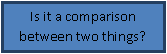
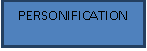
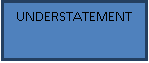
schoolchildren as they are widely spread and comprehensible. For instance, the teacher can propose the students anuncomplicated algorithm for
distinguishing some stylistic devices:




























At
the next stage teacher prompts students to find stylistic device and expressive
means in the “I Have a Dream” speech.
Firstly, teacher gives some historical background, in order to enhance
their attention, printed copy of this speech and explains that they’ll be
looking for the literary terms. While students are watching the video of the
speech, they should underline and label examples of literary terms that they
find. Students may work in small groups thus it can be a competition to see
which group can find the most examples of literary terms. At the end of the
task students hold a discussion about
king’s use of these literary terms helped him to spread his message. The
examples of literary devices are given below:
… Now is the time to rise from the dark and
desolate valley of segregation to the sunlit path of racial justice. (Metaphor)
… It is obvious today that America has defaulted
on this promissory note insofar as her citizens of color are concerned. Instead
of honoring this sacred obligation, America has given the Negro people a bad
check, a check which has come back marked “insufficient funds.”(Personification)
… No, no, we are not satisfied, and we will not
be satisfied until justice rolls down like waters and righteousness like a
mighty stream.(Simile)
Another source of literary
devices is songs and film extracts. They are essential authentic materials and
undoubtedly captivate students’ attention with their interesting content.
Students are getting really involved into the lyrics so that they can easily
find literary means. In addition, students enhance their vocabulary and face real
modern speech.The following exercise
encourages children to figure out if each one is an example of a simile, a
metaphor, a hyperbole, alliteration, a
personification:
1) You, with your voice like nails. (simile)
2)He’s so fluffy I’m gonna die! (hyperbole)
3)…cause I’m coming at you like a dark horse. (simile)
4)The wind is howling like the swirling storm inside. (simile)
5)Sunshine, she’s here, you can take a break. (metaphor)
6)…if you feel like a room without a roof (simile)
7)I could eat about a million and a half of these. (hyperbole)
My mama always said, life is like a box of chocolate.
You never know, what are you going to get.(metaphor)
All these tasks are of great efficiency and teachers
would benefit from them a lot.
Overall, the application of literary means in the
classroom is a pivotal source for creating authentic atmosphere and encouraging
students to speak. Children face natural speech and acquire language easier as
a consequence.
List of literature:
1.
Galperin I.R. Stylistics. M.,1981
2.
V.I.Shakhovsky. English Stylistics, 2008