Economic
sciences/2.International activity
Natalia M. Lashkevich
Master of Economics, PhD-candidate of the University
“G.d’Annunzio” Chieti-Pescara, Italy e-mail:
lashkevich.n@gmail.com, priorpost@mail.ru.
The analysis
Pasta exports of Italy.
Summary
The article describes tendencies of the international
trade of Italy of pasta during 2001-2010 years: trade balance; dynamic in pasta
exports, major export flows, more perspective markets for pasta; level of food
risks. The analysis of these tendencies allowed to admit that Italy is
characterized steady position in pasta exports to the EU. In order to prevent
and/or to decline the level food risks in exported pasta, Italian producers
should consider the involving such quality monitoring tool as integrated
tracing system of food risks.
Keywords: pasta,
the EU, Italy, exports, food risks.
Introduction
International trade plays an important role for an
economy of every country as it represents a significant share of gross domestic
product. During the last decade the EU has increased. The following countries
have entered into the EU: in 2004 – Cyprus, Czech Republic; Estonia, Hungary,
Latvia, Lithuania; Malta; Poland; Slovakia; Slovenia; in 2007 – Bulgaria,
Romania. [1] The expansion borders of the EU leads to the linearization of the
international trade and to the improving trade relations between countries.
Considered, that Italy is famous of its pasta and it
is one of export commodities, so let to analyse the influence trade tendencies
on pasta international trade of Italy during 2001-2010 years.
Table 1.
International trade of Italy, 2001-2010 years
|
Period |
Italy - EU-27,
ThT |
Italy – World,
ThT |
Share exports of
the EU in World exports,% |
||||
|
Exports |
Imports |
Deviation (+,-) |
Exports |
Imports |
Deviation (+,-) |
||
|
1 |
2 |
3 |
4 |
5 |
6 |
7 |
8 |
|
2001 |
951,8 |
9,8 |
+942,0 |
1535,0 |
12,9 |
+1522,1 |
62,0 |
|
2002 |
973,7 |
15,7 |
+958,0 |
1563,7 |
19,0 |
+1544,8 |
62,3 |
|
2003 |
966,0 |
22,7 |
+943,3 |
1526,1 |
26,9 |
+1499,2 |
63,3 |
|
2004 |
1029,9 |
26,4 |
+1003,5 |
1591,6 |
33,8 |
+1557,8 |
66,1 |
|
2005 |
1091,9 |
28,8 |
+1063,1 |
1679,7 |
34,9 |
+1644,7 |
65,0 |
|
2006 |
1144,9 |
31,3 |
+1113,6 |
1742,1 |
36,8 |
+1705,3 |
65,7 |
|
2007 |
1169,4 |
33,2 |
+1136,1 |
1772,0 |
38,4 |
+1733,6 |
66,0 |
|
2008 |
1138,3 |
33,5 |
+1104,8 |
1693,4 |
40,5 |
+1652,9 |
67,2 |
|
2009 |
1203,4 |
36,3 |
+1167,2 |
1731,9 |
43,9 |
+1688,0 |
69,5 |
|
2010 |
1215,9 |
31,1 |
+1184,7 |
1792,9 |
39,2 |
+1753,7 |
67,8 |
Source: [2]
Table 1 includes data about the international trade of
pasta of Italy with the EU and “World” during 2001-2010 years. The analysis
allowed to admit such steady tendency as the exceeded of exports under imports.
So, the Italian international trade of pasta is characterized positive balance.
Column 7 of table 1 shows that the EU’ markets are major exports markets for
Italy, because the share of pasta exports is more then 60%. To determine major
pasta export flows of the EU for Italy, the comparative analysis of the Member
States by average exports have done. The ranking of countries is presented at
the figure 1.
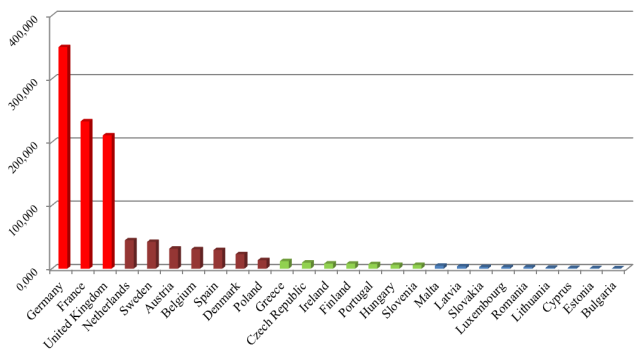 Figure 1. Ranking member states of the EU by average
volume of pasta exports from Italy, 2001-2010 years
Figure 1. Ranking member states of the EU by average
volume of pasta exports from Italy, 2001-2010 years
The ranking of pasta exports by volume helped to
divide State Members of the EU on 4 groups:
-
Group 1 (major
export flows) - Germany, France, the UK;
-
Group 2:
Netherlands, Sweden, Austria, Belgium, Spain, Denmark, Poland;
-
Group 3: Greece,
Czech Republic, Ireland, Finland, Portugal, Hungary, Slovenia;
-
Group 4: Malta, Latvia, Slovakia,
Luxembourg, Romania, Lithuania, Cyprus, Estonia, Bulgaria.
Considered, that the forecast of exports tendencies
and the search of new perspectives to increase the export are very important
for every country, the 6th degree polynomials were built for all Member States
of the EU.
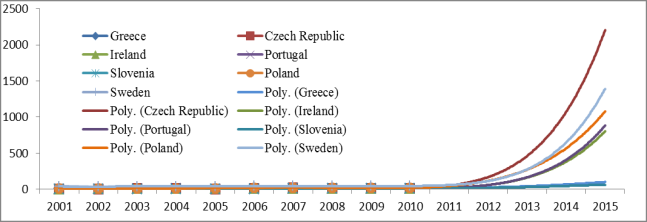
Figure
2. Perspective pasta export flows for Italy into the EU Single Market.
The analysis of polynomial trend lines showed that for
Italy the following countries are the more perspective pasta export flow: Greece, Ireland, Slovenia, Sweden, Czech
Republic, Portugal, Poland.
Taking into consideration, that the EU has created a
strong food safety control system in order to protect European consumers from
bad-quality, harmful and adulterated commodities, the analysis of food risks
has carried out. The following results were received:
-
In pasta exports
from Italy 39 hazards were identified [2003.352; 2003.415; 2003.429; 2004.043;
2004.051; 2004.107; 2004.107; 2004.149; 2004.149; 2004.150; 2004.178; 2004.185;
2004.367; 2004.464; 2004.478; 2004.478; 2004.497; 2004.497; 2005.788; 2005.945;
2005.945; 2006.0008; 2006.0083;
2006.0570; 2006.0592; 2006.0715; 2007.0063;
2007.0365; 2007.0392; 2008.0249; 2008.1513; 2009.0220; 2009.0697; 2009.0892;
2009.1487; 2009.1738; 2010.0316;
2010.0971; 2010.1657]. [3]
-
The structure of
hazards by share in total notifications: food additives (59%), insects (17,9%),
mycotoxins (17,9%); microorganisms (2,6%) and insufficient organoleptic
characteristics (2,6%).
-
There was no any
notification about food additives since 2007 in pasta. So, it can be said that
the Italian producers have changed their production technologies and improved
dosing systems.
It necessary to admit that all notifications were
received after food quality control at the domestic markets, so after internal
controls. Considered this fact, exported pasta from Italy is met the European
quality requirements. Therefore, such
hazards as insects, mycotoxins, microorganisms and insufficient organoleptic
characteristics can be occurred in cases of insufficient transport and storage
conditions during the movement of commodities from producers to consumers and
the distribution via trade operators.
Considered the listed reasons of food risks they can
be classified in three groups: A, B, C.
Table 2. Food risks points along the pasta food chain.
|
Stage-process |
Index |
Object of food risks |
|
Technological |
A |
Raw materials. Technological process
(itself/directly). Storage at the enterprises-producer. |
|
Technological-trade |
B |
Packaging/boxing of a delivery. Storage conditions
during the transportation, movement and distribution between chains: business
processes between producer-wholesaler(s); producer-retail network(s);
wholesaler(s) - retail network(s). |
|
Trade |
C |
Storage at the retail stores/shops – selling –
consumers’ storage before the consumption. |
Taking into consideration the elaborated
classification system of the occurrence food risks in pasta, the following
scheme of risk points during the movement of pasta along the food chain is
presented in table 3 for identified food risks.
Table 3. Scheme
risk points along the food chain for identified food hazards in exported pasta
from Italy.
|
Cluster. Hazards. |
Food risks points |
Description |
||
|
Compositions: food additives; ingredients |
A |
A: technological process (itself/directly) – dosing system. |
||
|
Biocontaminants: insects |
A – B – C |
A: storage at the enterprise-producer. B: storage conditions during the
transportation, and movement along the distributing chain. C: storage at the retail stores/shops – consumers’ storage before the
consumption. |
||
|
Mycotoxins: Fumonisins; Deoxynivalenol; moulds |
A – B – C A, B, C |
A: Technological process (raw materials). |
B: packaging/boxing of a
delivery; storage conditions during the transportation, and movement along
distributing chains. C: Storage at the retail stores/shops. Consumers’ storage before the
consumption. |
|
|
A, B, C |
A: storage at the enterprise-producer. |
|
||
|
A – B – C A, B, C |
A: Technological process (raw materials). |
|
||
|
Microorganisms: Bacillus cereus |
A – B – C |
The growth of risks along the
chain: A: Technological process (raw materials). B: storage conditions during the
transportation, and movement along the distributing chains. C: Storage at the retail stores/shops. Consumers’ storage before the
consumption. |
|
|
|
Control: organoleptic characteristics |
A,B,C A – B – C |
A: Technological process: bad-quality raw materials; technological process (itself/directly); storage at the enterprise-producer. B: storage conditions during the
transportation, and movement along the distributing chains. C: Storage at the retail stores/shops. Consumers’ storage before the
consumption. |
|
|
Source: [4], [5],
[6], [7], [8], [9]
Elaborated scheme shows that identified food risks in
exported pasta can be transferred by the following ways:
“A, B, C” – the occurrence food risks at any stage of
the food chain;
“A – B – C” – the occurrence at the first stage (here:
A) and transference risks along the food chain. The level of risks can be
situated at the initial level or it can be increased at next stages of the food
chain.
“A” or “B” or “C” – the occurrence food risks is
possible only at one stage of the food chain without the subsequent increase.
Hence, to protect the products during the movement
along the supply chain first of all it is necessary to improve monitoring
systems based on the concept of controlling or to involve the integrated food
risks tracing systems.
Conclusions
The carried out analysis allowed to admit, the
international trade of pasta of Italy is very effective because exports
exceeded imports and it is characterized the positive balance during 2001-2010
years. The EU is major trade partner for Italy because its share in total pasta
exports is more then 60%. Among Member States of the EU such countries as
Germany, France, the UK are major pasta export flows for Italy. More
perspective export directions for Italy on 2011-2015 are Greece, Ireland,
Slovenia, Sweden, Czech Republic, Portugal, Poland. Considered that the EU has
created a strong food control system and it is also a powerful non-tariff
barrier for any country, the analysis of RASFF notifications about the presence
of hazards in exported pasta from Italy has implemented. The analysis showed
that all 39 notifications were received after internal quality controls, so
after the passing border quality controls. Taking into consideration this fact,
producers and distributions of Italy should analysis the possibility of
involving such quality and food safety monitoring measures as integrated
tracing quality systems. It will allow to prevent the occurrence of food risks
during the movement of pasta along the food and supply chains.
References:
[1] Member states of the EU [e-source] //
http://europa.eu/about-eu/countries/index_en.htm
[2] Annuario
dell’agricoltura Italiana // INEA, Roma, ISBN 978-88-495-208-1.
[3]Notifications list [e-source] https://webgate.ec.europa.eu/rasffwindow/portal/
[4] ‘Opinion of the Scientific Panel on Biological
Hazards on Bacillus cereus and other Bacillus spp in foodstuffs.’ // The EFSA
Journal (2005) 175,1-48.
[5] ‘Bacillus cereus’ // Data sheets Prepared for
NZFSA by ESR Ltd. Issued July 2010, 1-3.
[6] Official Journal of
the European Union. Legislation. Volume 54, 12 November
2011, pp. 1-216.
[7] Contamination of Pasta and the Raw Materials for
its Production with Moulds of the Genera Aspergillus. M. Halt, D. Kovachevic,
H. Pavlovich, J. Jukich. // Czech Journal Food Science, Vol. 22, No. 2, p.
67-72.
[8] Cereal and Pantry Pests. Steve Jacobs, Sr. Extension Associate. [e-source] // http://ento.psu.edu/extension/factsheets/cereal-and-pantry-pests.
[9] Food safety
quality management system as the effective instrument of single market policy. Natalia
Lashkevich, Journal «International scientific researches», Vol. 3, Nom. 3-4
(July-December 2011), pp56-62