Математика/ 1.Дифференциальные
и интегральные уравнения
К.ф.-м. н. Ысмагул Р.С.
Костанайский государственный университет им.
А.Байтурсынова, Казахстан
Аlmost multiperiodic solution of evolyutsion equations
Let’s introduce some notations and definitions:
 - The class of n-dimensional
  -functions,
  -satisfying
the сonditions.
-satisfying
the сonditions.
 and almost multiperiodic in
  с
с  - vector- almost period
  , where
  when
when  ; countable-dimensional
vector
; countable-dimensional
vector , where
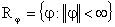 ; Wm и Vm - functionals that assign vectors Wm
 = ( φ1, …, φт, 0,…) и Vm
 = ( 0,…,0, φm+1,φт+2, …) to the vector φ = (φ1, ..., φt, ...).
Let’s consider a system of
integrodifferential equations of the form
 , (1)
, (1)
where x, Q, R are n-vectors-columns; P (t, φ) is a matrix of dimension n × n, φ = (φ1, ..., φt, ...) is a countable vector, and  ,
, >0 are small
parameters.
>0 are small
parameters.
Let’s
consider that the conditions  [1,c.168] и
  (
( ) are met if:
1) vector-function  is bounded and contiguous
with all
is bounded and contiguous
with all
variables, and has limited contiguous derivatives of first
order in  ,
, ; diagonally -
almost in period
; diagonally -
almost in period , belongs to
  -class evenly relatively
to
-class evenly relatively
to ;
;
2) continuous function  provides improper integral
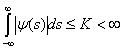 , where
  is permanent.
Let’s contemplate the differential operator:
 .
.
To
reduce the record we’ll take  . It should be noted that the coefficients of Lipshitce enhanced
condition for vector-function
. It should be noted that the coefficients of Lipshitce enhanced
condition for vector-function  are
are  .
.
Let’s contemplate the linearized equation:
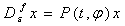 .
(2)
.
(2)
Let  be the
characteristic function of the functional
be the
characteristic function of the functional , which satisfies
the integral equation
, which satisfies
the integral equation
 .
.
.
For
characteristic function  there are rates analogous to relations of the form I(a-b) и 10-90.
Let’s consider the functional Т, representing each
vector-function 

 in vector-function


 , where

which is known from [1].
We will study

Considering that  , we can write
  .
.
From rates III(a-d) we can conclude that there is such a number  , for which with all
  there are the following relations:
1)  ,
,
2)
 ,
,
3)
 ,
,
4)
 .
.
Thus, we come to the statement of theorem 1.
Theorem
1. If
the conditions  ,
,  are met for the equation (1), than
for all the meanings
are met for the equation (1), than
for all the meanings ,
,  equation (1) has a single almost
multiperiodic solution from the class
equation (1) has a single almost
multiperiodic solution from the class  , converging in a zero vector with
  .
.
REFERENCES:
1. Umbetzhanov D.U. Almost periodic
solutions of evolution equations. Alma-Ata, Nauka, 1990, 188 p.