Influence of different modes
on the strength characteristics AGING ALLOY 47 HNM
Mukazhanov Ye.B.1
Telebayev Ye.Ye.2
Takenova G.D.3
Tynaliev Bauyrzhan4
1 Doctoral
Student, PhD, Associate Professor, Academy of Economics and Law, Zhetysu State
University. I.Zhansugurov, Taldykorgan, Kazakhstan
Taldykorgan
Polytechnic College
2 Taldykorgan
Polytechnic College
3 PhD, Associate Professor, Taldykorgan Polytechnic College
4 Taldykorgan
Polytechnic College
Taldykorgan,
Kazakhstan
One
of the important operations in the general cycle of heat treatment
precipitation-hardening alloys hardening is aging as a result of which not only
increases the strength properties, but also vary greatly and many physical
characteristics. As you know, the main processes occurring during aging is the
decay of supersaturated solid solution with the release of a new phase,
different from the original matrix, in general, not only the chemical
composition but also the structure. Since the collapse of the quenched alloy is
a diffusion process, the degree of decomposition, and the form of precipitates,
their dispersion, and other structural characteristics depend on the
temperature and duration of aging, the nature of the alloy and its chemical
composition, in addition, the structure and chemical properties of the alloy
aged affected by temperature heating and cooling rate during quenching and many
other factors. That is why the study of aging precipitation-hardening alloys
devoted significant amount of research, and interest in this research does not
weaken and beyond. The dependence of mechanical properties (elastic limit,
yield and tensile strength) of the structure and more factors, as well as
multi-stage process of decomposition of hardened alloy, combined with high
dispersion of emissions, especially in the early stages of aging, it very
difficult to study these characteristics with age. In most cases, to explain
many effects observed with aging, attracted by x-ray and electron microscopic
analysis using the method of microdiffraction.
Strength
characteristics and structure defining these properties in a state of maximum
hardening, largely determined by the phase and structural changes that occur in
the alloy 47 hnm in the most initial stage of aging. Therefore, it is advisable
to consider the modes of aging, not only in a state of maximum hardening, and
in a wide temperature range, from low-temperature aging, when the rate of decay
and diffusion processes in general is very low (this case corresponds to the
initial stages of decay) to the stage of the high-temperature aging in charge
mode overaging .
Figure
1 shows the mechanical properties of the alloy 47 hnm based on the time of
aging at 600º C, previously quenched from 1250ºC (exposure time at
hardening temperature was 2 min.) With increasing aging time is a slight
increase in hardening of the alloy, which is consistent with the structural
studies. Comparing the data of structural studies with the change of the
strength properties, it is possible to draw some conclusions, namely the contribution
to the strengthening of the alloy, apparently due only to collapse in the
excess phase, but as the volume fraction of this phase is low (5-10%), and the
amount of emissions within these particles is from 15 to 40 A, the increase of
hardening is very small. Within the matrix of any structural changes from
hardened material occurs (up to 10 hours of aging), and therefore its
contribution to the strengthening of the alloy can be neglected. Some drop of
plasticity is likely due to formation of segregations of alloying elements on
grain boundaries.
In
fig. 1 and 2 shows the kinetics of hardening of the alloy at 700º C,
pre-tempered at 1250º C. In the initial stages of aging is already marked
increase in resistance to small plastic deformation, the value of which
increases sharply with further increase in aging time. The observed increase in
hardening stage of decomposition is responsible, resulting in rapidly
developing decay, emitting incoherent α-phase.
Electron
microscopic study of the structure and metallography showed that intermittent
decay starts at the grain boundaries, and ends after 5-10 hours after the onset
of aging, and the volume fraction of the decay is 75-85%, which corresponds to
the maximum hardening. Nature hardening at this temperature aging is caused by
inhibition of dislocations, the separated particles intermittently
α-phase.
Ductility
of the alloy with increasing aging time decreases monotonically decreases to 5%
within 10 hours of aging, while for the quenched alloy was 25%. This decline is
understandable, given the sharp increase in strength. In addition, it should be
noted that the sensors are working in the elastic region with a very low
residual deformation and therefore such a reserve of plasticity is sufficient
for proper function.

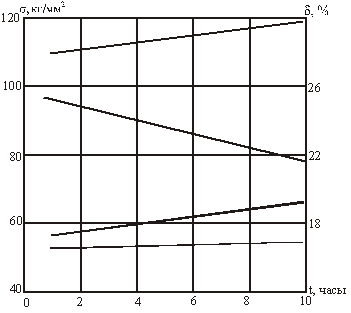
Figure
1. - mechanical properties of the alloy as a function of aging time at
600ºC, previously quenched from 1250ºC, 2 min.

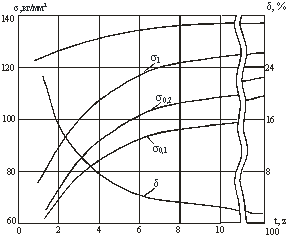
Figure
2. - Mechanical properties of alloy 47 HNM based on the time of aging 700
º C, pre-hardened from 1250 º C, 2 min.
Comparing
Figs. 1 and 2, we can see some data scatter in the values of
the yield strength and ductility. This is because the properties of the alloy
in Fig. 1 were obtained on the material, heat-treated at the factory, at the
time, as the properties of the alloy, as shown in Fig. 2 were studied in
another series of fusing material and processed in the laboratory. Scatter in
the data is due not only to different chemical composition of the material and
the heterogeneity of structure, but also the difference in the cooling rate
during quenching. With further increase of the aging temperature, a change in
the behavior of the strength properties of the alloy on the length of aging. In
Fig. 3 shows data on the effect of aging time at 800 º C on the microplastic
deformation resistance, deforming stress and ductility of the alloy 47 HNM.
First of all, it should be noted that in the initial stage of aging, the flow
stress and especially the yield stress has a value which is not conceding the
properties of the alloy aged at 700 º C. Therefore, this mode is
recommended for the production of elastic sensors, as this significantly
reduces the time of the heat treatment. With increasing aging time gave
strength and other flow stress, including tensile strength decreases, due to
the beginning of the coagulation process in the cells of the intermittent
collapse, at 100 hours aging sferoidezatsy slats α-phase. At the same time
there is a growth of plasticity, ie dislocation that occurred during
deformation, it becomes easier to overcome obstacles in the idea of large
coagulated particles of α-phase. Thus, the reduction of strength
properties and increased ductility perestarenii alloy caused by the increase of
distances between the previously formed precipitates due to their coagulation,
reducing the number of particles per unit volume of the matrix and decrease the
voltage required to bypass the particles dislocations. The stated view is
supported by structural studies, it is enough to compare the microstructure of
the alloy aged at 800 º C with the structure of the alloy treated at 700
º C. The intensity of coagulation increases with increasing temperature of
aging, such as at 900 º C or 1000 º C, while also there is a decline
of strength properties. Why spend the final heat treatment - aging in this
temperature range is unreasonable.
The
dependence of the strength characteristics (τ0,1; τ1; τв) and
technological plasticity (δ) alloy 47 HNM the length of time of aging,
ranging from 1 hour to 100 hours in the temperature range 600-800 º C is
shown in Fig. 4. The samples were pre-hardened from 1250 º C, for 2
minutes. From the analysis of the picture hardening alloy in this temperature
range, it can be concluded that the yield stress, as well as other flow stress,
reaches a maximum at 600 and 700 º C, for 100 hours of aging, with the
largest increase in hardening is observed at 700 º C. However, this aging
time is impractical in the factory, because of the great length of the heat
treatment, the nature of changes in the structure and strength properties of
the alloy in the temperature range investigated is also confirmed by the data
of [3].
As
an example, the change in the electrical resistivity of the annealing
temperature and annealing, the variation of which is shown in Fig. 5 and 6.
Thus, for high strength with minimal elastic imperfections heat treatment of
the alloy must be conducted in the temperature range 650-750 º C, and the
aging time should be between 10 to 20 hours, decreased with increasing
temperatury.Kak known quenching temperature determines the level of strength
properties, with further aging. For example, a higher hardening alloy of 36
NHTYU in aging is achieved after low-temperature tempering (930-970 º C)
compared with quenching at 1100-1250 º C. This effect of heating
temperature, due to the change of state of the grain boundaries, which
determines the nature of the decay (continuous or intermittent) in the
subsequent aging. However, in the beryllium bronze increasing quenching
temperature, increasing the degree of homogeneity of the solid solution as the
concentration and reduction of defects of the crystal lattice structure holds
the higher strength properties [1, 2].
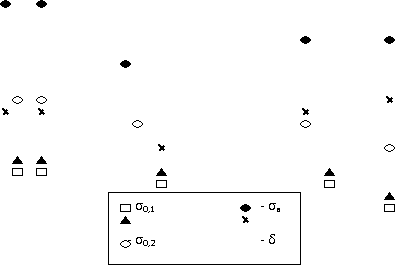
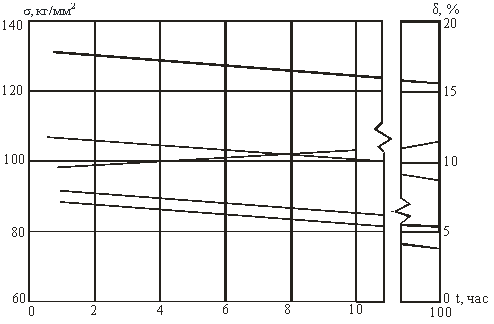
Figure 3. - Mechanical
properties of alloy 47 HNM based on the time of aging 800 º C,
pre-hardened from 1250 º C, 2 min.
Hardening temperature.0С

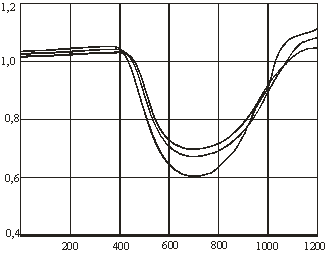
Figure 4. - The dependence of the electrical resistance of the alloy
47HNM temperature quenching. Initial state - cold deformed, 75% degree of
deformation and aging II H; 2-5 hours, 3-10 hours
б б c d b а


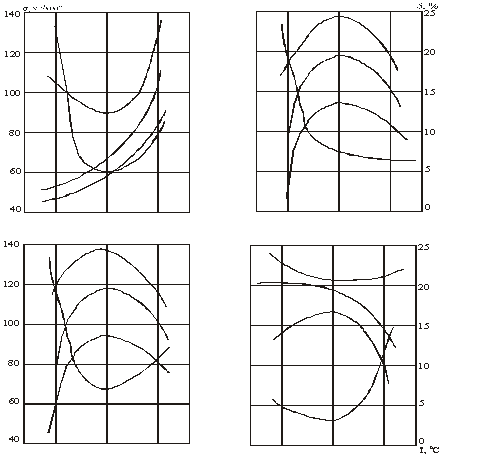
Figure 5. - The relationship between the strength
characteristics (, σ1-, σv -, δ -) alloy 47 HNM of aging
temperature, pre-hardened from 1250 º C, 2 min., A) - 1 hour, b) - 5
hours) - 10 hours, Mr. ) -1000 hours.


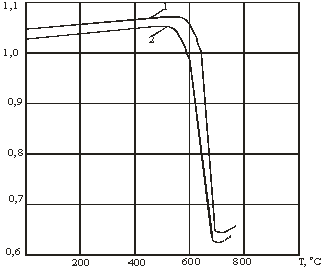
б б б
Figure 6. - The dependence of the electrical
resistance of hardened alloy 47HNM of tempering temperature. Initial state:
1-quenching from 1250 º C 2-quenching from 1300 º C.
Therefore, is not only of
theoretical interest to investigate the effect of quenching temperature on the
degree of hardening of the alloy 47 HNM the decay of supersaturated solid
solution.
In Fig. 6 shows the mechanical
properties of the alloy 47 HNM based on the time of aging, previously quenched
from 1000 º C. Exposure time during quenching is from 1 to 10 hours.
Analysis of mechanical properties shows that the yield strength and the
strength and flow stress corresponding to 1% residual strain change on the
curve with a maximum. Maximum strength is reached after five hours of aging and
to further develop softening process, leading to a drop in the mechanical
properties.
Hardening of the alloy in the
initial stages of aging is due to a relatively high degree of dispersion of the
structure (dispersion structure in this case should be compared with later
stages of aging at this temperature), the relatively small size of the
particles of α-phase and small interparticle distance, which effectively
prevents the movement of dislocations. In perestarennom material (the
descending branch of the curve) because of the processes koalesnentsii
sferiodizatsii and a marked decrease in strength properties. If you compare the
level of properties after quenching from 1000 º C and higher temperatures,
such as 1250 º C at the same time and temperature of aging, we can see a
significant reduction in the first case hardening. This difference at 700
º C and up to 15 hours of aging kg / mm.
Character marked reduction of
strength properties with decreasing quenching temperature is due, apparently,
low supersaturation matrix alloying component. The stated point of view also
finds support in the analysis of the variation of hardening of the alloy aged
at the time of exposure quenching from 1000 º C. From Fig. 7 shows that as
the firing time (from 1 to 10 hours) at a temperature of quenching and
subsequent aging at 700 º C the strength properties fall, though the
faster, longer heating time and minimum values they
reach the samples, kept at a temperature hardening for 10 hours. The fall of
the properties (τ0, 1) the transition from one hour to 10 hours of
annealing is 85 kg / mm to 70kG/mm2 respectively.

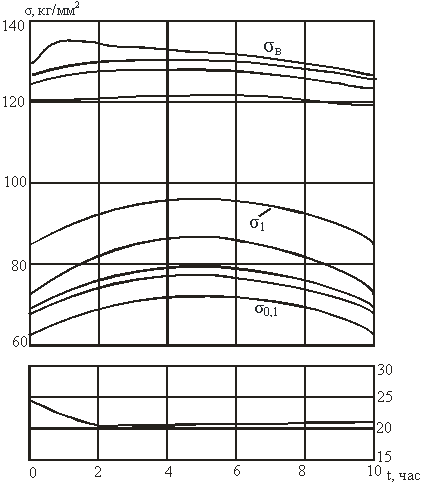
Figure 7. - Mechanical properties of the alloy 47HNM
depending on the time of aging at 700 º C, pre-hardened from 1000 º
C: -1 hour-2 hours, 5 hours, 10 hours.
Ductility of the alloy (graph of the plasticity of the
aging time is shown in the lower part of Fig. 7) for thermal treatment of
almost constant and only decreases depending on the aging time, and the
greatest rate of decrease is observed for the first two hours of aging.
In Fig. 8 shows the dependence of the mechanical
properties of the aging time of samples previously quenched from 1050 º C
for 1, 2, 5 and 10 hours. In contrast to the material, quenched from 1000
º C a distinct stage overaging in this case is not observed. This is shown
by the curve plasticity chart of which is shown in the lower part of the
figure. Plasticity in this case decreases monotonically, decreasing from 22% to
16%.

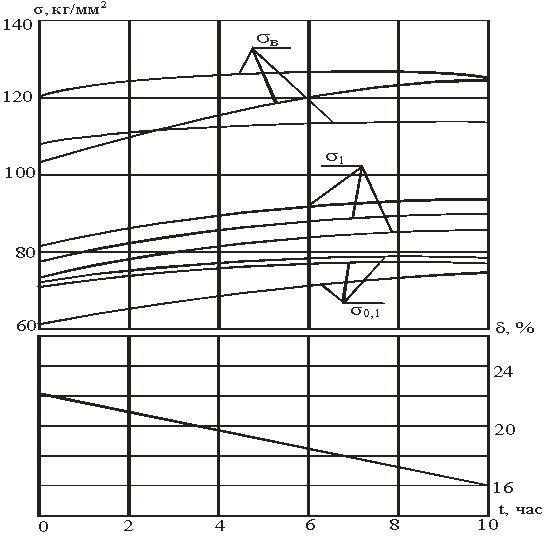
Figure 8. - Mechanical properties of the alloy 47 HNM
based on the time of aging at 700 º C, pre-hardened from 1050 º C: -
1 hour - 2hours - 5hours, 10 hours
Further increase of the quenching temperature to 1100
º C in order to achieve maximum strength properties, with subsequent aging
at 700 º C does not reach the target (Fig. 9). Although the values of
mechanical properties are slightly higher than in previous treatments (ie 1000
and 1050 º C), to reach the level of properties that meet the hardening
behavior in 1250 º C, 2 min, and the aging of 700 º C, 5h fails.
Not yet received an explanation of
the nature of plasticity changes depending on the time of aging, because there
is not any correlation in the change of the strength and plastic properties.
The
structural studies, as no public explanation for the appearance of the maximum
on the curve of plasticity.
When comparing the mechanical
properties of the alloy 47 HNM quenched from 1250 º C (Fig. 2) and the
properties of the alloy, tempered at lower temperatures (Fig. 7, 9) that the
values of the deforming stress in case hardening at 1250 º C is
significantly higher than that of quenched samples in the temperature range
1000-1100 º C.
Thus, with increasing quenching
temperature during subsequent aging of the strength properties of the alloy are
growing, and in fact more so the higher the temperature quenching. The same
effect was observed at 1300 º C, but low technological properties not
possible to recommend this mode for use in the production of elastic sensing
elements ..

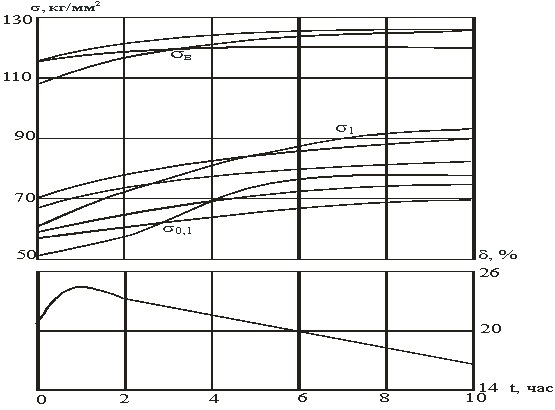
Figure
9. - Mechanical properties of the alloy 47 HNM based on the time of aging at
700 º C, pre-hardened from 1100 º C: - 1 hour - 2hours - 5hours, 10
hours.
In conclusion, it should be noted
that at the present time in our laboratory developed more sophisticated methods
of heat treatment, allowing not only increase the strength of the alloy 47 HNM,
but also to improve processing properties, while reducing the time of heat
treatment. Such methods of processing, for example, is a step aging, including
low-temperature treatment at the first stage of aging and the subsequent
high-temperature processing in the second stage of aging.
literature
1.
Precision alloys. Spravochnik.Pod red.B.V.Molotilova.M.,
"Metallurgy", pp. 368-371,1974
2.
A.G.Rahshtadt. Spring steels and alloys. M., "Metallurgy", 1971.
3.
Zh.P.Pastuhova, A.G.Rahshtadt. Medi.M. spring alloys, "Metallurgy",
1979.
4.
TV Krasnopevtsev RM Paretskaya, GG Knyazev. Sat "Modern spring alloys,
processing and testing, Part 1. LDNTP, page 15, 1967. "
5.
TV Krasnopevtsev RM Paretskaya. Physical and mechanical properties of
corrosion-resistant alloy 47 HNM with high elastic properties. In Sat Tr.
TsNIIChM: Precision alloys. M. "Metallurgy" no. 64. pp. 90-99, 1968.