Технические науки/6.Электротехника и
радиоэлектроника
Ritter D.V.,
Shakishev B.E.
The North Kazakhstan state
university after M. Kozybaev, Petropavlovsk
DEVICE EXCITATION OF SURFACE WAVES
Various types of single-ended transmission
lines (OLP) of electromagnetic energy: bare wire (line Sommerfeld), wire, coated with a layer of dielectric (Goubaux line), cable with corrugated polished
surfaces, etc. [1].
Most of the energy of electromagnetic field ¬ surface symmetrical E-wave is
concentrated in the area around the cylindrical wire OLP
radius to the wavelength λ. In the structure of the surface E-wave has
a radial component of the electric
field Er and insignificant
largest longitudinal component Ez (Drawing 1).
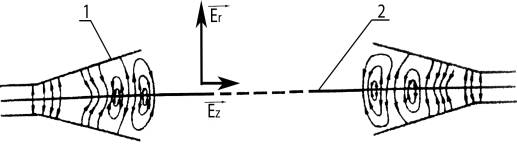
Drawing 1- Product Overview excitation of a
surface wave
The magnetic field lines in the form of
closed circular lines are perpendicular and symmetric with respect to ARS wire.
PSV
must be used for special and mobile devices excitation of a surface wave. Unit
excitation of surface wave located in concen-turning energy of the
electromagnetic field. As devices excitation of surface wave in ARS applied horn
and horn-insulating agents, allows for transition from coaxial transmission
line in OLP, ie the structure of the TEM-wave structure of the surface of
E-wave [2]. Drawing 1 shows the location of the conical horn 1 at two ends of
the wire and the ARS is the structure of the electromagnetic field sur stnoy
wave propagating along the OLP. [2]
Horn-dielectric
surface wave exciters for OLP (analog) are horn exciter dielectric insert
placed over the wire [3,4]. Dielectric insert serves deceleration device for
slowing tion and concentration of the
electromagnetic field in the transition from the coaxial cable to the plane of
the aperture of the horn with a further gradual decrease in the concentration
field. In [4] as a deceleration device used dielectric insert of polystyrene in
the form of two cones joined bases.
The
most widely used device surface wave excitation HN in the form of a conical horn, the diameter of the aperture of
which is > 2 λ [2,5] (prototype).
Note that the use of horses České horn to excite a number of
disadvantages, which include the small Shai mechanical strength in the location where the attachment
relatively large conical horn.
Encouraged
to apply as a mouth roystva excitation of a surface wave dipoles set in
conjunction with the reflector. Diagram of the excitation of a surface wave is
shown in Drawing 2.
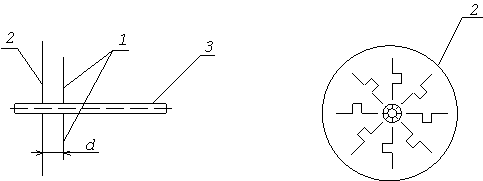
Drawing 2 - The
proposed device excitation of a
surface wave
It consists
of a set of oscillators 1, located near the plane of the reflector 2 and placed
perpendicularly and symmetrically wire ADT 3. Dipole located in the same plane,
in accordance with circular symmetry component of the electric field Er
relation ¬ respect leads ADT. Power to each vibrator let down so that the potential
at the near end to the wire OLP vibrator was one sign. The distance between the
vibrator and the reflector is d d <λ/4.
Excitation of
a surface wave device operates as follows.
Power of the
signal coming from the generator, evenly distributed between each vibrator ¬ dy
of the whole population. Radiation combined vibrators PriVO ¬ leads to
excitation and propagation in both directions leads to ARS surface wave. The
reflector reflects the incident surface wave at him, and, in general, in the
"ARS-reflector" is unidirectional ¬ fief surface wave propagation ¬
HN caused by radiation combined vibrators. Such a device is a surface wave
excitation functions as the reception and the transmission, is structurally
simple to perform and yields positive results, as the application of a flat
reflector ¬ tion in the form of a disk with a set of vibrators, located near at
a distance of ≈ 0.1 λ, significantly easier than using the horn
switch from MOUNT feeder to his neck.
In addition, the excitation field PSV in one direction from the plane of the
reflector in combination with possible isolated wire and reflector will be used
as any one OLP ¬ tional area wired network
Literature:
1.
Troshin G.I., Makarova L.I.,
Hudajkova V.A., Chistin A.F. Single wire line of transformation// 1962.- issue
6. – p.34 – 54.
2.
Semenova N.A., Polikovskij A.M.
Lines of the surface wave for television transformation. – M., 1963.
3.
Semenov N.A. Wave Eoo parameters in
the line of the surface wave// Radio engineering and electronics. – 1964. –
V.9.- № 9.- p. 1634-1641.
4.
Efimov I.E. Radiofrequency lines of
transformation.- M.: Sov.Radio, 1964.
5.
Kismereshikin V.P., Lobova G.N.
Using of the transmission opened lines in technique of communications
facilities// Informational technologies
and radio nets – 96. The first international science-practical conference. –
Conference materials – Omsk, 1996. – p.29.
Informations about authors / Сведения об авторах
|
Surname / Фамилия |
Ritter / Риттер |
|
Name / Имя |
Dmitry / Дмитрий |
|
The organisation, post / Организация, должность |
The
North
Kazakhstan
state
university
after
M. Kozybaev, The teacher /
Северо-Казахстанский государственный университет им. М. Козыбаева, преподаватель |
|
The address / Адрес
|
Kazakhstan, the
city
of
Petropavlovsk, street Jumabaev
115,
apartment
601
/ Республика Казахстан, город Петропавловск, улица Жумабаева 115, квартира 601,
почтовый индекс 150000 |
|
The electron
address of the author / Электронный адрес автора |
|