D.t.n. Kushnir V.G., k.t.n. Benyukh O.A., magistrant Komarov A.P.
Kostanay state university by A.
Baitursynov, Kazakhstan
The
water-pump belt working process at various speeds
It is known that increasing the velocity of the driven roller
conveyor starts to form the water-pump so-called "water wedge"
between the drum surface and the tape. This causes slippage of the tape and
substantially lowers productivity water lift. [1]
In solving the problem of contact-hydrodynamic behavior of a
rubber band on a metal drum is necessary to determine its deflection under the
action of pressure resulting in a layer of water between it and the drum. Modulus
material hundred times less than the modulus of elasticity of the steel drum,
moreover, the thickness of the tape is less than ten times the radius of
curvature of the drum at its coverage. Therefore, the approximate solution admits reversibly assume
tape is a flat layer lying on a completely rigid base and
firmly adherent to it.
Contact-hydrodynamic theory in its most general formulation
is a joint decision of 3 mutually independent tasks: hydrodynamic
- for fluid flowing through the gap; contact - for the rubbing surfaces; heat -
for lubricant and friction surfaces. [2]
Heat processes
beyond the scope of our problem, so only the first two, with the offer to use
the procedure for distribution calculations sliding bearings with non-metallic
collar, while introducing the assumption that the role of the journal will play
a leading drum, and the role of non-metallic clips - gummed tape.
As is known, the basic equations of motion hydrodynamic
solid compressible medium has the form:
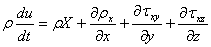 ;
;
 ; (1)
; (1)
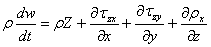 ;
;
and the continuity equation:
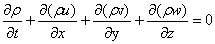 (2)
(2)
Taking into consideration that as the intermediate layer in
this case is water, which is a Newtonian fluid and it Stu law is valid:
 (3)
(3)
wherein: m 0 - viscosity at atmospheric pressure;
n - coefficient of viscosity.
For compressible viscous Newtonian fluid using the
generalized Newton's law for the relation between stress and strain rates:
 ;
;
 ; (4)
; (4)
 ;
;
where 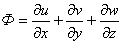 (5)
(5)
After substituting (4) into (1), for compressible Newtonian
fluid basic hydrodynamic equations take the form:

 (6)
(6)

where: x - coordinate measured along a tangent to the
bottom surface reverse side of
the movement, m;
y - coordinate measured across the
lubricating layer, m;
z - coordinate measured along a tangent to the bottom surface
and directed
perpendicular to the axes X and Y, m;
k0 - hydrodynamic pressure at a given point, Pa/m2;
px, py, pz - normal stress at a given point, N/m2;
Jx, Jy, Jz - shear stresses at this point, N/m2;
u, v, w - the corresponding components of the velocity of the
element fluid in
the direction of axes X, Y,
Z, m/s;
ρ - density of the liquid at a given point, kg/m3;
μ0 - absolute viscosity of the fluid at a given point,
kg/m;
X, Y, Z - components of body force per unit mass;
t - duration, with;
λ1 - the
second viscosity coefficient, which determines the dissipation
(scattering) energy during compression and expansion.
It is known that during compression-extension of liquid
thermodynamic equilibrium is broken and the process of recovery is dependent on
its properties and the conditions in which there is a liquid.
Duration of the impact of external forces on several
orders of magnitude greater duration of relaxation. When m is at
least time to change the volume balance be restored. However, in
some cases, the relaxation time increases significantly, and if the cycle time
"tensile-compressive" becomes less than or of the same order with the
relaxation time, a considerable dissipation occurs (dispersion) of energy which
is a measure of viscosity to the second λ1, λ2 - it is
not a constant but a function of frequency of motion, in which it manifests
itself. For Newtonian fluids, λ1 = 1.
The thickness of the lubricating layer is very small compared
to the linear dimensions of the other layer, e.g. the width of the tape and the
contact area, and the drive drum. Then we can assume that the pressure does not change across
the lubricating layer, for fluid pressure at a given point of the lubricating
layer is a normal mu voltage with the opposite sign.
Thus, for a Newtonian fluid the systems of equations (6) will
greatly simplified form:
 ;
;
 ; (7)
; (7)

wherein:  and
and  , equal to the product of the shear stresses on
viscosity minute gradient shear rate.
, equal to the product of the shear stresses on
viscosity minute gradient shear rate.
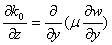
Tangential movement of the rubbing surfaces have a higher
order of smallness compared with radial, so they can be neglected.
Then:  ;
;
 ; (8)
; (8)
 .
.
It is known that the basic differential equation of
hydrodynamic lubrication theory does not change its structure regardless of the
accounting change in viscosity across the lubricating layer. Homogenization
temperature, viscosity and density of the liquid lubricant layer obtained
across the velocity profile of fluid elements in the direction of the X and Z:


 (9)
(9)
The
basics of Korovchinsky M.V equation hydrodynamic lubrication theory for the
general case of motion surfaces offered written as:
 (10)
(10)
where: h - film thickness at a given point, m;
Ua, Ub - velocity in the direction of the rubbing surfaces reverse
X-axis, m/c;
Wa, Wb - velocity of rubbing surfaces in e.g. a phenomenon reverse axis
Z,
m/s;
V0 - removal rate from each other rubbing surfaces measured normal to the
surface, m/s.
Axial pull friction area (axis Z) is much less than the
length of the friction area of the X-axis, then, consequently, a
three-dimensional flow of lubricant can be regarded as flat.
With this in mind, the original system of equations (1) is
simplified to a single expression:
 (11)
(11)
where: h 0 - film thickness at the maximum pressure, m;
Х0, x - coordinate of the end of the field of friction, m.
In this example, the mode of movement of the rubbing surfaces
is considered to be steady, V0 = 0, and
taking into account (3), the expression (11)
becomes: 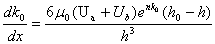 (12)
(12)
Due to the fact that water pressure-viscosity coefficient n
is 0, so equation (12) simplifies to:
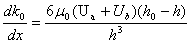 (13)
(13)
Thus, as seen from the formula, the pressure in the water layer between
the belt and pulley is directly proportional to their velocity and inversely
proportional to the cube of the thickness of this layer.
Literature
1. Kaplan R.M., Kaskarauov I.A. K isledovaniyu lentochnykh
vodopodmnikov dlya pastbishchnykh skvazhin. Vestnik s/kh nauki.-Alma-Ata, 1971. №7. s
101-107.
2. Kulpin P.I., Nechaev V.A., NechaevB.V.
Eksperimentalnye issledovaniya vodopodemnika s povyshennoy skorostyu dvizheniya
lenty. / Mekhanizatsiya rabot v zhivotnovodstve. Sb. nauchnykh rabot.
Saratovskiy SKhI. Saratov, 1975, vyp.43. s. 140-147.