Экология /2.Экологические и метеорологические проблемы
больших городов и
промышленных зон.
A.S. Ergaliev
M. Utemisov West Kazakhstan State University,
Uralsk, Kazakhstan
Environmental monitoring avifauna in
a zone of oil extracting of the West Kazakhstan
Fauna
ecological monitoring in a zone of oil extracting KOGCF has long-term
character. The given researches are spent by forces of scientific biologists’
WKSU named after M. Utemisov since 2009. As a part of complex researches of
fauna us also it is studied avifauna Burlin area of WKO.
The
fauna of birds WКО are rich and
various on the structure. From the middle XX in till now in region stay more
than 60 kinds of the birds concerning 19 groups is fixed. Most numerous of them
on specific riches is groups falconiformes, anseriformes,
charadriiformes and passeriformes whereas loonsformes, copepods, phoenicopteridae,
caprimulgiformes, upupa epops, coraciiformes, swifts and cuculiformes are
presented only by 1-3 kinds. Other groups on a saturation occupy intermediate
position and include 2 (podicipediformes) on 1 (foliaceous and strigiformes), 1
(grus) and 2 (piciformes) kinds. From the general number of the birds
registered in area on a share nesting it is necessary about 23 kinds that makes
approximately 60 % avifauna. Other birds concern groups flying, aestivates,
wintering and stray kinds. Meanwhile such division has rather conditional
character as among birds breeding within region it is possible to allocate some
tens mass migrants which during spring and autumn time follows to reproductive
regions and cross limits of Burlin and Chingirlau areas of WKO. Besides, there
are kinds which conduct rather settled way of life and meet in area both warm,
and a cold season.
It is
expedient to notice also, that the general riches of fauna defined
approximately of 33 kinds, cannot be used without some updating for the
characteristic of fauna of region at present time. The matter is that the most
part of the birds carried to group stray, was met in the field of only 1-2
times and enough removed from the present period terms. On existing in
faunistics traditions, kinds, whose stay in certain territory does not prove to
be true within 25 years from the moment of last registration, are deduced from
regional faunistic lists. Following, this rule from avifauna areas already should
exclude now some kinds, among which curly pelican, a white goose, a marble
teal, a sea eagle долгохвост, white-headed
forces, an Egyptian vulture, houbara, Asian pacific golden plover and a number of
others. There are some similar kinds and among flying and wintering birds.
Whose occurrence within area though has cyclic character however is the
extremely rare. Taking into account these remarks; at the characteristic
avifauna region it is expedient to be guided by number regularly marked on
territory of area of birds which makes about 33 kinds.
By type of bird biotopical of area forms well
expressed ecological groupings: compophilic, limnophilic, epilithic and
denrophilic. Compophilic the grouping despite presence opened landscapes
(agrocenosis, steppes, meadows and their anthropogenous modifications),
occupying about 90 % of territory of region also is rather poor. It is
presented by typical kinds of area complex, steppe, semidesertic and mesophilic
meadow birds (crested, small, grey, steppe, white-winged, black and field
larks, quail, landrail, yellow, yellow forehead wagtails and other kinds).
Dendrophilic
the grouping is characterized by considerable specific riches that the Berezka
and Utva are distinctly observed in flood plains the rivers. The fauna wood
biogeocenosis, occupying all about 4 % of territory of area, are made by birds
deciduous and forest-steppe formations. Some from dendrophils are adapted to
nesting in artificial wood plantings and occupied almost all steppe and
semidesertic zones which have occupied almost all steppe, have now reached here
high number (a rook, forty, grey warbler, warbler-whitethroat and others).
Limnophilic grouping it is dated to a semi-aquatic habitats. Its basis makes
the birds connected with steppe reservoirs of limanno-field type. It in the
majority of representatives podicipediformes (big, black-necked and red-necked grebe) copepods (the big
cormorant), foliaceous (the majority of herons, the big and small bitterns),
anseriformes (a grey goose, a swan-shipun, ogoro, shelduck and others), grus
(a bald-coot, gallinule, crake and others) and wading passeriformes (nightingale
cricket, millerbird warbler, marsh, reed and lesser ground millerbird and
others). An insignificant specific variety characterizes grouping epils-approximately
9 % avifauna. Possessing the high ecological plasticity, many of them could
adapt for nesting in hollows and nests corvidae birds, structures
and constructions of the person. Sometimes their populations here even are much
larger, than primary habitats. From all variety of birds of region, according
to research scientists of WKSU named after M. Utemisov now within Burlin area
and in a zone of oil extracting Karachaganak oil and
gas condensate field it is noted 31 kinds of birds. Which on prevalence
degree concern rare, usual, numerous kinds (table № 1).
Table 1 - the list of birds of territory KOGCF
(rare - +, usual - ++, numerous - +++)
|
№ |
The kind name |
Number |
|
|
The Russian name |
The Latin name |
||
|
1. |
Grey heron |
Ardea cinerea Linnaeus |
+ |
|
2. |
Wild duck |
Anas platyrhyncha Linnaeus |
+ |
|
3. |
Cane harrier |
Circus aeruginisus Linnaeus |
+ |
|
4. |
Red-footed falcon |
Erythropus vespertinus
Linnaeus |
+ |
|
5. |
Common
kestrel |
Cerchneis tinnunculus
Linnaeus |
++ |
|
6. |
Grey partridge |
Perdix perdix Linnaeus |
++ |
|
7. |
Bald-coot |
Fulica atra Linnaeus |
+ |
|
8. |
The ring-dove |
Columba palumbus Linnaeus |
++ |
|
9. |
Blue rock pigeon |
Columba livia Linnaeus |
+ |
|
10. |
Cuckoo |
Cuculus canorus Linnaeus |
+ |
|
11. |
Golden bee-eater |
Merops apiaster Linnaeus |
+ |
|
12. |
Hoopoe |
Upupa epops Linnaeus |
++ |
|
13. |
Coastal swallow |
Riparia riparia Linnaeus |
+ |
|
14. |
Rural swallow |
Hirundo rustica Linnaeus |
+ |
|
15. |
Field lark |
Alauda arvensis Linnaeus |
++ |
|
16. |
Yellow wagtail |
Motacilla flava Linnaeus |
++ |
|
17. |
White wagtail |
Motacilla alba Linnaeus |
+ |
|
18. |
Starling |
Sturnus vulgaris Linnaeus |
+ |
|
19. |
Forty |
Pica pica Linnaeus |
+++ |
|
20. |
Daw |
Coloeus monedula Linnaeus |
++ |
|
21. |
Rook |
Corvus frugilegus Linnaeus |
+++ |
|
22. |
Grey a raven |
Corvus corone Linnaeus |
+++ |
|
23. |
Marsh millerbird |
Acrocephalus palustris
Bechsrein |
+ |
|
24. |
Hawk warbler |
Silvia nisoria Bechsrein |
+ |
|
25. |
Ordinary chat |
Oenanthe oenanthe Linnaeus |
++ |
|
26. |
Chat dancer |
Oenanthe isabellina Temminck |
+ |
|
27. |
Field sparrow |
Passer montanus Linnaeus |
++ |
|
28. |
House sparrow |
Passer domesticus Linnaeus |
+ |
|
29. |
Garden bunting |
Emberiza hortulana Linnaeus |
++ |
|
30. |
Scarlet grosbeak |
Carpodacus erythrinus Pallas |
+ |
|
31. |
Bilious bunting |
Emberiza bruniceps Brandt |
+ |
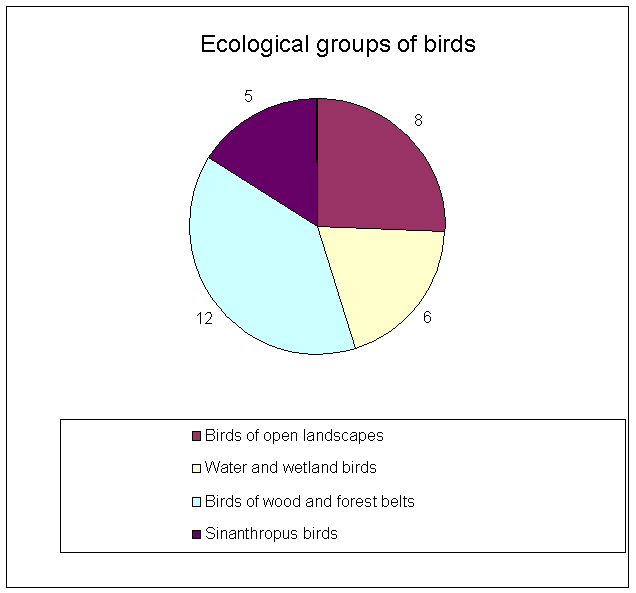

Drawing 1 –
Ecological groups of birds.
From
birds in a quantitative sense prevail perching birds. 4 ecological groups of
birds from which birds of wood and forest belts are presented by 12 kinds,
birds of open landscapes – 8, water and wetlands - 6, sinanthropus
– 5 kinds are allocated. Prevalence of birds of wood and forest belts speaks
presence of a sanitary-protective zone in a contour of a deposit which is
partially presented by a dead wood.
The
qualitative and quantitative structure of birds increases at removal from a
deposit on considerable enough distance (in vicinities of the rivers Utva, Karaoba,
Solyanka).
References
1. Bykov B.A. Ecological's 11 Bulls the dictionary. Publishing house
"Science", KazSSR, А-А, 1983, p.215.
2 Brem А «the Life of animals», М: «Exmo», 2003, P. 66-70, 131-132, 615-617, 666-667.
3 Rall
J.M. «Mammals of the Volzhsko-Ural sand» Microbiology, epidemiology and
parasites, 1935, volume 14, P. 71-78.
4 Serzhanin I.N. «Mammals SSR», Minsk, 1955, p.311.
5 «Mammals of Kazakhstan» under edition of member-correspondent KazSSR.
A.A.Sludsky. Volume 1. A part the third. Alma-Ata. "Science", 1977,
p.118-146, 313-338.