Velychko O.P.
PhD
in Economics, Associated
Professor
Dnipropetrovsk State Agrarian University, Ukraine
Logistical infrastructure in
agribusiness
In
contemporary economic studies the general term “infrastructure” is mainly
identified with different types of organizational management.
Thus І. Tsygaliuk and L. Babyk consider infrastructure as a set
(complex) of establishments, organizations and other subjects of spheres of
circulation, which provide the functionality for the market economy of a
country or a separate business [1, p. 148].
Similar
approach to defining essence of infrastructure can be found in works by Z.
Gerasymchuk and Y. Podernia-Mosiuk. According to them infrastructure is a
complex of organizations, establishments, middlemen, which task is in serving
any social-economical system for providing the appropriate functionality of
that system [2, p. 7].
Profound
study of this issue in logistics was carried out by Ye. Krykavskyi and N.
Chornopyska. Besides scientists also consider logistical infrastructure as a set
of enterprises of different organizational-commercial forms which create organizational-economic
conditions for passing of material, informational, financial and labor
resources by creating the potential in the corresponding logistical services.
However on the other hand they include in the term logistical infrastructure a
set of buildings and constructions with necessary equipment for storing the
goods, transportation and manipulation means, means of packing, means of
receiving, transferring and processing of information and so on [3, p.
109-111].
However
in most studies infrastructural elements of agrilogistics are considered in the
general system of the producing infrastructure of the agrarian complex.
In our view
the term logistical infrastructure in agribusiness should be connected with both
organizational and intra- and between organizational establishments. It is reasonable
to identify the following separate elements inside it which perform important logistical
tasks and provide carrying out of logistical processes and display
institutional-objective direction of development in logistics in agricultural
sector of economy (Fig. 1).
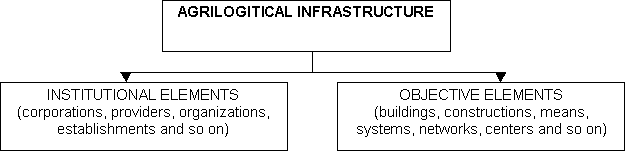
Fig. 1.
Main elements of logistical infrastructure in agribusiness
Source:
Author’s development
At that change of material objects in logistical infrastructure in agribusiness is a consequence of management over
development of providing logistics.
In general
understanding components of theory of institutionalism are such institutions as
a country, corporation, organization and establishment. To a certain extent they
appear in the system of logistical infrastructure of agrarian entrepreneurship.
Most often they achieve statuses of organizational-law forms.
Moreover
agrilogistical infrastructure is also a set of objects which have specific
location and versatile characteristics.
Furthermore
important infrastructural objects in agrilogistics are buildings and constructions
with necessary equipment for storing the produce, transportation systems and
networks, centers of packing produce, distributing centers and so on. Most
often they are intra-organizational logistical formations but could obtain the
status of separate organizational or between organizational forms.
Infrastructural
objects of agribusiness are connected with a chain of logistical business processes
in the field of plant cultivation, among which one of the most important is the
process of storing and transporting of the ready produce.
Institutional-objective
development of providing agrilogistics is connected with the term “infrastructure”
[4, p. 47]. Besides it is reasonable to distinguish institutional
(corporations, providers, organizations, establishments and so on) and
objective (constructions, buildings, means, systems, networks, centers and so
on) elements in logistical infrastructure. Owing to that logistical infrastructure
should be connected not only with organizational but also with intra- and
between organizational logistical formations and vice versa.
In agrarian
logistics important infrastructure object (buildings, constructions with necessary
equipment for produce storing, distributional centers, transportation systems and
networks and so on.) may achieve a status of independent organizational or
between organizational forms, at the same time most often they are
intra-organizational logistical formations.
One of the
essential consequences of management in development of providing logistics in
agrarian enterprises is a change of material objects of logistical
infrastructure.
Reference:
1. Tsygaliuk, І.I. & Babyk, L.R.
(2007). Ekonomіka pіdpryiemstva (v pytanniakh і vіdpovіdiakh) (Economics
of enterprise (in questions and answers)). Kyiv: Tsentr uchbovoi lіteratury (in Ukr.)
2. Gerasymchuk, Z.V. & Podernia-Mosiuk, Yu.A. (2008). Ekonomіchna sutnіst іnvestytsіinoi іnfrastruktury regіonu (Economical essence of the investment infrastructure
of the region). Zbіrnyk naukovykh prats
Lutskogo natsіonalnogo tekhnіchnogo unіversytetu (Ekonomіchnі nauky) (Collection of works by Lutsk National
Technical University (Economical Sciences)), 5(17), 5-7 (in Ukr.)
3. Krykavskyi, Ye.V. & Chornopyska, N.V. (2012). Logіstychnі systemy (Logistical Systems). Lvіv: Vydavnytstvo Lvіvskoi polіtekhnіky (in Ukr.)
4. Velychko, O.P. (2013).
Innovative development in logistics and its connection with logistical
management and management of logistics. Marketyng ta menedzhment innovatsii (Marketing and Management of Innovations), 1, 45-52