Economics/14.
Economic Theory
Ph.D.
in Economics Dmitriev A.А.
North-West Institute – The Subsidiary of the Russian
Presidential Academy of National Economy and Public Administration, Russia
On the Question of Economic Growth Necessity:
Evaluation of Efficient Rates and Maintenance of Stable Dynamics
A variety of conditions that underpin sustainable
economic growth acts as the subject of a matter of many discussions between
representatives of many economic schools. However, the existing diversity of
approaches can be restricted to two principal directions [1], [4]. The
Keynesian demand theory's assumption, complemented by factors determining the
dynamics of supply, can be taken as a basis for the first trend [3]. The second
trend is based on neoclassical models, including particularly noteworthy the
economic growth model of R. Solow [6], [7].
At the same time, it should be noted that according to
the author's opinion none of the theories that form the above mentioned
directions, does not pay sufficient attention to the issue of "the
economic growth necessity".
Taking out of the brackets the things which "need no extra
proof", the theories emphasize the factors promoting a positive economic
dynamics, as well as the obstacles faced in the efforts to achieve an
acceptable growth rate.
The author proposes to change an approach to a consideration
of a problem and makes wonder: what is a pressing need for economic growth? It
is generally accepted that economic growth is a means to meet the growing
population consumption [4]. Indeed, taking
into account study findings conducted by the of the Minnesota University, that
by 2050 the world's population growth rate will outstrip the food growth rate,
the problem of increase in output in agro-based industries is sensibly burning [10]. However, this problem, despite its critical importance in
terms of the physical survival of the people, has an industrial character,
while aggregate growth data of all industries, regardless of their involvement
in the process of public consumption, are the subject of the modern economic
growth theory.
What other increasing people needs can be
satisfied by enterprises? Let's tale as
an instance a wireless phone market. It will be reasonable to suppose that
nowadays technology and industrial bases can provide everyone, who has enough
funds, with this devise. But there is a growing number of evidences (still not
found a confirmation in formal records, though) that manufacturers, having
possibilities to ensure a trouble-free service of the devices for at least 5
years of operation, voluntarily cut their real useful life to one to two years [9]. Afterwards cell phones break down, and a consumer is forced to buy
another model. So, with regard to this industry the explanation of economic
growth purpose from needs satisfaction point of view seems at least absurd: the
purchasing needs are satisfied, while a growth of production turnover (achieved
including by the above mentioned method) of corresponding industries serves to
achieve a certain purpose.
It is reasonable to ask, how far this purpose
meets public interests, considering the
amount of resources involved in the process of achieving it.
Let's try to study this purpose transcend the limits
of the above mentioned industry, but from macroeconomic approach.
Start with the
quotation from the work of J.M. Keynes "The General Theory of Employment,
Interest and Money": "Consumption is satisfied partly by objects
produced currently and partly by objects produced previously, i.e. by disinvestment. To the extent that
consumption is satisfied by the latter, there is a contraction of current
demand, since to that extent a part of current expenditure fails to find its
way back as a part of net income... Now all capital-investment is destined to
result, sooner or later, in capital-disinvestment. Thus the problem of
providing that new capital-investment shall always outrun capital-disinvestment
sufficiently to fill the gap between net income and consumption, presents a
problem which is increasingly difficult as capital increases" [3, p.107].
Thus, the great scientist connects the following two
issues: the pace of investment growth, which is, as you know, the main factor
for economic growth in the Keynesian approach, with a temporary gap between
demand and supply.
We shall consider this connection more detailed, using
an abstract model of the national economy without external commercial
relations. To simplify the model we will also suppose that there are no
government expenditures and dues in the system. In the economy some industries
operate producing end products in the amount of Y. These industries consume the
production, which is manufactured by intermediate fields, in the amount of
X. Wages paid to employees of all industries
w are formed by means of the aggregate income Y+X. Under conditions, all
enterprises get profit, which is calculated by subtraction of material
expenditures and wages from an income. Material expenses of end industries are
equal to the sum of production expenditures of intermediate industries X, while
material expenses of intermediate industries are equal to the sum of each other
production expenditures.
Taking into account basic assumption of import absence
we draw attention that a wage has to be a source for a payment of a total output
(Y). In such a way a payment passes directly to end industries, while to
interim ones indirectly - through a purchasing of their products, i.e. raw
materials, components etc., by end industries. But under the given conditions
Y>w, as wages are formed as a part of an aggregate income. What then next
time will be a payment source for that part of output, which will remain after
a salary payment? For instance, an output is equal to RUB 15 trillion. Of this
amount RUB 12 trillion are spent for wages (also indirectly via a financing of
interim industries, which pay wages to their employees). And, assuming an
absence of savings, the same amount of wages has to be spent on products
purchases. But an aggregate cost of purchased production is equal to RUB 15
trillion. Where is the missing RUB 3 trillion then? And if to assume savings
involving, then the problem will appear in another view: now a wages fund,
which could be spent on a consumption, is decreased even more: for example, to
RUB 10 trillion. Now, there is an underconsumption in the sum of 5, but not 3
trillion as before!
Further, the part of an aggregate income that was not
allocated in to the wages fund (RUB 5 trillion), would have to be channeled to
an investment financing. Thus, the following question arises, whereby companies
will be able to finance investments in the total amount of RUB 5 trillion, if
their production at the same value of RUB 5 trillion will not be purchased.
On the other hand, at equilibrium RUB 2 trillion of
savings are fully converted into investments via mechanisms of financial
market. By this financial injection companies cover RUB 2 trillion of
investment costs. But we still have RUB 3 trillion, which is not compensated
either by consumption of wages earners or by their savings.
Consequently, a part of
investment (both long-term and for current expenses) just cannot be financed. A
reasonable objection arises: investments can be financed through a loan. But a
loan has to have its source. Savings accumulated by the banking system are the
main source. But the savings amount in our example is a part of wages paid by
companies to their employees: RUB 2 trillion. This is the part of money that
was withdrawn from current consumption and returns to economic turnover through
a crediting system. In other words, RUB 12 trillion from RUB 15 trillion of
final output is spent on wages. RUB 2 trillion from this amount is directed for
savings. RUB 10 trillion of wages, in turn, is spent for production payment.
Another RUB 2 trillion businesses receive from loans, derived from savings.
Again RUB 3 trillion of production is not recovered! Besides, it will be
necessary to pay for a credit. The real value of this payment is a differential
in a credit interest rate and a deposit rate. And this value just decrease the
total amount that remain available for enterprises: say, this time only RUB
11.5 trillion of production will be covered instead of RUB 12 trillion.
Thus, it may be concluded
that a propensity to costs reduction by reducing of wages creates condition for
reducing of aggregate income. Plus, income reducing will have to be speeded up.
The last conclusion can be easily proved
by elementary arithmetic.
The following question will
be quite reasonable: how was this system in existence for nearly two hundred
years, if the principle resulting to a cascade (cumulative) decreasing of
aggregate income has been accepted as a basis? The doubt can be removed if to
pay attention that the situation has been considered from a static aspect: a
momentary interaction between enterprises, wages earners and banks took place.
But real economic processes develops within a period of time, even more, we
speak not about just stages changes, but about a process development. Forestall
a consideration of economics as a dynamic process we will specify two
conditions: the first one was mentioned above referring to J.M. Keynes and the
point is that there is a time gap between consumption and products sale, and
the second one includes an admission of existence of technological progress as
a fundamental condition for economic growth [1],[4],[9].
Now, let us consider interaction of supply and demand
implemented in several steps.
The part of income received on the stage 1 (denote by
Yt1) is spent on investments (improvement of manufacturing process,
creation and updating of new production methods). As a consequence, an output
is increased up to Yt2 on the next stage. But, a wage Wt2
has to be grown together with an output, moreover, by the amount that will make
possible to buy the production volume of the previous stage, which is equal to
the profit amount received also on the previous stage - it1.
Wages paid to employees on the second stage is the only
means to pay in full the production output produced on the previous stage. For
instance, in the given above example a new amount of output is RUB 18 trillion.
15 trillion from this amount is total wages. Some part of this wages is spent
for a financing of the output which has been produced on the previous stage
(exactly those RUB 3 trillion which formed a profit). But a new contradiction
emerges. A profit is also generated on the second stage - the same RUB 3
trillion (18 trillion minus 15 trillion). This amount, in its turn, can be
financed by a part of wages that will be formed on the next stage. This process
can be demonstrated on the following diagram (Fig.1)
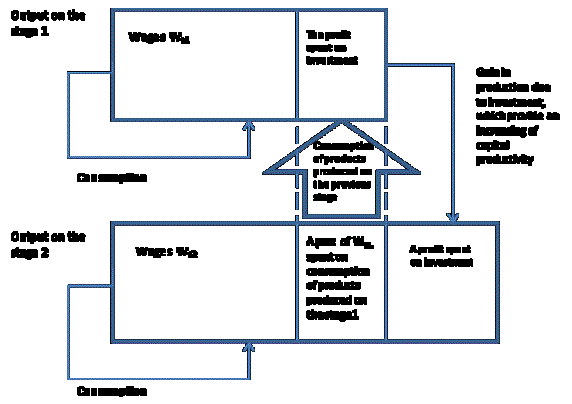
Figure 1
As the diagram indicates, on the
second stage (period) even more part of output turns out to be not sufficiently
financed due to the fact that a part of wages (a part Wt2) was given
on the previous stage. And on the third stage it will be required still more
part of wages in order to finance both a profit of the second stage (it2)
and a part of wages of the second stage (a part Wt2)
It seems to be evident that if at any stage an
investment efficiency turns out to be insufficient for creating of wages-fund
as needed, then a part of output produced on the previous stage will stay to be
stored at warehouses. As a result, an income from sales of these products
companies hoped for will not be fully received. Further, to avoid decreasing of
a profit rate (due to losses of the previous period) companies can make a
decision to reduce salaries. But in accordance with the above given scheme a
reduction of wages will undermine an aggregate demand even more. And an
economic growth process, powered on each stage by investments in technological
development, will give place to a fall process that will also have a
self-spiraling accelerated behavior. Let's compare this conclusion with the
conclusion of J.M. Keynes, given on the page 3 of this article, that amounts of
new investment are always have to be sufficient enough to fill up the gap
between net income and consumption.
Thus, a modern market
economy can be compared with a two-wheeler, which is required to gain
continuously the certain speed in order not to fall sideways. Back to the issue
of economic growth necessity stated in the beginning of this article we will
formulate the following hypothesis: the fact of a profit existence by itself
inevitably push owners and management of companies to an output expansion and
products sale without regard to whether it meets public needs or not. And the
more a profit rate, which is companies count on, the more investment efficiency
provided economic growth is required. And it is quite in tune with the
conclusion of J.M. Keynes that "financial reserves, which are not spent on
current investment, affect adversely on the level of consumption and
employment, and stimulate an increasing of new investments" [3, p.101].
Before moving to the next
point it is necessary to touch on one more problem aspect of no small
importance.
Namely, an increased amount of output on each stage
(or in each period) has to be provided by sufficient volume of financial
resources. Thus, a growth rate of
economic money supply has to be adequate to the expectative growth rate of gain
in production that is quite corresponded with the monetarism doctrine [5]. And
it turns out that such a brittle system of an aggregate product reproduction is
kept from downfall only due to a possibility of continuous increasing of labor
and capital productivity together with a balanced policy of money supply. But
there will be always a possibility to successfully combine these two factors of
economic growth? It is obvious that the answer will be negative, because
scientific and technological development acting as the primary instrument of
labor productivity [6], [7] is not a properly predictable unit.
Consequently, there must be another mechanisms, which
allow to recover possible losses upon occurrence of unfavourable circumstances.
To reveal a nature of these mechanisms, let's assume existence of foreign trade
relations in the taken system. Then, it turns out that a gap between aggregate
output and aggregate demand (in the amount of RUB 3 trillion as shown on the
page 4 of the article) can be filled in
by export income. And in the case if earnings from sales of products abroad
will be, at least, not less than a total profit, then there will be no
necessity to increase an output of products for a domestic sales so
significantly. However, it seems that such an attractive way to avoid the
problem of domestic demand has its restrictions. In particularly, an expanding
of production capacity delivered abroad can lead to a conflict of interests of
the countries, which are competitors in some fields on the international market:
export incomes of one country are formed by withdrawal of money resources from
circulation of an importing country, which in other cases could be spent for a
domestic demand.
At the end we would like to summarize the conclusions,
which are formulated by the article, and which reflect the author's point of
view regarding the discussed issue:
1. It is proposed to consider a profit as the "negative"
factor of economic growth, i.e. the growth serves as a feedback on the response
of a total profit increasing, or as a method of negotiation of its
destabilizing influence;
2. Closing the gap between an aggregate demand and aggregate supply
resulting from a profit by a production capacity expanding, companies get an
incentive to a continuous increasing of production output without regard to
whether this product will be really demanded by society or not. In this case,
such motive of economic growth as a job creation [10] just amends this
conclusion, as far as a salary also will not be fully paid to new employees
because of a profit-maximizing reason;
3. A continuous development of labor productivity (achievable through
scientific-technical progress and technical progress, business activity)
together with a balanced policy of money supply is an inviolable factor for a
sustainable economic growth;
4. An expanding of products export facilitates stabilization a country's
economic situation and decreasing of dependency on domestic demand, which is
always not sufficient to cover a supply at a long-run equilibrium. At the same
time, possibilities for export expanding are limited, and one of the most significant
constraint is determined by competitive and differently directed interests of
countries entered into international trade flow as participations of a
"zero-sum play".
At the same time the author of the article accepts
that the suggested approach requires the further amendments with consideration
of the factors as follows: taxation and government expenditures, functioning of
securities and currency markets, government debt, exchange rate, etc. The
author expresses thanks in advance for constructive comments on the theses.
References:
1. Agapova Т.А., Seregina S.F. Macroeconomics – М.: Publishing house
«Delo and Service», 2001
2. Dornbusch R., Fischer S. Macroeconomics – М.: «Infra-М», 2002
3. Keynes J.M. The General Theory of Employment, Interest and Money - М.: «Gelios ARV», 2012
4. Lavrov Е.I. Economic Growth, Theories and Problems: education guidance - Omsk:
Publishing house of OmGU, 2006
5. Fisher I. The Purchasing Power of Money, М.: Publishing house «Delo», 2001
6. Solow M. Robert. А Contribution to the Theory of Economic Growth/ M. Robert. Solow / /The
Quarterly Journal of Economics, 1956, №1, pp.65-94
7. Solow M. Robert. Technical Change and the Aggregate
Production Function / M. Robert. Solow / / The Review of Economics and
Statistics, 1957, №3, pp.312-320
8. Digging deeper into the grought /
gli.enviroment.umn.edu/tag/food-secutity/
9. The Quality of Modern Cell Phones /
http://club.radioscanner.ru/topic1179.html
10. The slowdown in the world economic growth, calls
for innovative solutions and increased cooperation among business leaders
worldwide / http://eurochambres.eu