1О.M. Sinchuk,
Dr of Sciences (Technics), Prof., 2D.A.
Mykhhailychenko, snr lect., S.M. Boyko,
asp.
1SHEE «Kryvyy Rih National University»
2Kremenchuk Mykhailo Ostrohradskiy National
University
THE PECULIARITIES OF THE WIND POWER GENERATING AUTONOMOUS SYSTEMS’ EXPLOITATION IN THE UNDERGROUND
MOUNTAIN IRON-ORE MINING
The prospect and specificity of work of the wind-power generation complex in the conditions of the
operating underground iron-ore mines was analysed. The
aerodynamic features of vent currents of air of the underground iron-ore mines
and their influence on the the wind power generating system’s work was investigated. For achieving the optimally possible efficiency of the
functioning of the wind power generation system, its construction was justified and offered for
practical realization. It was worked out the structure
of the electromechanics part of wind power generation complex and its control
system with the forecast potential of reliability and quality of power supply for
consumers of the electric energy in the
underground iron-ore mines. It was proved the economical efficiency of the application of the wind power generation
system in the conditions of
the underground iron-ore mines.
Key words: wind power generation system, wind power generation complex, renewable
energy sources, economical efficiency.
The actuality of the theme. Due to the stable tendency of the annual
growth of the consumption of the electric
energy (EE), the increasing of the prices for its production, as
well as the influence of the environmental restrictions, which
are constantly raising, the task of increasing the volumes of
EE becomes more and more urgent by means of the renewable
energy sources, especially wind energy, which in wind power
generation system (WPS) will be converted
into electricity. It is important that the expected effect of their implementation is possible to achieve only in common usage and application of the wind
turbines in spheres including industry and everyday life. Those
underground mines can be of
great interest, where, according to the work technology of the artificially created
air flow with its constant parameters present.
The aim of
the researches focuses on the development of the theoretical aspects and practical solutions as for particular usage of the air
vent stream of the underground iron-ore mining to produce the electrical
energy by means of the developing of the autonomous wind energy generating complexes with the automatic
control system.
The
materials of the researches. To achieve the mentioned above
aim it was analyzed the specificity
of the wind power generating complex
(WPC) in terms of the operating underground iron-ore mines, a design of the
complex with the vertical axis of the rotation
within the direct conversion of the wind
energy into EE was developed, and its structure was
synthesized .
To fulfil the above objectives it was assessed and analyzed the possibility and
specificity of the wind
power generating complexes (WPC)
in terms of the operating underground iron-ore mines (IOM). The primary configuration of the structures of the complex with
the vertical axis of rotation of
the wind energy transformation
was offered as the object for further research and studies [1, 2].
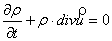
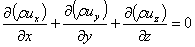
The continuity
equation of the air flow with velocity u by
Euler’s variables
can be viewed in the following form (1)
[3, 5]
 (1)
(1)
where  – the divergence of the vector of velocity
  ,
,  – concentration,
  – the rapidity of the gas motion.
 ,
,  ,
,  (2)
(2)
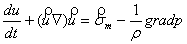
The
equation of motion (Euler’s
equations) in the vector form has the following coverage (3) [4, 5]:
 (3)
(3)
where  – tension, p – pressure,
  – concentration,
  – rapidity,
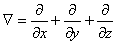 the operator «Nabla»
The equations of motion of the viscous gas can be written in the form of the
Navier-Stokes’ equations in the vector form (4):
 (4)
(4)
where t - time; uj - Cartesian components of the vector of the average speed (u,v); p - pressure;
r - concentration; ν - the coefficients of the
kinematic viscosity, are provided in condition if  and
and  , where
  – the kinematic viscosity (coefficient
of the internal friction),
– the kinematic viscosity (coefficient
of the internal friction),  – second viscosity,
 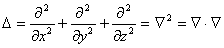 – the Laplace operator,
  – the
field tension of the mass power,
– the
field tension of the mass power,
ρ concentration, p – pressure.
According to the research results it is obvious to state that the feature of the working of WPC is
that it is a non-linear, non-stationary object of being in command of and it is under the influence of the dynamic
wind tension, the energy of which is of the
stochastic nature [4, 3].
As
a result, it was developed the structure of
Electromechanical part of the WPC [5, 6] on the basis of the
asynchronous generator with
short circuited rotor, with the help of the
regulation of frequency and the output voltage it makes the level of energy consumption of the connected
consumers stable. A rechargeable battery (battery) is of
great importance for maintenance of uninterrupted power supply to consumers in
the emergency conditions of work and issuance generator of the WPC to provide the
nominal voltage level and frequency.
In the process of rotation of the wind wheel and shaft of the
generator, the microcontroller analyzes the value of signals incoming,
and it makes a conclusion about the value of the
specified voltage of triacs blocks. Until the
power
of the additional capacitors allows to regulate
the output frequency and voltage, these parameters are controlled by the
battery of the working capacitors. If the
capacity
control does not bring results, frequency and voltage
continues growing, the specified voltage is applied to the second
group of triacs and it
connects
ballast tension that normalizes the output
voltage and frequency.
The
proposed model, which is developed
on the basis of the fuzzy sets theory, carried out within Matlab
6.5 [8, 7]. The results of the simulation are presented in Fig. 1.
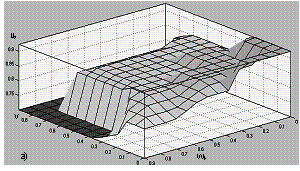

Figure 1 – The
dependence of the voltage tasks: (a) for the remote control unit
(RCU) on
the output frequency and voltage of the generator, air velocity and rotation of the wind wheel (WW); b) for the voltage supply (VS) from the output frequency and voltage
of the generator, air velocity and rotation
of the WW.
The following option of the programming
allows the control system to respond to any changes on the levels of WPC and
according to these changes, it adjusts the output parameters of the asynchronous
generator.
The
structure of the new WPC and its control
system allows to increase the reliability and quality of the power supply
to the consumers, to expand the battery service
term, to ensure the replacement of out-of-order parts, and to reduce
expenses for their operation, and maintain the constant power
supply to the consumers of EE [9, 10].
While calculating the economic efficiency and expediency of the application of the WPC in the conditions of IOM,
it is necessary to consider the peculiarities of operation,
the specific characteristics of the installation and EE remoteness from the customer.
Thus, as a result of the carried out calculations, it can
be concluded that it is economically
practicable to use the WPC in the operating underground IOM, with the purpose of generating the electrical energy, even in comparison with the application of the WPC within the same parameters in a landscape
conditions.
Conclusions
1. As a result of the appliance of the ventilation
air flows in the underground iron ore mining,
the conversion of wind energy into electricity there is a
real opportunity to generate and use EE for underground enterprises own
needs, at the same time saving money for its purchasing.
2. It was developed the mode to
control the output voltage of the asynchronous generator with a short-circuited
rotor within the composition of the wind power
electrotechnical complex and it enables to regulate smoothly the
value of the output parameter, at the same time the system will
consider the slightest changes of the speed
ventilation flows or extent of the tension.
3. It was proved the economic efficiency
of the wind power generating systems’ appliance in the conditions of the underground
iron-ore mining.
List
of references
1. Sinchuk O.N., Boiko S.N., Shcherbak M.A. About the dependence of the
energy of the coordinates of the wind power system with a vertical axis of rotation in the condition
of the aerodynamic conditions mines// Technical
Electrodynamics. Thematic edition «Power electronics and energy efficiency».
Part 4 - Kharkiv, Institute of
Electrodynamics of NAS of Ukraine, 2012. - P.171-172
2. Sen’ko V.I,
Boiko S.N., Shcherbak M.A.,
Zhukov A. A. Mathematical model of the system of controlling the electrotechnical complex of a wind power system on the basis of the fuzzy controller// Electro-technical and energy-saving systems. Thematic issue of «Problems of automated electric control. Theory and practice» scientific journal - Kremenchug, KrNU,
2013. - Vol.. 3/2013 - P.117-129
3. Sinchuk O.N., Boiko S.N. Fuzzy logic and coordination of operative modes
of the wind power system within the flow velocity in the conditions of ore mines
«Technical Sciences - from science to practice»: materials of the XIV international scientific-practical conference. (October 10,
2012) - Novosibirsk, «Siberian Association of consultants», 2012. - 50-55 P.
4. Yavorskiy B.M. Reference book in Physics for Engineers and Students B.M. Yavorskiy, A.A. Detlaf / / «Science» M - 1971. - P.
134 - 269.
5. Prahovnyk A.V., Solovei A.I., Prokopenko V.V. and others Energy management / A.V. Prahovnyk - K.: IEE NTUU “KPI”,
2001. - 470 P.
6. Q. Wang and L.-C. Chang, “An intelligent maximum
power extraction algorithm for inverter-based variable speed wind turbine
systems,” IEEE Transactions on Power Electronics, vol. 19, pp. 1242–1249,
September 2004.
7. T. Nakamura, S. Morimoto, M. Sanada, and Y. Takeda, “Optimum control of
ipmsg for wind generation system,” Power Conversion Conference (PCC), vol. 3,
pp. 1435–1440, 2002.
8. Harki Apri Yanto Modeling and control of household-size
vertical axis wind turbine and electric power generation system / Chun T. L.,
Jonq. C. H., Sheam C. L. // 2009 National Taiwan University of Science and
Technology. 7 рр. Taipei, Taiwan.
9. Sreedhar Reddy
Guda Modeling and power management of a hybrid windmicroturbine power
generation system. / Sreedhar R. G. //
2005 Montana State University. A thesis submitted in partial fulfillment of the
requirements for the degree of Master of Science in Electrical Engineering. 154 pp. Bozeman, Montana.
10. S. Muller, M.
Deicke, and R.-W. De Docker, “Adjustable speed generators for wind turbines
based on doubly-fed induction machines and 4-quadrant igbt converters linked to
the rotor,” IEEE Industry Applications Conference, vol. 4, pp. 2254–2259,
October 2000.