R.F. Zhussupova, K.M. Nabiyeva
L.N.Gumilyov Eurasian National University
Conditions
of enhancing linguistic giftedness and foreign language aptitude of Astana’s
pupils
The article describes different
approaches to the definition of learners’ giftedness in
Astana city, types of giftedness; moreover
it presents characteristics of how to define giftedness among Astana’s
learners. The article presents “Multiple Intelligences”
model of giftedness by Gardner as the model for teaching English language to
gifted students. In addition, the problem of evaluation and assessment of
gifted students’ performance in the classroom is analyzed in the article. The
article also presents the term "polylingual communicative giftedness” as a
complex psycholinguistic and communicative-strategic ability for learning
world’s languages and preparedness to communicate in any
language. The statistics of gifted students’ achievements of Astana that take
part and achieve results at international scientific Olympiads and competitions
is given in the article.
Key words: giftedness, linguistic giftedness abilities, signs of giftedness,
model of giftedness, gifted pupils, scientific Olympiad.
Language makes up a significant part of the total human experience and
possesses different structures and patterns of meaning and may pay attention to
contrasting aspects or characteristics of events. This gives the foreign
language its unique quality, with its own particular blend of sounds,
conventions and shared understandings, which the native speaker assimilates
both culturally and linguistically. The foreign language learner has the
challenge of learning new knowledge and a new mode of meaning in order to gain
some insight into another person’s reality and access to other social domains.
There needs to be applied a
comprehensive approach to mastering a foreign language and acquiring the
language proficiency. First of all, communicative skills, language intuition
and language ability do not necessarily facilitate a learner with the formation
of the second language
personality. It also should be noted that the formation of the second
language personality is the final stage of mastering a foreign language.
The notion “second language personality” is defined as “the total of the
foreign language aptitude of a learner on the cross-cultural level” [1,
59]. Thus, both the linguistic
giftedness and the foreign language aptitude are only pre-requisites to the formation
of the cross-cultural competence and the development of the second language
personality.
Moreover, there are still many controversial questions concerning the
development of linguistic giftedness and foreign language aptitude, i.e. the
opportunity of individualization and differentiation of language education in
schools; relevance and necessity to teach foreign languages from an early age,
new approaches to the development and support of gifted children; “side
effects” of multilingualism and early foreign language education; non-testable methods of revealing
the linguistic giftedness; the direct connection between foreign language
aptitude and native language acquisition, the innate character of linguistic
giftedness.
The Voytko
psychological dictionary (1982) defines the notion of giftedness as “a high
level of abilities and potential” [2]. Giftedness is the result and evidence of
the high level of a person’s intellectual development.
N.S. Leytes
defines giftedness as:
«1) a
fundamentally unique combination of abilities that provides a successful
implementation of activities. Thus, a set of integrated abilities with a
special structure makes up for the lack of other skills by means of developing
the complex of combined abilities;
2) general abilities
that determine the amplitude of a person’s abilities, his level and the
peculiarity of activity;
3) an
intellectual potential and integral individual characteristics of cognitive
capabilities and learning abilities;
4) talent; the
internal conditions for outstanding achievements in a given field. Multiple
meanings of the term “giftedness” point out the issue of an integral approach
to a sphere of abilities. The phenomenon of giftedness requires a complex
scrutiny, i.e. by means of applying psychophysiological,
differential-psychological and social-psychological approaches [3, 247, 248].
Giftedness by occupation is distinguished the following way:
· practical,
· theoretical (cognitive),
· artistic-aesthetic,
· communicative
·
spiritual-evaluative giftedness;
By sphere of mind:
· intellectual,
· emotional
· volitional;
By degree of development and forms of manifestation:
· topical and potential,
· evident and hidden giftedness;
By manifestation of giftedness in different kinds of activities and age peculiarities:
· common (mental) and special,
· early and late giftedness.
The general
giftedness is the foundation for the development of special giftedness. The hypothesis about the existence of general giftedness was pointed
out by the English psychologist Francis Galton in the middle of XIX century.
And in 1929 Charles Spearman presented the two factor intelligence theory which
explained the high degree of correlations in diverse tests by the general
factor of mental energy, i.e. the majority of special factors define the
success of implementation of a certain test.
For a long time there have been many discussions among the proponents
of quantitative evaluation of primary
abilities (Edward Lee Thorndike, Louis Leon Thurstone)
and the proponents of “general factor” (Hans Eysenck, Cyrul Burt
and others). Thanks to the researches of J. Guilford, E. Torrance and D.
Bogoyavlenskaya psychology distinguishes two types of general giftedness:
intellectual and creative giftedness (creativity) [4, 16-20].
Gardner produced
a model for giftedness called Multiple Intelligences, which incorporates
domains that are socially and culturally valued. The eight intelligences include:
the linguistic, musical, logical-mathematical, spatial, naturalist,
bodily-kinaesthetic, interpersonal and intrapersonal. Thus, intelligence is not
a single entity and in Gardner’s view each discrete intelligence is a system in
its own right. Therefore each intelligence operates independently of others and
an ability assessment of one does not indicate there would be a similar ability
level in another [5, 3-33].
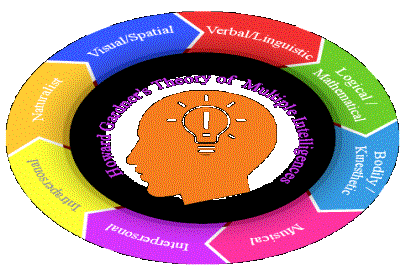
Pic.
1 Gardner Multiple Intelligences.
Sternberg asserts
that in order for a person to be considered gifted they have to meet five
criteria: excellence, rarity, productivity, demonstrability and, value. The
individual needs to be extremely good at something “relative to peers”, and
possess a “high level of attribute that is rare”. They must possess the
potential for productive work in some domain. It is not enough to be labeled
“gifted” based solely on test scores. An individual has to demonstrate gifted
traits, according to Sternberg and Gardner. The demonstrability criterion
states that the individual’s giftedness should stand up to assessment using
valid and reliable tests. The value criterion restricts the identification to
those who possess an attribute that is valued as relevant by the society or
culture [6, 14-27].
Linguadidactics
considers the development of special giftedness on separate subjects as the
most future-oriented one, as giftedness transfers from a prospective point to the point of actuality which actively
manifests itself in educational-cognitive activity of learners.
Giftedness can
display itself at different stages of personality development, but namely the
senior school age is considered by psychologists as the most sensitive age for
the development of giftedness which manifests itself in reflective and
productive skills. Moreover, the senior school age is not just the age of the
manifestation of giftedness but the age for deepening and integral composition
of already established abilities and their complexities [7, 210-214].
There are many
discussions in works of national and foreign psychologists concerning special
abilities and in particular the foreign language aptitude. The analysis of
scholarly literature that looks into scholarly literature allows to distinguish
the following:
– intellectual
abilities as intellect characteristics provide the success of intellectual activity in the context of correctness
and velocity of information processing, originality and multiplicity of ideas,
depth and tempo of learning that are displayed in abilities to observe, raise questions, discern problems, put forward hypotheses, give
definitions to notions, classify, draw conclusions and inferences, structure
materials, explain, prove and defend ideas
(М.А.Kholodnaya, 2002) [8,
138];
– communicative
abilities as psycho-physiological peculiarities of personality which provide a successful interaction between language partners in solving pragmatic
and communicative problems. In fact, communicative abilities presuppose not
only a language proficiency but also rules and norms of communication with
respect to the extra-linguistic situation (E.А.Golubeva, 1989; M.Canale,
G.Zimmerman, 1973) [9,
341-346];
– linguistic
abilities as a complex mental formation which is characterized by a dynamic
structure that unites the following components:
·
mnenic – the scope of verbal, semantic and mechanical
memory (I.А. Pappoport, 1976; J.Carrol, 1962);
·
reflective – logical and
associative thinking (Y.А. Vedenyapin, 1969; I.А. Zimnyaya, 1970; V.
Nechunas, 1971);
·
perceptive – ability to presuppose language elements, flexibility
of transformational processes, sensorial-perceptive and differential sensitivity (А.Т. Alybina, 1977; М.М. Hochlerner,
1983; I.N. Lukashenko, 1983; F. Marek, 1967) [9, 364-369].
The evaluation of
giftedness can not be based solely on testing – the degree and distinctness of
giftedness is revealed in the course of training and education while
implementing a certain informative activity with learners.
It is not the goal to distinguish giftedness as early as possible in a
premature and excessive manner. In fact, the revelation and development of
gifted learners should be facilitated by special schools (for example: musical
and mathematical) involving extracurricular activities, different coteries,
studios, school Olympiads arrangement, competitions of school art performances.
On the other hand, it is absolutely unacceptable to hinder the development of
gifted learners. The academic workload, forms of education and training of
these children should be correspondent with their abilities. The solicitude for
gifted children presupposes the development of abilities by virtue of general
educational development and personality enhancement» [3, 248].
One cannot judge
about the existence of giftedness solely on the ground of standard examination
results. The giftedness in children can be distinguished and examined only in
the process of education and training, i.e. in the course of implementing some
kind of informative activity.
Whereby, the early manifestations of giftedness do not yet determine a person’s
future abilities: for the reason that it’s difficult to foresee the course of a
further formation of giftedness [10, 257, 258].
A gifted personality
possesses the unity of mind and activity, i.e. such kind of person is a highly
active learner whose psyche serves as a unique and ultimate plan of activity;
as a creative model of reality which enables a gifted learner to familiarize
itself easier with the environment on all levels of determination; as an
individual, a personality and a human being – thus providing a life-sustaining
activity, internalizing and producing a better social experience [11].
According to the
principle of mind development, a creative and gifted personality develops in
the process of early maturation and formation of psycho-physiological potential
(meaning – the human body), as well as in the process of abilities development
by acquiring values and their use (meaning – the individual development) and in
the course of transformative and values-formative activity (meaning –
personality). All of these levels consequently dominate over each other and
replace each other under the scope of the unified factor system of the psyche
formation. The leading factor of giftedness is considered to be the personal
development which is connected with the creative activity. Moreover, creativity
appears as the creation process of individually and socially-valuable product,
as well as the process of self-development, self-fulfillment and
self-objectification of personality – on the basis of mastering and enrichment
of socially-historical experience [11].
In particular, a
creatively gifted personality embarks on the path of intensive creation of
inner and outer world with its positive and negative tendencies, success and
failure, achievement and risks. Following that, it requires some understanding,
acceptance and support from society and each member of the society for whose
prosperity the promotion of gifted and talented learners takes place.
The data of 2014
indicates that there are 88 public schools in Astana: 77 public schools, 11
private schools with the total of pupils: 102587 people.
Along with
innovative schools, there are four specialized schools for gifted pupils – the
Zerde school, the Kazakh-Turkish lyceum for gifted boys, the Kazakh-Turkish
lyceum for gifted girls and the school-lyceum № 48. These schools are among the
best ones in Astana and their pupils often demonstrate great results. The
number of pupils in such specialized schools amounted to 1426 which means that
there is a 14 % increase in gifted pupils at schools (Table 1).
The
number of gifted students in specialized schools of Astana. Table 1
|
№ |
The name of school |
The
number of pupils |
||||
|
2010-2011 |
2011-2012 |
2012-2013 |
2013-2014 |
2014-2015 |
||
|
1 |
The Zerde school for gifted pupils |
238 |
242 |
279 |
340 |
389 |
|
2 |
The kazakh-turkish lyceum for gifted girls |
245 |
267 |
272 |
279 |
290 |
|
3 |
The kazakh-turkish lyceum for gifted boys |
301 |
312 |
345 |
396 |
436 |
|
4 |
The school-lyceum № 48 |
72 |
46 |
218 |
235 |
311 |
|
|
Total |
856 |
867 |
1114 |
1250 |
1426 |
However, even
with a noticeable increase in the number of schools, the number of schools for
gifted students still remains the same.
In 2015 out of
102687 pupils, 67 % of them (68800 pupils) took part in educational Olympiads,
scientific and intellectual competitions of different levels.
Thus, 26255
school children participated in polytechnic competitions and 42545 pupils took
part in academic competitions of general education.
19787 pupils (which
makes up 28 % of all pupils in Astana) took part in the municipal Olympiad: 10012 pupils participated in polytechnic
section, 97662 pupils took part in academic section.
Overall, there are 4052 winners in the academic section and 3857 winners in the
polytechnic section.
On March 18th
2015 the Regional scientific and practical center “Astana Daryn” held the municipal academic Olympiad “Polyglot” at school № 71. In total, 66 educational institutions submitted applications to
take part in this Olympiad. Out of 212 pupils who were selected to take part in
this competition in English language section, 88 of them proved to be excellent
at English.
The republican
program of education development 2011-2020 of
the Republic of Kazakhstan states that there is an aim to integrate with
the world educational field which would result in increasing the
competitiveness of Kazakhstani education.
For the purpose of education system advancement and implementation of
challenges The Ministry of Education and Science of the Republic of Kazakhstan
has taken steps to enhance requirements for international intellectual
competitions where Kazakhstani pupils take part.
By order of the
Ministry of Education and Science of the Republic of Kazakhstan of December 7th
2011 № 514 there has been approved “the list of republican and international
Olympiads and scientific projects competitions on general education subjects,
professional skill competitions and tournaments where there have been included
20 international Olympiads and 9 international scientific competitions on
general education subjects, republican scientific competitions and republican
Olympiads. Pupils of educational
institutions of Kazakhstan withstand the competitions with flying colors at
international level in Olympiads and scientific competitions, thus presenting a
positive image of our country in the world stage. The spectacular example of
efficacy of municipal education system is the victories in international
Olympiads and scientific competitions (Table 2).
Table 2. Data on
participants of international competitions
2014-2015 educational year.
|
The title of competition |
Total of participants |
1st place |
2d place |
3d place |
Total of medal places |
|
International
competition «MOSTRATEC» (Brazil) |
18 |
4 |
4 |
10 |
18 |
|
International
scientific competition “The young scientist
(South Korea, Daejeon) |
52 |
5 |
7 |
23 |
35 |
|
International competition
of pupils’ research works on the mechanics
and mathematics named
after U. Dzholdasbekov |
60 |
6 |
6 |
24 |
36 |
|
ХІ international competitions on space exploration “Discovering the world
of science” (Baikonur) |
105 |
11 |
14 |
31 |
56 |
|
The All-Russian Olympiad “Sozvezdiye” of scientific – research
and educational – research projects among children and youth on the
environmental protection problem “Person – Earth – Space” in Moscow. |
7 |
|
|
5 |
5 |
|
International
competition of projects «INFOMATRIX» |
49 |
2 |
7 |
18 |
31 Grand Prize: 4 |
|
The All-Russian
competition of research works named after V.I. Vernadsky |
3 |
1 |
|
|
1 Certificates: 2 |
|
Internation Olympiad
IYEPO-2015»(Georgia) |
34 |
3 |
14 |
16 |
33 |
|
International
scientific competition “Mathematics and
project engineering (Moscow)” |
48 |
1 |
3 |
5 |
9 |
|
International
competition «I-SWEEP» (USA,
Houston) |
4 |
|
|
|
4 Certificates: 4 |
|
Asia-Pasific Olympiad |
2 |
|
2 |
|
2 |
|
International Olympiad
«Silk Road» |
1 |
|
1 |
|
1 |
|
International Balkan
Olympiad |
1 |
|
|
1 |
1 |
|
International Eurasian
Olympiad on computer |
3 |
|
|
3 |
3 |
|
The first Republican
Olympiad on Kazakh language and Literature named after K. Bitibayeva |
8 |
|
1 |
1 |
6 Certificates: 3 |
So, totally in
2014-2015 319 pupils of Astana participated in international top-rated
Olympiads and scientific competitions in the United States of America, Brazil,
Georgia, Russia and South Korea and became the recipients of 235 medals: 37
gold medals, 59 silver medals and 135 bronze medals (Table 3).
The results of
participation of Astana schools in international Olympiads and scientific
competitions. Table 3
|
Educational year |
Total of medal places |
Gold medals |
Silver medals |
Bronze medals |
|
2009-2010 |
153 |
56 |
44 |
53 |
|
2010-2011 |
172 |
69 |
46 |
57 |
|
2011-2012 |
104 |
23 |
38 |
43 |
|
2012-2013 |
144 |
43 |
41 |
60 |
|
2013-2014 |
237 |
64 |
76 |
97 |
|
2014-2015 |
235 |
37 |
59 |
135 |
Thus, we can
observe the dynamical growth of achievements among gifted pupils during
2009-2015.
These numbers
indicate the growth rate of winners among
Kazakhstani pupils and represent the productivity of Astana education system (Diagram 1).
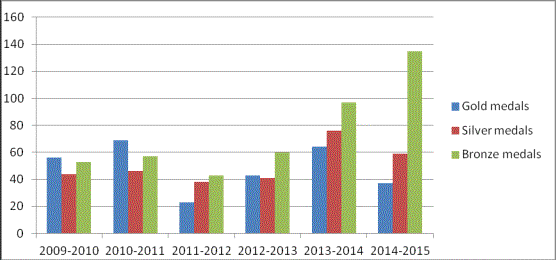
Diagram 1. The results of participation of Astana
schools in international Olympiads and scientific competitions
By summing up all
theoretical definitions, types and signs of giftedness among gifted school
children of Kazakhstan, it is possible to conclude that besides linguistic
abilities school children of our country possess an enormous potential to a “poly-lingual
communicative giftedness”. We have presented this term as a complex
psycho-linguistic and communicative-strategic ability to learning worldwide
languages and a promptitude for communication in a foreign language.
Above all, it is
important to create such an educational process which includes an
individual/research and collective/creative activity of learners and to provide
the development of intellectual abilities and formation of foreign
communicative skills among gifted school children.
This overview
allows to draw a conclusion that there are favorable conditions for enhancing
linguistic giftedness and foreign language aptitude of pupils.
On the ground of
the aforementioned data, we highly recommend that there should be opened a
separate school for gifted pupils by the selection method of pupils’
achievements in scientific competitions, Olympiads for creating a thriving and
inspiring environment, or such kind of conditions where a pupil would fulfill
his/her potential and achieve the best results.
Acknowledgements:
We would like to
acknowledge the Republican scientific and practical Center “Astana Daryny” for
the provided data on gifted students in specialized schools of Astana and also
on information regarding international Olympiads and competitions where
Astana’s pupils take part.
REFERENCES
1
Гальскова,
Н.Д. Современная методика обучения иностранным языкам Текст. / Н.Д. Гальскова.
- М.: АРКТИ, 2000. - 166 с.
2
Психологический словарь
/ Под ред. В.И. Войтко. - М.: Высшая школа, 1982. – 176 с.
3
Психология
одаренности детей и подростков / Под. ред. Н.С. Лейтеса. М.: Изд. центр
«Академия», 1996.
4
Рыбалка
В.В. Определение понятий одаренности, таланта, гениальности личности:
классические и современные методологические подходы // Одаренный ребенок. 2011.
№ 2. - С.16-38
5
Gardner H. Frames of mind: The
Theory of multiple intelligences. New York: Basic Books. 1983. – 459 p.
6
Sternberg R. and Davidson J. Conceptions
of giftedness. Cambridge: Cambridge University Press. 1986. – 467 p.
7
Имакова Г.У. Проблемы обеспечения соответствующей
психо-физиологической возрастной ментальности эффективными учебниками
иностранных языков учащихся начальных классов. Международная
научно-практическая конференция «Актуальные проблемы учебниковедения и учебного
книгоиздания в условиях обновления содержания образования». – Астана: «Учебник»
РНПЦ, 2014. – 280 с.
8
Холодная М.А. Психология интеллекта. Парадоксы
исследования. - 2-е изд., перераб. и доп. - СПб.: Питер, 2002. – 272 с.
9
Голубева Э.А. Способности. Личность.
Индивидуальность. Дубна: "Феникс+", 2005 -512с
10 Психология: Словарь /
Под общ. ред. А.В. Петровского, М.Г. Ярошевского. 2-е изд., испр. и доп. М.:
Политиздат, 1990.
11 Рыбалка В.В.
Методологические вопросы научной психологии (опыт личностно центрированной
систематизации категориально понятийного аппарата): Науч.-метод.пос. - Киев:
НИКА-ЦЕНТР, 2003.