Sarsenova A.E., Ph.D., Associate Professor, Dauytova
A.B., undergraduate
Taraz Innovation and
Humanities University, Kazakhstan,Taraz
Development of organizational-economic mechanism of
competitiveness management of the enterprise
Competitiveness is the main property of the organization, without
which it is impossible to exist and to operate effectively in a market economy.
According to M. Porter, "no country, no company can afford to ignore the
objective necessity of competition. They should try to understand and master
the art of competition".
Currently, the service sector permeates all sectors of
the economy. Modern trends in the world testify to the growth of service
activities and the gradual predominance of consumption over the consumption of
goods that requires special attention to this activity.
The problem of competitiveness of the enterprises of
sphere of services is extremely important and directly linked to the
development of effective mechanism of management the competitiveness of
enterprises.
The question of the definition, the structure,
functioning, tools of the mechanism of management competitiveness of the
enterprise to date, remains controversial in the economic literature there is
no common view on understanding of essence of organizational - economic
mechanism of management. Analysis of the literature shows that the authors
consider a variety of different approaches to selected issues related to this
problem.
Statement of the problem. The development of market
economy, change of the service requirements need further theoretical
understanding and practical implementation of new tasks related to improving
the competitiveness of Russian enterprises. The leading position of the
enterprise market is impossible without the formation and implementation of an
effective management mechanism competitiveness. Thus, these circumstances
require the setting of objectives of the study scientific and practical points
of view, issues related to the management of competitiveness of the enterprises
of sphere of services through the development of organizational-economic
mechanism of management.
Methods of study. Theoretical foundations of
competitiveness management of enterprises of a services sector developed on the
basis of applying the following methods: system approach, analysis and
synthesis, comparison, systematization, observation, monographic method,
logical analysis and practical experience.
Efficiency of competitiveness management of the
enterprise is impossible without taking into account the scope of activities.
In this case the problem of managing the competitiveness of the enterprises of
sphere of services. Services is economic
relationship arising from the results of the labor that creates use-value,
manifested in the form of useful goods (things) or activities to meet specific,
reasonable human needs [3, p.89].
The services market is a kind of commodity market it is
developing according to the laws of market economy has specific features that
necessitate a special approach, in particular, to the management of the
enterprises of sphere of services.
The main features of the market of services are [15,p.89]:
• high dynamism of market processes;
· geographical segmentation;
·
high
rate of turnover of capital;
·
high
degree of sensitivity to changes in the market;
·
the
specific organization of services production (large capacities for flexible
response to changing market conditions);
·
specific
features of the organization process for the provision of services (development
of communication links, increased requirements to the professional qualities,
experience, skill level, culture and ethics of the manufacturer);
·
considerable
differentiation of the services;
·
uncertainty
of result of the provision of services.
The competitiveness of the enterprise is a relative
feature that expresses the difference of the development of the firm from the
development of competitive firms in the degree of satisfaction with the goods
of human needs and production efficiency. The competitiveness of enterprises
characterizes the possible relations and the dynamics of its adaptation to the
conditions of market competition [8,p.56].
One of the most important properties of
competitiveness — the ability to influence it, i.e. it is possible and to manage.
Management is a conscious purposeful action on the
part of the actors bodies on people and economic objects aiming to guide their
actions and get the desired results [9,p.87].
Management of competitiveness of the enterprises of
sphere of services — is management in market conditions, its competitive
advantages, the result of which is the best position in relation to competitors
and the stable position of the enterprise generate sufficient profit, allowing
him to develop.
Competitive advantage is the most preferred individual
numerical assessment of key competitiveness indicators in the studied plant in
comparison with the same indicators that occur with the main competitors.
Increase of competitiveness of the enterprise is not
achieved randomly, need a valid system for competitiveness. The basis of
competitiveness management should lie with the strategic approach, which is
implemented through the control mechanism. Organizational-economic mechanism of
management is a system of achieving the objectives of competitiveness,
providing the necessary end result. Without the creation and improvement of
this mechanism to the enterprise in modern market conditions to get the desired
result.
The mechanism of competitiveness management can be
defined as a set of resources, methods, tools, instruments and levers of
influence on the market processes used by the governing bodies of all
hierarchical levels to achieve the goals of the economic development element of
the economic system [6,p.54]. The mechanism of management is considered as one
of the aspects of the enterprise.
In our opinion, the mechanism of competitiveness
management includes the following structural elements:
• management goal (desired result of activities, which
must be achieved within a certain time interval);
• the control factors (factors of competitiveness, in affect to achieve goals);
organizational structure of
management;
•
management resources (technical, financial, social,
institutional and other, the use of which implements the selected method of
governance and is ensured the achievement of the goal);
• methods of influencing factors (trends, tools).
Table 1 - Elements
of the mechanism of competitiveness management of the enterprise of sphere of
services
|
Organizational-economic
mechanism of competitiveness management of the enterprise |
||||
|
Objectives:
operational, tactical, strategic competitiveness |
Management
factors (external and internal) |
Organizational structure of management |
Resources
(human, logistical, financial, social, institutional, etc.) |
Methods of
influence (bearings, tools) |
To achieve a high level of competitiveness of the enterprise is an
important strategic advantage. The management of enterprise competitiveness
requires a long period of time, large funds and resources, the professionalism
of managers and specialists.
Management of competitiveness of the enterprise has to implement not
only in the short term (tactical control), but for the long term (strategic
management). Strategic management creates competitive advantages that ensure
the successful existence and development of the enterprise in the long term.
Strategic management comes from the fact that to create a sustainable
competitive advantage — is to offer more perceived value to consumers and other
stakeholders.
These benefits can be associated with the characteristics of service
products and characteristics of the enterprise and its market position.
Tactical management of competitiveness is aimed at developing and implementing
specific measures for the implementation of strategic plans of management
competitiveness of the enterprise.
Having defined the structure of management mechanism, it is necessary to
develop a model that would take into account the peculiarities of the
enterprise and its position in the market.
The solution to this problem must be approached systematically and
comprehensively, and that is realized most fully on the basis of system
approach. In the theory of control systems organizational and economic
mechanism includes content and economic aspects of its structure and functions.
The economic component creates the conditions for the implementation of the programme and the formation of economic relations between
the stakeholders in the implementation of programs to improve the management
system based on economic tools and methods.
Organizational mechanism of the system determines the composition of the
classified according to the nature and content of relations between components
of the system, due to the structure of relationship management. The sequence of
ordered relations, coordinated in relation to the objectives of the system and
the structure of the decision-making process, determines the organizational
control mechanism [8,p.56].
The economic aspect carries substantial basis, it describes the work
items included in the mechanism, organizational — represents the functional
aspect describes how to operate the machine elements.
Organizational-economic mechanism of management in the General sense is
an organizational-economic interaction of subjects of management arising from
the improvement of facilities management, as well as economic methods and tools
that are used. Mandatory elements of any organizational-economic mechanism are
the subjects of management, organizational forms of their relations, facilities
management, economic methods, results, control, description of control
conditions [1,p.112]. Pic. 2 presents a model of
organizational-economic mechanism of competitiveness management of the
enterprise of sphere of services.
The efficiency of the mechanism of competitiveness management of the
enterprise requires the fulfillment of certain requirements of the enterprises
of this sphere of organizational-economic model of activity of the enterprise,
forms and methods of evaluation of effectiveness of management decisions.
Organizational-economic mechanism of competitiveness management of the
enterprise is effectively realized in the control technology. In this case, we
use a process approach that allows us to consider technology as a complex of
organizational measures, operations and receptions, directed on increase of
competitiveness of the enterprise of sphere of services.

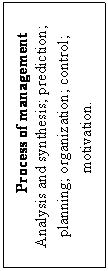



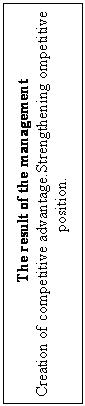
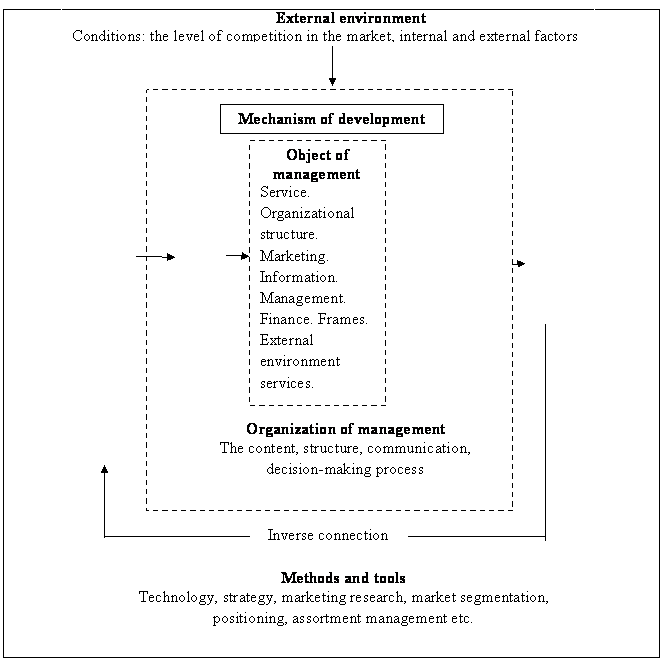
 Pic.2 Model of
organizational-economic mechanism of competitiveness management of the
enterprise of sphere of services
Pic.2 Model of
organizational-economic mechanism of competitiveness management of the
enterprise of sphere of services
Process approach considers the general management functions as related.
Process control is a continuous process of interrelated actions,
strategic marketing, planning, process organization, accounting and control,
motivation, management.
Technology of enterprise
management competitiveness is a rational and logical sequence of management
decisions and actions. Based on this technology, the company can develop
reasonable projections of possible changes to make corrections in the choice of
specific strategies in its ongoing activities and to solve practical tasks of
managing own competitiveness (see table).
Table 2 - Technology of management competitiveness of the enterprises of
services sphere
|
Stage |
Events |
|
1. Strategic analysis of the situation in the market. |
The analysis of the external environment. |
|
2. Analysis of competitiveness of the enterprise |
The definition of indicators to assess the
competitiveness of the enterprise. Assessment of competitiveness of the enterprise. Determination of the main factors of competitiveness
of the enterprises of sphere of services. Identifying target segments to identify areas of
competitiveness management. |
|
3. The purposes of the definition of competitiveness
management of the enterprise |
Strategic orientations of management of
competitiveness of the enterprise. |
|
4. Formation of the strategy of competitiveness |
Analysis of possible strategies. The choice of optimal strategy |
|
5. The choice of methods and means of achieving the
objectives and implementing the strategy |
The choice of methods with the features of a managed
object. The choice of method content. The choice of methods for
organizational form. Determining of means |
|
6. Planning for implementation of the strategy of
competitiveness |
Determination of competitive advantages and
standards of competitiveness. |
|
7. Organizing the implementation of activities to realize
the strategy to ensure competitiveness |
Development of the implementation programme of the strategy. Implementation of the strategy of competitiveness |
|
8. Control and coordination of the implementation of
competitive strategy |
The monitoring of implementation of the strategy. Coordination of the implementation of the strategy |
|
9. Evaluation of the implementation of the strategy
of competitiveness |
Expert assessment of the level of implementation of
the strategy of competitiveness. |
The given technology of management competitiveness
enterprises of sphere of services designed to effective functioning of our
proposed organizational-economic mechanism of management and allows for the use
of various methods and tools to generate long lasting and sustainable
competitive advantage will result in improving the competitive position of the
enterprise market.
The creation and improvement of
organizational-economic mechanism of competitiveness management of the
enterprise is a condition of competitiveness management of the enterprise of
sphere of services, resulting in ensuring and strengthening its competitive
advantages.
Based on everything mentioned above, we can draw the
following conclusions:
·
the
services market is a kind of commodity market, has specific features that
necessitate a special approach to the management of the enterprises of sphere
of services;
·
one
of the most important properties of competitiveness — the ability to influence
it, i.e. it is possible and necessary to manage it;
·
management
of competitiveness of the enterprises of sphere of services is management in market conditions, its
competitive advantages;
·
improving
the competitiveness of the enterprise is implemented through control
mechanisms;
·
the
mechanism of competitiveness management can be defined as a set of resources,
methods, tools, instruments and levers of influence on the market processes
used by the governing bodies of all hierarchical levels to achieve the goals of
the economic development element of the economic system [6,p.42];
·
the
mechanism of competitiveness management includes: management objectives,
management factors, organizational structure, resources, methods, impact;
·
the
basis of competitiveness management of the enterprise is a management the
competitiveness factors;
·
implementation
of management competitiveness requires organizational support;
·
when
developing a model of competitiveness management of the enterprise it is
necessary to consider features of activity of the enterprise and its position
in the market;
·
organizational-economic
mechanism of strategic management of competitiveness of enterprise is
effectively realized in the control technology, i.e. the complex of
organizational measures, operations and receptions, directed to increase the competitiveness of the enterprise
in the sphere of services.
LIST OF LITERATURE
1. Ansoff, New corporate strategy: translated. from engl.
SPb.: Piter, 1999. 485 p.
2. Baikov E. A. implementation Management
of the strategic potential of enterprise development // Scientific-technical
Bulletin of Saint-Petersburg state Polytechnic University. Economic
science.2012. № 2—2(144). С. 107—112.
3. Barinov N.. Services (socio-legal
aspects) : monograph. Saratov: Stilo,2001.
192 с.
4. Big Encyclopaedic dictionary.URL:
//dic.academic.ru
6. Jin, M. A. Theoretical bases of formation of mechanism of
management the competitiveness of enterprise // the Culture of the black sea.2006. № 95. С. 118—126.
8. Makasheva Z. M. Research of control
systems: proc. allowance. M.: KnoRus,2008. 176 с.
9. Meskon M. Kh.,
Hedouri F. Fundamentals of management: per. from
English. Ed.
3rd. M.: Matter,2009. 692
с.
13. Porter M. Competition: translation from English. M.: Izd. house "Williams",2005.
608 с.
14. Raizberg B. A., Lozovskiy
L. S., Starodubtseva E. B. Modern economic
dictionary. M.: Infra-M,2006. 495 с.
15. Tultaev T. A. Marketing of services:
textbook. M.: Infra-M, 2012. 208 с.