E-banking. History,
advantages and risks.
Tursyn Abylay Oraluly, Kaldybekov Salamat, Sadyhanova
G.A.
KazNU Al-Farabi
Abstact
This article provides the brief overview of the
e-banking system as a whole. Further we review the history of development and
advantages that e-banking brings in compare to traditional banking. In the
third part the is a review of risks of fraud. In conclusion we state that the
e-banking is growing fast and will have more transformation in future for
example in the blockchain technology’s direction.
Introduction
E-banking – providing banking services in electronic
format. There are various formats, such as a desktop application (which might
be offline or online versions), website and mobile application. Those services
may include:
- checking account balance, debts, transaction history;
- transferring money;
- paying bills and etc.
The main service of banks is putting money in the bank
and getting deposit interest or taking some money as debt and returning it with
banks interest. These operations are steadily moving to non-cash operations.
This is the call of our time. As there is a big wave of automation of vast
parts of old jobs as well it is true for the banking system. The one, who uses
new technologies as soon as possible, can get competitive benefits on the
market.
As well it leads to the
wide spread of various electronic services. The growth of the market attracts
frauds who steal the assets of participants of the system. This situation
requires administrative regulation, which is provided by the bank’s inner
security system and various special organizations accredited by authorities to
protect the fair work of the market. The government defines institution that
monitors and regulates bank management and the banking system.
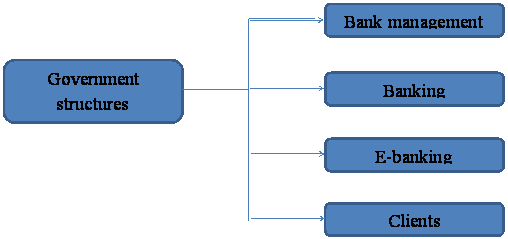
Figure 1.
Structure around the e-banking
History
of development and advantages
E-banking is a very important technology nowadays. For
the management of banks it is important as a competitive tool in industry for
delivery of services. It is convenient for customers who values their time and
choose to make operations remotely. Highly valued customers, who are educated,
prefer using internet so they also might be attracted with it. Research of
Young [3] suggests that adding internet delivery channel increases profits.
Obviously the expansion of a bank on international levels gets easier because
they do not need to open branches everywhere. Most of services can be delivered
via internet. Lastly, e-banking can reduce the load of branches.
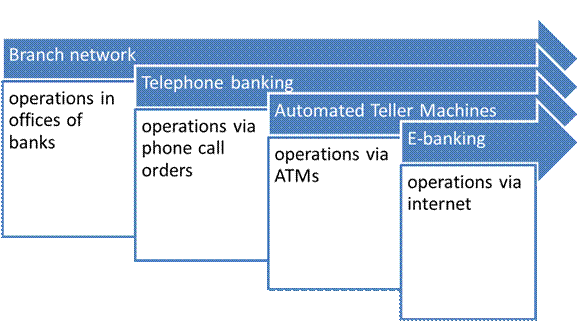
Figure 2. Stages of e-banking’s evolution
Some research suggests that e-banking is not a
revolutionary technology but just a step in evolution of the banking system
[1]. In the figure 2 we can tangibly
see the development stages of the banking system where every new channel of
delivering banking services adjusts to previous making them closer to
customers.
According to Devlin [2], until the early 1970’s the
banking system was highly regulated and got only little technological
improvements. From 1980’s to 1990’s, there was a big wave of deregulation in
the industry so the competition has grown. The peak of that growth was in 2001
at the burst of the internet bubble. One survey by TechWeb News stated that in
2005 e-banking was the fastest growing commercial activity.
Due to ease of access via internet banking services
can be provided internationally if laws do not restrict it. E-banking shows
rapid growth in last decades due to the wide spread of the internet and
maturity of the average user. Also the spread of high speed broadband
stimulated the rapid growth of e-commerce, which consecutively activated
e-banking. People tend to purchase goods via internet shops, the brightest
examples of it are Amazon and Aliexpress, world’s biggest internet retailers.
The risks
However the same advantage of ease of access brings
few risks. There are few types of fraud that were classified as sales fraud,
purchase, cheque payment fraud and ATM fraud [4]. Nevertheless, in that frauds
might be involved the personnel of bank. Those are huge risks in running
e-banking for the banks and for the clients.
The fraud can be schemed based on multiple
vulnerabilities such as connection between customer and bank. If the channel is
not protected with secure connection, the schemer can get the secret personal
information of a customer. Also he can use social engineering to manipulate
customer. For instance, schemer can introduce himself as a bank worker and ask
for customer’s confidential information to the access for account and move
money.
Payment fraud includes false payment information, when
cybercriminal use gained information about customer’s account to purchase good
for another person. Also this type of fraud can be applied on the e-commerce
participant like internet shops, who use e-payments. The payment fraud may use
vulnerabilities of refund policy in e-commerce.
ATM fraud is a physical contact with banks delivery
channel in order to corrupt the ATM’s work by making false orders to take cash
from customer’s account or installing malware into the ATM. These schemes are
already known and well secured, however there are risks of unknown
vulnerabilities of ATMs that can be abused.
All of these frauds are very sensitive for the
businesses attempting to integrate e-banking
into their payment channels. In order to be protected from that the bank
should always be on touch with latest news in the field of electronic security,
such as newly discovered vulnerabilities of systems they use. Keep their
security policy adaptive to new technologies and new schemes.
Conclusion
E-banking sure has its benefits like lower delivery
costs (after reaching a certain critic mass of client base), higher sales and
potential for offering greater convenience for consumers of the banking
services. As well, there are some cons like high cost of integration, need of
higher educated labor with higher wages to work with complicated systems, risks
of unauthorized persons getting access to accounts via internet.
In this article there were provided a basic review of
e-banking’s main features, background and risks. So e-banking is a tool for
banking system to improve efficiency and expansion opportunities. And of course
e-banking is a step of banking system into the digital era. Although we already
can see it in our everyday life, we all should use it carefully considering all
risks.
Source list:
1. M. Shah & S. Clarke (2009) E-Banking Management:
Issues, Solutions, and Strategies
2. Devlin, J. F.
(1995). Technology and
Innovation in Retail
Banking Distribution.
International Journal of Bank Marketing, 13(4), 19-25.
3. Young, R. D., Lang, W. W., & Nolle, D. L. (2007).
How the Internet affects out-put and performance at community banks. Journal of
Banking & Finance, 31, 1033 –1060.
4. Usman A.K. (2013) Critical Success Factors for Preventing
e-Banking Fraud
5. Romi I.M. (2015) Mapping E-banking Models to New
Technology. Journal of Internet Banking and Commerce, Volume 20, issue 2
6. Driga I. & Isac C. (2014) E-banking services –
features, challenges and benefits.