Экономические
науки / 4. Инвестиционная деятельность и фондовые рынки
Onyusheva
I.V., PhD, Professor of RAM, RANH,
Sarkissyan S.E.
University of International Business, Almaty,
Republic of Kazakhstan
The
Concept of an Investment Project, Its Types and Features
Key Words: investment project, strategic competitiveness, competitive advantage, average returns, above-average returns, strategic
management process.
In this article we are going
to define the notion of an investment project, to classify its types and
features and to elaborate a key question “why do we need to invest?”
In order to build your wealth, you will want to
invest your money. Investing allows you to put your money in vehicles that have
the potential to earn strong rates of return. If you don’t invest, you are
missing out on opportunities to increase your financial worth. Of course, you
have the potential to lose your money in investments, but if you invest wisely,
the potential to gain money is higher than if you never invest.
An investment project is a
comprehensive action plan, which includes the design, construction, acquisition
of technology and equipment, training, etc., aimed at creating new or upgrading
existing production of goods (works, services) in order to obtain economic
benefits [1].
It is a long-term allocation
of funds (with or without recourse to the project's sponsor) to carry an
investment idea through to its stable-income generation stage. A viable
investment project aims at achieving a profitable return that ensures timely
payment of interest and principal, attractive return on the invested capital,
and positive and consistent cash flows [2].
In this context an investment project can be defined as an optimal set
of actions of investment based on sector, global and coherent planning on the
basis of which a defined combination of human, material and other resources
leading to economically and socially determined development.
Any projects, whether they
are investment or not, vary so much that they are difficult to define. In order
to clarify the notion of project let us consider some definitions offered by
different sources (see Table 1 below).
Table 1 - Overview of
definitions ‘Project’, ‘Investment’, ‘Investment project’
|
No. |
Definition |
Source |
|
1 |
A project is a unique venture with a beginning and an end,
conducted by people to meet established gals within parameters of costs,
schedule and quality. |
Buchanan and Boddy [3] |
|
2 |
A project is a
set of resources temporarily assembled to reach a specified objective,
normally with a fixed budget and with a fixed time period. |
Mike
Field and Laurie Keller [4] |
|
3 |
A project as the simplest form is a discrete undertaking with
defined objectives often including time, cost and quality (performance)
goals. All projects evolve through a similar ‘life-cycle’ sequence during
which there should be recognized start and finish points |
Mike
Field and Laurie Keller [4] |
|
4 |
An investment project is an comprehensive action plan, which includes the
design, construction, acquisition of technology and equipment, training,
etc., aimed at creating new or upgrading existing production of goods (works,
services) in order to obtain economic benefits. |
Vilensky P.L., Ryabikova N.Y [1] |
|
5 |
An investment project is long-term allocation of
funds (with or without recourse to the project's sponsor) to carry an
investment idea through to its stable-income generation stage. A viable
investment project aims at achieving a profitable return that ensures timely
payment of interest and principal, attractive return on the invested capital,
and positive and consistent cash flows. |
Business
Dictionary [2] |
|
6 |
An investment project is an allocation of resources with the expectation
of a profitable return on the allocation in the future. The return is
typically anticipated more than a year in the future. |
Kovalev V.V [5] |
|
7 |
An
investment
is the current commitment of money or other resource in the expectation of
reaping future benefits. |
Zvi Bodie, Alex Kane, Alan J.
Marcus [6] |
|
Note: Compiled on the base of [1-6]. |
||
From the definitions we
notice that in order to apply a project it needs a set of means, different in
their nature, which, to be operated, must rely on well-coordinated actions.
In other words, any activity
must take place in a pre -established order, not too early as this may mean a
waste of resources, but not too late, as this may compromise the project’s
purpose itself.
Finally, the project must
have a well-defined and quantified purpose which, even if it cannot be
assimilated with the purpose of the programme it derives from, must contribute
to its achievement. The investment project is the concrete motivation of some
current expenses in the hope of future benefits. Its specific features,
distinguishing it not only from current activities, but also from other types
of projects, are: amplitude, finality and structure [5].
The execution of any
investment project is under the pressure of two factors: time and cost. For
managers, but also for the other factors involved in the project, respecting
the periods for execution and the consumption of resources: human, material,
financial, technical etc. is a permanent preoccupation during execution. But
for this they need adequate tools and techniques, both for the correct
dimensions of the time and resource parameters and for later monitoring and
control on site.
The shaping of the execution
process is based on a specific trait of projects, namely that their execution
is a complex structure of activities in a specific technological and
constructive interdependence, characterized by: assimilation with a certain
role during the execution of the project; not performing an activity may affect
execution, the finalizing time or may compromise quality or cost objectives;
strict time delimitation, with a clear beginning and ending; consumption of
resources: material, financial, human and time, with a specific cost and
available within limits; connection with at least another activity through a
relation of anteriority which, technologically speaking, shows that it cannot
start even if only one of the previous activities is not completed- possible
partial superimpositions are accepted in particular circumstances.
The
activities which contribute to the execution of a project are of three types:
- Actual - consuming
resources and time;
- Expectations- consuming
only time;
- Fictitious- consuming
neither time nor resources, being just technological conditioning between
certain activities in the first two categories.
For an
investment project to succeed it is firstly necessary a common conception of
the problem and its definition together with the beneficiary, a conception that
implies: the clarification of the positions of those involved and the clear
definition of the project theme, which means defining the objectives of the
project, elaborating the strategy, planning the necessary means, tools and
stages. The clear, quantifiable
results of the different stages of the project will allow qualitative and
quantitative evaluation, as well as an evaluation of reaching the objectives;
the setting of ways and rules of cooperation with the beneficiary all along the
project, an aspect that will allow clarification of language misunderstandings,
interpretation of tasks, avoidance of conflicts, re-evaluation of different
problems concerning the execution of the project al minimal expenses. Solving
conflicting situations that occur in any project is easier if there is a basis
for mutual trust, partnership and understanding the position of each
participant in the project; access to information and provision of quality
information by promoting information policies on the progress of the project
that must be open, clear, unbiased for negative interpretation.
The information must be
fairly complete, accurate, sent in adequate form and in due time to those using
it in making decisions or in performing an activity, so that it allows a
correct estimate of the situation at any time; a realistic evaluation of the
resources available for the initiation and performance of the project.
The
execution of an investment project cannot start on the idea that the source for
certain facilities will appear later, when its use is urgent [5].
Classification of investment
projects can be carried out on several grounds. Thus, depending on their mutual
influence investment projects can be divided into:
- Independent, when the
decision to adopt a single project does not affect the decision to accept the
other one. In order to separate an investment project A from the project B, two
conditions must be done:
- Should be possible
(technical, technological) A draft implement regardless of whether or not a
project B is accepted;
- The cash flows expected
from project A, should not affect the acceptance or rejection of the project B.
Sometimes the company due to
lack of funds cannot simultaneously carry out two projects. In this situation,
the adoption of the project will entail rejection of the second. However,
calling the projects dependent only on the basis that an investor hasn’t enough
funds for their simultaneous realization, would be wrong.
If the decision to carry out
a project has an impact on another project, that is, the cash flows of the
project "A" changes depending on whether accepted or rejected the
project "B", the projects are considered to be dependent. These projects
can be also divided into the following types:
- Alternative (mutually
exclusive), in which two or more projects cannot be realized at the same time,
and the adoption of one of them automatically means that the other project
cannot be implemented. For example, on a dedicated piece of land we can be
built either shop or dining room or parking, the adoption of one of these
projects automatically makes it impossible for the implementation of others;
- Complementary, when the
realization of several projects may occur only together. Thus complementary
projects can be divided into:
- Complementary, when the
adoption of a single investment project leads to an increase in revenues from
other projects;
- Projects related to each
other substitute relationship when the adoption of a new project leads to some
reduction in income from one or more existing projects. Identification of
complementarity and substitution relationship implies prioritization of
investment projects not isolated, but in the complex, especially when the
acceptance of an investment project by chosen criteria is not obvious [8].
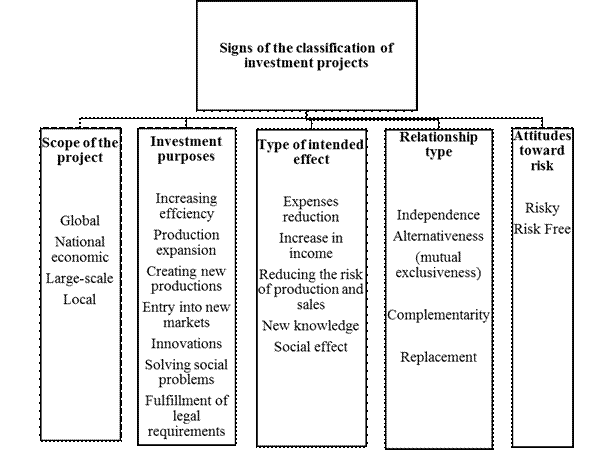
Picture 1 –
Classification of investment projects
Note:
Compiled by the author on the base of [4,5].
Let us highlight the
classification of investment projects according to picture 1
Scope of the project
(social importance) project is influenced by the results of its implementation
for at least one of the (internal or external) markets: Financial products and
services, labour, etc., as well as the economic and social situation.
Depending on the importance
scope of the project, they divided into:
- Global, the implementation
of which significantly affects the economic, social and environmental situation
in the world;
- National economy, the
implementation of which significantly affects the economic, social and environmental
situation in the country;
- Large-scale, the
implementation of which significantly affects the economic, social and
environmental situation in certain regions or sectors of the country;
- Local, implementation of
which has no significant effect on the economic situation in the region and
does not alter the level and structure of prices in the commodity markets [10].
Investment purposes.
A key feature during the classification of projects. Picture 1 highlighted
seven major groups of projects.
-Increasing efficiency in
production. These projects are aimed mainly at reducing costs through the use
of resource-saving technologies, advanced materials, more efficient equipment,
better work organization, training of employees, and so on.
- Investments in the
expansion of existing production. Projects of this type include increasing
production capacity due to the increased demand for the company's products.
-Investment in the creation
of new production/industries. Such projects are mainly aimed at new
construction or reconstruction of existing enterprises for the production of
new products.
-Investments related to
entering new markets. Such projects often include:
1. Expansion of production
(if not existing market oversaturated products of the company);
2. The adaptation of
products to the characteristics of the new markets (safety requirements and
ergonomics, national characteristics, climatic conditions);
3. Development of means of
delivery, advertising, after-sales service.
Investments in research and
innovation. Projects aimed at research work, development work, the development
of new technologies and so on. They play a crucial role in today's dynamic
world. Despite the unpredictability of the results of such projects, large
companies spend a lot of money for implementation of such projects
Investments in social
purposes. The purpose of these projects is to solve certain social problems
(the construction of holiday homes, sports centres, hospitals, kindergartens
and so on.). Similar projects have an obviously costly effect, although it is
likely an indirect economic benefit.
Investments made in
accordance with the requirements of the law (forced investments). The
objectives of these types of projects are the implementation of legislation:
- The environment
(protection of air and water, recycling and disposal of toxic waste, etc.);
- Sanitary-epidemiological
norms;
- Fire safety;
- Labour Protection &
Safety Department;
Examples of such projects
are:
- Construction of sewage
treatment plants chemically polluted drains;
- Construction of burial of
toxic waste [5].
Type of intended effect.
Evaluation of the projects can be carried out according to various criteria.
The results in the implementation of the projects do not always have the
character of an obvious profit. Some projects unprofitable in economic terms,
can generate indirect revenue through reliability and stability in the supply
of raw materials and materials, to enter new markets of raw materials and product
sales, achieve social impact, reducing costs on other projects
In this case, the criteria
for assessing the advisability of investing in the project, based on formal
algorithms can give way to formalized criteria.
We can select the following
types of effects:
- Expenses reduction;
- An increase in income;
- Reducing the risk of
production and marketing;
- The acquisition of new
knowledge;
- Social effect.
Relationship type.
Identifying of different relations of interdependent investment projects is
very important for their analysis.
Projects are called
independent if a decision on the adoption of one does not affect the decision
on the acceptance of others. The project is called alternative or mutually
exclusive, if the adoption of one of them means that the rest must be rejected.
Interconnected projects with
complementarity, if the adoption of a new project contributes to the growth of
income of one or more other projects. For example, the construction of the
service center is accompanied by not only the income
from the provision of services by the center, but
also the growing number of customers of the main products raised the prospect
of possible repairs of purchased products. Identifying relationship of
complementarity implies consideration of projects in the sector, rather than in
separately. This is particularly important when the decision on the main
criterion of the project is not obvious - in this case, additional criteria,
including the presence and degree of complementarity should be used.
Projects interconnected
relationship of substitution, if the adoption of a new project leads to some
reduction in income from one or more existing projects.
Attitudes toward risk. Project may be risky or risk free, but it is quite difficult to find
risk free projects because risk itself presents in any project implementation [10].
Since we have touched upon
the basic principles of investment project, let us look through a project life
cycle. Projects have a definite start and finish point within which their
objectives need to be fulfilled. This is known as the project lifecycle. While
this is usually defined by a start and finish date, the lifecycle of a project
can also be defined by a finite resource such as money or a fixed amount of
staff time available to the project.
Most projects can be divided up into five basic
stages and processes. Terms that are commonly used for these are:
-initiation (or start)
-planning and development
-production and implementation (execution)
-monitoring and controlling
-closing
All projects will use these basic elements but at a
level appropriate to the size and complexity of the project.
Initiation.
It is a formal beginning of a project and will be triggered by the issue of the
project which briefly describes the purpose of the project, and authorizes
budget expenditure. The initiation stage is where work is carried out to assess
what needs to be done and how best to do it with whatever resources are
available.
Planning and
development. After the high level planning
done during initiation, a more detailed phase of planning and development
usually occurs. The result should be a clear specification for what needs to be
done, who by, and when.
Production and
implementation. At
this stage, it is important to ensure that the project remains focused on its
objectives and that any factors which could affect the execution of the project
are closely monitored.
Monitoring and
controlling. Throughout the production and
implementation stage the ongoing progress of the project must be monitored. Progress
must be controlled and any issues which arise as a result of the day-to-day
work must be dealt with.
Closing. Closing
is the last phase of any project and is when the work done is formally accepted
and the project is dissolved. Closure does not necessarily mean success, but
simply the final point of the project - when failed projects are cancelled, for
instance, they should also be closed [11,12].
To sum up, an investment
project is a complex and labour intensive work that should be done by various
specialists. An investment project should be economically proved and be
prepared to generate money in the future. Also we have overviewed the
classification of investment projects and found out that there could be
different types of investment projects, different purposes and different
outcome of any investment project. We have touched upon a life cycle of
investment project – it consists of several stages or life cycles that should
be done or accomplished one by one. Usually many investment projects have this
life cycle, but still it depends on the exact case. In next subchapter we are
going to come closer to the fundamental aspects of economic efficiency of
investment project, we will briefly cover the methods of evaluation of economic
efficiency of investment project.
References:
1. Vilensky P.L., Ryabikova
N.Y. Recommendations for calculations of economic efficiency of investment
projects. - Moscow: Finance and Statistics, 2003.
2. Business Dictionary, http://www.businessdictionary.com. [Electronic source: last data access: 07.10.16]
3.
Buchanan and Boddy. The Expertise of the Change Agent: Public Performance and Backstage
Activity, 1992. - P.8.
4. Mike Field and Laurie Keller.
Project management, 1997. – 450 p.
5.
Kovalev V.V. Methods
for evaluation of investment projects. - Moscow: Finance and Statistics, 2003.
– P.144
6. Zvi Bodie, Alex
Kane, Alan J. Marcus. Essentials of investments, 2010. – 722 p.
7. Eng.
Ec. Ph.D. Student Ioan HURJUI; Ştefan
cel Mare University of Suceava.
Investment projects: general presentation, definition, classification,
characteristics the stages”; No.8, 2008.
8. V.V. Kovaleva, V.V.Ivanova, V.A.Lyalina. Investment: the book. – Мoscow: «Welbi», 2003. – 324 p.
9. Harold Bierman, Seymour Smidt. The Capital Budgeting Decision: Economic Analysis of
Investment Projects, 2007. – 402 p.
10. Lipcic I.V., Kossov V.V. Investment project. –M.: BEK, 1996. – 452 p.
11.
Lock D. The essential Project
Management, 3rd edition, Gower Publishing Ltd.,2007, - 204 p.
12.
Lock D. Project Management, 9th
edition, MPG books Ltd., 2007, - 520 p.