PhD, Smirnova O. V.
O.M. Beketov National University of Urban Economy in
Kharkiv, Ukraine
DIFFERENTIATION OF THE
INNOVATIVE INFRASTRUCTURE OF TECHNOPARKS
Existing global
experience in design and construction of technoparks is systematized. The features of forming of the innovative infrastructure of technoparks as architectural
and urban structures of a new type are determined.
Keywords: innovation, differentiation, infrastructure, technopark, urban environment.
Technopark is a new form of territorial integration of
science, education and industry as a union between scientific organizations, design bureaus,
educational institutions, manufacturing companies or their subsidiaries. Technopark is created in order to accelerate
the development and application of scientific and technological as well as technical and technological achievements by
concentrating highly qualified professionals, applying equipped
production and experimental information base; often it has a preferential tax treatment. [1,2] The functional structure of technopark reflects the main areas of its
activity (Fig. 1). It includes:
– functional group "the core of technopark" which unites research
activity enterprises (directed on fundamental research, work on the idea of product
creation, its’ research and development) and experimental production
enterprises (engaged in development activities, production preparation, manufacturing
of new products);
– functional group "complex service" provided
by enterprises engaged in commercial activities, education, management and
supervision of works’ execution and
promotion of the product on the market;
– functional group "simple service", provided
by enterprises and firms engaged in related activities. They include:
warehousing, engineering, social and personal services, business activities,
housing.
The level of development of dominant and related functional groups of technopark
directly affects on its differentiation.
The analysis allowed to differentiate these parks into three types:
small, medium and large.
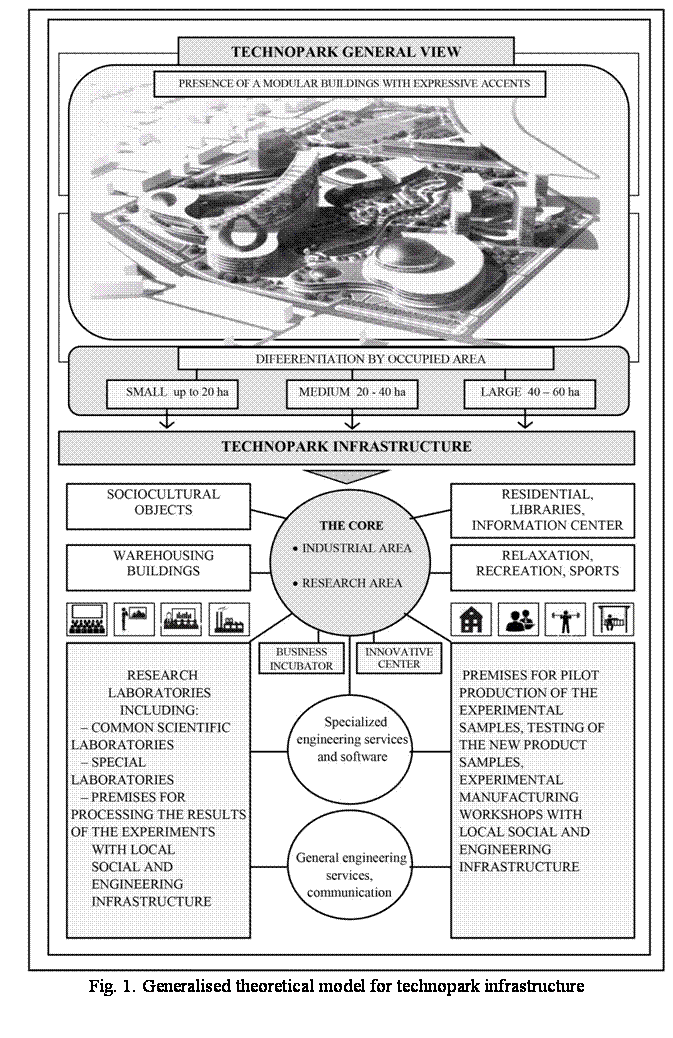
Small parks (with area up to 20 hectares) are the simplest
technopark structures designed for development of small beginner firms, often
they serve as innovative centers / business incubators or urban industrial
parks. They are designed to accommodate small firms on average of 3-5 people
involved in the development of high technologies, which are harmless and do not
require large areas for research. This may be information technologies and
microelectronics, precision engineering industry and instrument making,
micromechanics, optics, biochemistry and biotechnology, pharmaceuticals,
medicine, etc. Business area is usually
dominated in the functional structure of a small urban technoparks (about
50-60%). In general, their functional and planning organization is
characterized by a limited ability of territorial expansion, so while forming of
these industrial parks it is necessary to be rational and economical in land
usage and to achieve maximum investment efficiency. The area of landscaped
territory must be at least 15%, more preferably 25-30%. Density of urban
development of small industrial parks must be calculated considering the
coefficient of 0.5-0.6. Small parks including objects which do not require organization
of sanitary-protective zones over 50 m and if its’ area do not exceed 5
hectares can also be placed in residential, public and business areas.
In
organization of functional and planning structure of small technopark it is
prerequisite to include its territory into communication frame of the city, to
establish common driveway network to buildings, parking lots, underground
garages and to main citywide highways, airports, railway stations and bus
stations as well. Parking plots are arranged at the rate of 10-15 parking
places for 100 employees. The distinguishing feature is the absence of the need
for organization of new major transport arteries. While developing, enterprises as a part of a technopark need some space expansion. Prospective formation of small technopark provides the following options for
its further improvement:
– development using free areas of the city
(creation of a dispersed city technopark structure);
– development using the border and peripheral
areas of the city;
– development using free areas outside the city.
So that is how its infrastructure consistently changes and the appearance of medium and large
industrial parks goes.
Medium technoparks (with area of 20-40 hectares) are formed in urban settlements
structure, as well as in the peripheral areas with the prospect of further development outside the city limits. These parks have a well-developed infrastructure and are
characterized by having not only basic (manufacturing, research) but also
additional functional areas. The subject-spatial content of these areas
foresees inclusion in their structure of a various social and cultural
facilities, residential buildings, data centers and business incubators, also
sports and recreational buildings, warehousing and others. Complex interaction of these objects’activity not only ensures efficient operation of all technopark,
but also facilitates its further development. So, evolving over time, medium
technoparks may become structural units of large industrial parks.
Large technoparks are autonomous territorial complexes with significant size
(over 40 ha area), built on the basis of the organization of mutually
beneficial interaction between large, medium and small forms of high-tech
business, having developed scientific and industrial infrastructure,
well-adjusted market infrastructure and extensive service and communication
systems. They are designed as modern urban structures with all necessary
infrastructure facilities and a tendency of development to the scale of a
technopolis with a population of about 30-50 thousand people. Selecting the site
for technopark placement is determined by the presence of large free areas.
Therefore, such large technopark complexes with an advanced functional
structure, allowing to manufacture high-tech products are the most appropriate
to be placed near the city at a distance
of 5-10 km from them (according to the features of the placement of European
technology parks). The time each spent to get to the technoparks should be minimal.
Building density of technoparks with population of 1000-2000 people is
calculated with coefficient of 0.8-0.9.
The
process of large technoparks formation foresees inclusion of full innovation
chain: research, development
and production activities. The functional structure of a large industrial park
located outside of the urban environment is the most developed, provides the
autonomy of industrial park and includes a full set of functional components. In technoparks which are outside the city it is important to minimize building density. The ratio of business housing to the total area of industrial park should
not exceed 25% (or 15% - with usage of two-story buildings) and 50-60% of the total area should be given for the landscape zone. There are economic zone (simple service area) and parking zone
provided in the industrial park. If there is free area the objects of household
zones are located at a distance of 1-1.5 km from the main buildings of the technopark.
Open warehouses are combined at one site and shielded from the street, buildings
and landscaped grounds. It should be noted that the creation of large technoparks located in the peripheral areas of the
city will gradually smooth out the edge between the periphery and the center in all social spheres, will stimulate the emergence of new scientific
and industrial centers, centers of high-tech industry and information which are differ by high standard of living. In conjunction with the city's research formations (universities, research institutes, high tech
manufacturing enterprises, industrial laboratories and others.) and through the
cooperation with ventures of other technoparks, large industrial parks can develop their territories to the extent of technopolis carrying out the full cycle of "research - manufacturing – innovation application". Thus, considering the features of the organization and functioning of the
industrial parks, we can conclude that the process of their formation provides the
establishment of various infrastructures with significant or insignificant integration of science, education and industry and inclusion to its structure of natural and industrial environment of a new generation, where natural environment is dominated and production technology is subordinaded to it. Such a system provides a set of specified technical and economic indicators of production
while maximizing the natural resources preservation, creating comfortable working, household and recreation conditions for people.
Literature
1.
Igoshev B. M. the History of technical
innovations: study guide. / B. M. Igoshev, A. P. Usoltsev. – Publishing house
"Science", 2013. – 400 p.
2. Kryzanowska N. J. Trends in the formation of innovation
centers in the urban environment / N. Ya kryzanowska, O. Smirnova //
Vseukrainska Naukovo-techn. Conf. "Problems archtecture I mostobudivel in
umovah GlobalSat" – H.: the UNIVERSITY im. O. M. Beketov, 2016. – Pp.
102-103.