Miski-Oglu
A.G., Shlapak N.S.
Pryazovskyi
State Technical University
Strategic use of Information
technologies
in managers’ training
Nowadays the Information technologies (IT) and computer technologies as an integral part of IT, are commonly used in solution of various tasks: rating of an external
and internal environment, marketing researches, business plan development, product quality assurance, enterprise reorganization.
One of the topical
issues of our time is the preparation and training of
qualified experts for them to operate productively
in an advanced area of contemporary technologies. In this
regard, the role of
information technologies in educational process increases significantly, which entails
the prevalence of standard and specialized software for personal PC. Currently the Microsoft Office software package is widely used. It includes “Word” text editor,
“Excel” worksheets, “Access”
database and project
presentation design program called “Power Point”.
One can not but mention a huge role of Internet global network as a universal multifunctional
source of knowledge as well as the global
information guide.
Numerous
researches show the following properties of information technologies
(Fig. 1).
They are useful for managers
due to the following features:
- help to bridge the gap between economics and mathematics;
- carry the advanced methods that provide an effective solution of economic problems;
- conform
current economical procedures
to International requirements;
- connect to unified information space - economic and educational;
- allow managers to make a rational decision.
mathematics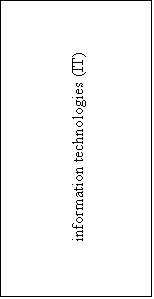


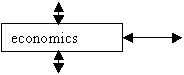
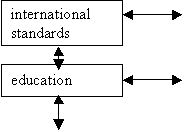


Fig.1 – Integration of information
technologies
Particular
role in enterprise management is given to modern systems of enterprise asset management. The
most famous among them are Oracle Applications and SAP R/3.
According to our opinion, the Enterprise Resource Planning is the management in IT language.
As
we know, management
is the process of planning, organization, motivation
and control, necessary for the main organizational purposes to be planed and achieved [1].
As a corroboration of above-mentioned, there
is a table that shows basic interrelation between management functions
[1, 2] and the main SAP R/3 modules [3, 4] (Table 1).
Table 1 – Management functions and SAP R/3 modules
|
Name of the
function |
Name of the
module |
|
Planning |
PP, PD |
|
Organization |
MM, LO, SD, QM |
|
Motivation |
PA |
|
Control |
FI, CO, EC |
The main function of the given modules:
PP (Production planning module)
- sales aggregation and production planning, long-term planning, production program
drafting, material requirement
planning, productive capacity requirement planning, commercial
manufacturing contracts, specification drafting, strip maps and assembly charts, product costing;
PD (Personnel planning and Development module)
- responsible for Applicant Management strategy, HR management, Personnel development;
ММ (Material
Management module)
- purchasing, maintenance, storekeeping and inventorying, warehouse management, provider certification;
LO (General Logistics
module)
- procurement, production, inventory
management, selling, maintenance, quality control;
SD (Sales & Distribution module)
- products’ marketing, shipping and transportation, invoicing;
QM (Quality management module)
- quality management
basic operations in accordance with standard ISO 9000;
PA (Personnel
Administration
module)
- records management, working hours accounting, travel expenses, salary calculation;
FI (Financial Accounting module)
- the General Ledger, Accounts Payable,
Account Receivable,
fixed assets accounting, closing entries operations, the Finance Information
System;
СО (Controlling module)
- additional charges accounting, product costing, profitability analysis;
ЕС (Enterprise controlling module)
- contains management information system
and capital
Investment Management.
The above-given SAP R/3 modules functioning
system indicates that the modules are able not only to fulfil the management
basic functions, but also provide a link between these
functions.
Foregoing information demonstrates the full range of advantages from using SAP R/3 as a study application for future managers. For this purpose
mini SAP software can be used in educational process. The given program installation and operation system requirements allow to apply all technological means available in Higher Education Institutions.
There
is a list of
basic system requirements:
- Operating system Windows XP
Professional;
- File system NTFS;
- Browser Internet Explorer or Firefox;
- Random-access memory
>
1 Gb;
- Processor Intel Pentium III with CPU frequency > 1.1 GHz;
- High resolution monitor.
List of literature:
1. Michael H. Mescon, Michael Albert, Franklin Khedouri, Management. – New York: Harper & Row, 1988.
2. Shlapak N.S., Serkutan Т.V. Management: tutorial. Mariupol: PSTU, 2009. – 191 p.
3. Michael Rebstock, Knut Hildebrand, SAP R/3 fur Manager. – Bonn: ITP, 1998.
4. Miski-Oglu А.G., Shlapak N.S. Optimization of the industrial enterprises // IV International scientific conference «Achievement of
higher education - 2008». – Sophia, «Byal GRAD-BG» OOD, 2008. – p.47-48.