Bashkueva T.D.
(Chita State Medical Academy, Chita,
Russia)
Gomboeva N.G.
(Zabaikalsaky State University, Chita, Russia)
The reproductive function of women in Transbaikalia
The
female reproductive system is very sensitive to adverse environmental factors of
any origin, including low intensity. Specific and nonspecific reactions play
the significant role in the formation of ecologically dependent reproductive
pathology. Reproductive pathology is manifested by reduced fertility, increased
rate of pathology of pregnancy and labor, the worsening the fetus’s and newborn’s
status until death, increasing the rate of gynecological pathology. Severity of
unfavorable effects of the environment on reproductive function and the limit
of sensitivity to woman's body is determined by various factors, including
ethnicity.
There
is a competition for energy reserves in the body which is always limited in
adapting to the natural environment while implementing reproductive and somatic
functions in the body simultaneously [Yu.P. Gichev, 2003].
Ethnic
differences are particularly marked in the time – chronophysiological features
of reproductive function [N.A. Aghajanian, 2009].
Most
of populations of Transbaikalia are the Russians and the Buryats. The Buryats are
the native population of the region, so they posses a higher degree of
adaptation. It occurs primarily in brachymorphic body structure. The resettlement
of the Russian population was happened from XXVII century. The Russian
population acquired features of native population due to cross-breeding. The Russians
suffer more from diseases than the Buryats, a particularly there is a great difference
in hypertension and diseases of the respiratory system. This indicates a lesser
degree of adaptation of the Russian population in the region of residence. The
redistribution of energy for adaptation is largely due to the use of energy
required for reproduction [V.P. Kaznacheev, S.V. Kaznacheev, 1986].
The
data confirm the above mentioned position in Table 1.
Table
1
Pregnancy pathology by ethnicity in Duldurginsky region
(2000) *
|
The ethnic groups |
number |
The threat of
premature birth |
fetal hypoxia |
fetal
anemia |
mortinatus |
||||
|
n |
% |
n |
% |
n |
% |
n |
% |
||
|
The Russians |
94 |
7 |
7,4 |
16 |
17 |
- |
- |
- |
- |
|
The Buryats |
153 |
9 |
5,9 |
17 |
11 |
3 |
2 |
1 |
0,6 |
*
Data of maternity ward from Duldurginskoy District Hospital
The
perinatal mortality (stillbirth and deaths in the first week of life) was
revealed to be 3,9 in 1963 in the Russians and 1,9 1,0 in the Buryats
respectively per 1000 births according to the research by TS.D. Tsydypov [1969]
child mortality dynamic in Aginsky Buryat district in 1963 – 1967 years.
The
increase of perinatal mortality during the study period was due to the increase
in stillbirth. The causes of labor weakness were fatigue (45%), mother's
illness and the associated premature birth (15%), premature detachment of
normally situated placenta (10%), narrow pelvis and fetal anomaly location
(5%). The prematurity took the leading part in the Russians (64.3%); labor
traumas (38.5%) and prematurity (15.4%) were among the Buryats.
Consequently,
main principles put forward by the V.P. Kaznacheev were confirmed by above
mentioned data. Adaptation to the region of residence and socio-economic
conditions occurs due to reduced reproductive function both in the Russians and
in the Buryats. However, higher rates of pregnancy pathology among the Russian population
are likely to testify to more stress adaptation mechanisms in a given
population. Besides, the research by T.E. Belokrinitskoy and et al [2006, 2009] have shown that girls of
the Russian nationality (compared with the girls of the Buryat nationality)
have earlier sexual experience, a great number of extra-marital sexual contacts,
divorces, labors, abortions. Therefore, chronic inflammatory diseases of the
reproductive system develop and more often in primary infertile (at 3.06
times). The authors believe that the determining factor is the Buryat national
culture in sexual and reproductive behavior.
Physiological
adaptation of uncomplicated pregnancy in native residents of Chita was accompanied
by hyperlipidemia which was associated with an increased need to use lipids as
an energy source [A.D. Kolesnikov and et al. 2004].
High
indicators for anemia were due to malnutrition (Fig. 1).
Figure
1
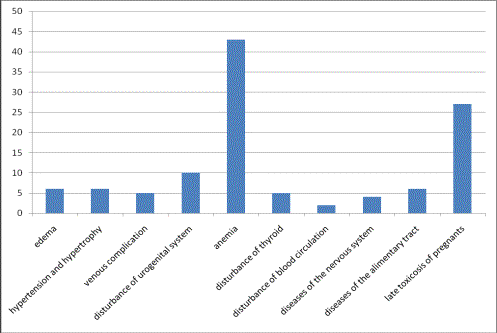
Fig. 1 Pathology of pregnancy per 100 women in Kalgan district in 2003 *
The rapid increase in overall morbidity was observed both in 1994 -
945.6 cases and in 2010 - 1451.1 cases per 1000 population. These data indicated
the decline of women’s health status.
The worsening women’s reproductive health status at the beginning of
pregnancy is registered as a whole in Russia. 1/8 of women may be considered as
healthy ones.
Socio - demographic factors have a significant influence on the
probability of an unfavorable pregnancy outcome [A.I. Grzybovsky et al., 2003].
The combination of harmful factors of environment, including manufacturing,
natural - climatic, ecological lead to the decrease of fertility [N.V. Zaitsev
et al., 2005].
Therefore women's reproductive health status depends on not only
natural, climatic, socio-economic factors but also on ethnicity. This may be
one of the indicators of a lower adaptation degree of the Russian population
compared with the native residents of the region. However, there is a tendency
of increasing of pregnancy pathology in both ethnic groups.
Bibliographical
list
1. Aghajanian N.A. Adaptive and ethnic physiology: life span and man’s health.
- Moscow: PFUR. - 2009. – 34 p.
2. Belokrinitskaya N.I., Belokrinitskaya T.E., Suturina L.V. Fertility
status, gender behavior and gynecological morbidity in different ethnic groups
of the Trans-Baikal Territory / / Transbaikalia Medical Journal. - 2009. N.1. -
P. 37 - 39.
3. Belokrinitskaya T.E. National culture as a determinant of sexual
behavior and reproductive attitudes of girls - teenagers / / Transbaikalia
Medical Journal. - 2006. N. 2. - P. 13 - 16.
4. The impact of environmental factors on the reproductive health of
working women of childbearing age / N.V.Zaytseva et al. / / Human Ecology. -
2005. N. 6. - P. 56 - 59.
5. Gichev Yu.P. Pollution and environmental - related human pathology. -
Novosibirsk: Nauka. - 2003. - 136 p.
6. Change in lipid homeostasis in Chita native women during
physiological pregnancy / A.D.Kolesnikov et al. / / Medicine in Transbaikalia:
achievements and prospects: scientific-practical conference materials.
Dedicated to 80th anniversary of the region. Clinical. hospital. - Read:
Research CSMA. - 2004. - P. 180 - 182.
7. Kaznacheev V.P., Kaznacheev S.V. Adaptation and the constitution of
man. - Novosibirsk: Nauka. - 1986. – 120 p.
8. Estimation of the incidence of adverse pregnancy outcomes in working
women in Severodvinsk / A.I.Grzhibovsky [etc.] / / Human Ecology. - 2003. N.1. –
P. 3 - 6.
9. Tsydypov C. D. Infant mortality in Aginsky Buryat district in
1963-1967 years. / / Questions of medical geography and health resort. - Read:
Ed. of Zab. phil. GS USSR. - 1969. Is.2. -P. 32-36.