Ph.D. Kryuk Т. V., Ph.D. Pikula L. F.
Donetsk National University of Economics and Trade
named Mikhail Tugan-Baranovsky, Ukraine
CHANGING OF THE BIOCHEMICAL composition APPLES DURING STORAGE
Today
healthy living is in a fashion not only in the West, but also in Ukraine. Each
of us knows about the dangers of fatty foods and the benefits of fruits and
vegetables, which lies in their ability to prevent diseases and maintain good
health for a long time. They are a valuable source of fiber, minerals and vitamins,
especially antioxidants - β-carotene, vitamin
C and phenolic compounds that protect cells against aging and diseases.
The most
popular fruits are apples of different species and varieties in the ration of
the inhabitants of Ukraine. This is the perfect healthy meal: low-calories (medium-sized
apple contains 100 calories), protects the organism from the cardiovascular
diseases, reduces the risk of the formation of the cancerous tumors, normalizes
cholesterol in blood, protects tooth enamel from the influence of destructive
bacteria, prevents the destruction of brain cells, reduces the level of
respiratory diseases, etc. [1]. In addition apples possess a pleasant taste,
and their price is available at the Ukrainian food market even for disadvantaged
people. All this causes the high consumption of fruits during the entire
calendar year.
The
period of ripening apples is the fall, late varieties are beginning to gather
in early October, but only after 2-3 months of storage they reach the consumer
ripeness. These apples are well preserved during the entire winter period and
therefore are particularly popular among the population. These include:
Reinette Simirenko, Jonathan Wells, Golden Delicious, and others.
The aim
of our study was to investigate the changes of the biochemical composition of apples
(for example of sort «Reinette Simirenko») during storage.
Storage
conditions were as follows: the sorted out, dry apples are picked in a
cardboard box, each apple was wrapped in paper. Room temperature ranged from 10
to 12 oC with humidity of
45 %. From November to March with
a periodicity of 35-40 days we spent the monitoring of the organoleptic and physic-chemical
parameters of fruits.
Fruits
are packed in the store. They were with the stems and without injuries and pests.
Apples had the appearance, shape and taste typical for this class: light-green
color with many light circular dots with size 2-5 mm, white, juicy, tender flesh,
wine-sweet taste.
The
number of basic chemical substances was determined in the initial samples. From
the results (Table 1) we can see that the concentration of reducing sugars,
pectin, vitamin C, phenolic compounds and total dry substances generally
correspond to average statistical content of these components in the apples «Reinette Simirenko» .
Table 1
− Contents of chemical components in fresh apples
|
Chemical substances |
The initial contents |
The
average content for the sort «Reinette Simirenko» [2] |
|
|
Dry substances, % |
15,0 |
13,0 |
|
|
Reducing sugars, г/100 г |
2,3 |
10,0 |
|
|
Pectin, мг/100 г |
940 |
1000 |
|
|
Vitamin С, мг/100 г |
1,0 |
7,3 |
|
|
Phenolic substances, мг/100 г |
400 |
354 |
It is
known [3] the losses of the nutrients occurs inevitably during the storage of
food caused by ongoing biochemical processes in them, especially such as
breathing, self-warming, as well as the processes that are related to the vital
activity of microorganisms. Indeed, as shown in Figure 1, during storage of
apples there is a significant change in their chemical composition: decreases
the concentration of pectin, phenolic compounds and vitamin C. The burning of
carbohydrates is the result of the fruits’ breathing, what is reflected in the
loss of dry substances as a whole [3]. Indeed, the decrease in the amount of
dry substances for 4 months was 15% (Fig. 1).
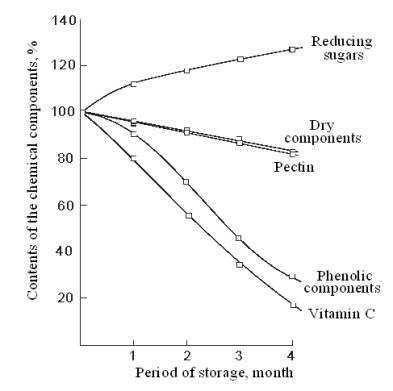
Figure 1 − Changing of the chemical substances contents during
storage of apples
The
maximum decrease of concentration is observed for easily oxidized phenolic components
and vitamin C compared with other investigated components, them residual
concentration is 18 % and 30 % respectively. The level of reducing sugars, however, greatly increases
compared with them primary content − more than 25 %. Obviously, this is due to
hydrolysis of more complex carbohydrates; such assumption is confirmed by a
parallel decrease in the concentration of pectin.
In
general, it is clear that biochemical changes occur already at the initial
stage of storage, with an increase period of storage the rate of reaction
increases. Average loss of nutrients is 10 % already after the first month
of storage of apples and after 4 months average losses reach 45 % (Table 2).
In the
process of storage organoleptic characteristics of fruit deteriorated
significantly. The apples have lost the original luster after 2 months, after 4
– they acquired a yellow color, there was a browning skin, subcutaneous
mottling revealed, texture was soft and friable. In general, the appearance of
the fruits after 4 months of storage testified that there is a process of
microbiological spoilage in them. The consequence of the occurrence of
undesirable chemical and biological processes is a marked deterioration in the
taste of apples.
Table 2 − Changing of
the chemical substances of apples during storage
|
Chemical substances |
Contents by
month storage |
Losses / increase, % |
||||
|
0 |
1 month |
2 month |
3 month |
4 month |
||
|
Dry substances, % |
15,0 |
14,4 |
13,6 |
13,2 |
12,8 |
15 |
|
Reducing sugars, g/ 100 g |
2,3 |
2,5 |
2,7 |
2,8 |
2,9 |
27 |
|
Pectin,
mg/100 g |
940 |
900 |
865 |
818 |
800 |
15 |
|
Vitamin
С, мg/100 g |
1,0 |
0,8 |
0,6 |
0,4 |
0,2 |
82 |
|
Phenolic substances, мg/100 g |
400 |
360 |
280 |
180 |
120 |
70 |
Thus, it’s
necessary to create special conditions for storage to preserve the original nutritional
quality of apples, otherwise the nutritional value of fruits is greatly
reduced, and eating these fruits during the «vitamin starvation» in the spring has the value
of taste only.
References:
1.
Яблоки против болезней // [Электронный ресурс].
Режим доступа: http://2medic.ru.
2.
Семечковые плоды // [Электронный ресурс]. Режим доступа: http://www.znaytovar.ru.
3.
Метлицкий, Л.В. Биохимия
плодов и овощей / Л.В. Метлицкий.– М.: Экономика, 1970.– 210 с.