Natalia Melnyk
Kyiv State Maritime Academy
WORLD
SHIPBUILDING
Shipbuilding is the construction of ships and floating vessels. It
normally takes place in a specialized facility known as a shipyard.
Shipbuilders, also called shipwrights, follow a specialized occupation that
traces its roots to before recorded history.
Shipbuilding and ship repairs, both commercial and military, are
referred to as "naval engineering". The construction of boats is a
similar activity called boat building.
Shipbuilding is an important and strategic industry in a number of EU
Member States. Shipyards often play a significant role for the regional
industrial infrastructure and, with regard to military shipbuilding, for
national security interests. The European shipbuilding industry is the global
leader in the construction of complex vessels such as cruise ships, ferries,
mega-yachts and dredgers. It also has a strong position in the building of
submarines and other naval vessels. Equally, the European marine equipment
industry is world leader for a wide range of products from propulsion systems,
large diesel engines, environmental and safety systems to cargo handling and
electronics.
There are around 150 large shipyards in Europe, with around 40 of them
active in the global market for large sea-going commercial vessels. Around
120,000 people are directly employed by shipyards (civil and naval, new
building and repair) in the European Union. With a market share of around 15%
in volume terms, Europe is still vying (with South Korea) for global leadership
in terms of the value of civilian ships produced (18 billion Euros in 2011)[1].
But today's leaders in global shipbuilding is Korea, China and Japan
South Korea is
the world's largest shipbuilding nation with a global market share of 37.45% in
2011. South Korea is the global leader in the production of advanced high-tech
vessels such as cruise liners, super tankers, LNG carriers, drill ships, and
large-sized container ships. In the 3rd quarter of 2011, South Korea won all 18
orders for LNG carriers, 3 out of 5 drill ships and 5 out of 7 large-sized
container ships[2].
South Korea's
shipyards are highly efficient, with the world's largest shipyard in Ulsan
operated by Hyundai Heavy Industries slipping a newly-built, $80 million vessel
into the water every four working days [3]. South Korea's "big
three" shipbuilders, Hyundai Heavy Industries, Samsung Heavy Industries,
and Daewoo Shipbuilding & Marine Engineering, dominate global shipbuilding,
with STX Shipbuilding, Hyundai Samho Heavy Industries, Hanjin Heavy Industries,
and Sungdong Shipbuilding & Marine Engineering also ranking among the top
ten shipbuilders in the world[4]. In 2007, STX Shipbuilding further
strengthened South Korea's leading position in the industry by acquiring Aker
Yards, the largest shipbuilding group in Europe. (The former Aker Yards was
renamed STX Europe in 2008). In the first half of 2011, South Korean
shipbuilders won new orders to build 25 LNG carriers, out of the total 29
orders placed worldwide during the period[4].
China is an
emerging shipbuilder that briefly overtook South Korea during the 2008-2010
global financial crisis as they won new orders for medium and small-sized
container ships based on their cheap prices, although its current production is
limited mainly to basic vessels [2].
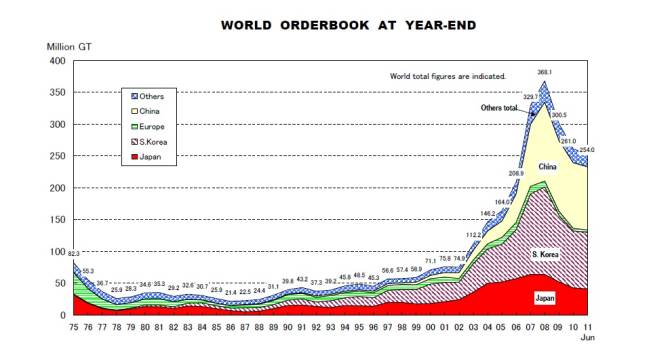 Japan lost its once industry leading position to South Korea in 2003,[3]
and its market share has since fallen sharply. The European nations' combined
output has fallen to a tenth of South Korea's, and the outputs of the United
States and the rest of the world have become negligible.[4]World shipbuilding orderbook
at Year-end share by countries (2011)[2].
Japan lost its once industry leading position to South Korea in 2003,[3]
and its market share has since fallen sharply. The European nations' combined
output has fallen to a tenth of South Korea's, and the outputs of the United
States and the rest of the world have become negligible.[4]World shipbuilding orderbook
at Year-end share by countries (2011)[2].
Modern
shipbuilding makes considerable use of prefabricated sections. Entire
multi-deck segments of the hull or superstructure will be built elsewhere in
the yard, transported to the building dock or slipway, then lifted into place.
This is known as "block construction". The most modern shipyards
pre-install equipment, pipes, electrical cables, and any other components
within the blocks, to minimize the effort needed to assemble or install
components deep within the hull once it is welded together.
Ship design work,
also called naval architecture, may be conducted using a ship model basin.
Modern ships, since roughly 1940, have been produced almost exclusively of
welded steel. Early welded steel ships used steels with inadequate fracture
toughness, which resulted in some ships suffering catastrophic brittle fracture
structural cracks (see problems of the Liberty ship). Since roughly 1950,
specialized steels such as ABS Steels with good properties for ship
construction have been used. Although it is commonly accepted that modern steel
has eliminated brittle fracture in ships, some controversy still exists [5].
Brittle fracture of modern vessels continues to occur from time to time because
grade A and grade B steel of unknown toughness or fracture appearance
transition temperature (FATT) in ships' side shells can be less than adequate
for all ambient conditions[5].
References
1.
European Commission Enterprise and
Industry http://ec.europa.eu/enterprise/sectors/maritime/shipbuilding/index_en.htm
2.
Korean: Korea Marine, # 1 four years
recaptured http://news.khan.co.kr/kh_news/khan_art_view.html?artid=201110192122065&code=920501
3.
James Brooke (2005-01096).
"Korea reigns in shipbuilding, for now". The New York Times.
Retrieved 30 December 2009.
4.
"7 Korean Shipbuilders Rank in
Top 10". Marinetalk.com. 2006-01-03. Retrieved 2010-11-17.
5.
"Marine Investigation Report -
Hull Fracture Bulk Carrier Lake Carling". Transportation Safety Board of
Canada. 19 March 2002. Retrieved 8 October 2009.