География и геология/ 9. Экономическая география
Postgraduate student Todieva M.V.
Moscow
State University, MSU
Structural
and territorial changes in the economy of the Republic of Moldova
Abstract. Considerable structural changes in the economy of the
Republic of Moldova describe its postsoviet period of development. To a large
extend the changes are conditioned by new social, economical and political
circumstances in the country. Such processes as the decrease of industrial
production and economical degradation have an evident regional pattern.
Structural and territorial changes in the production branch of economics of the
Republic of Moldova in accordance with local economical regions is in the focus
of this paper.
Key words: production branch of economics, structural and
territorial change, postsoviet period, region, the Republic of Moldova.
Introduction. New economical and political
circumstances that occurred after the disintegration of the USSR caused
significant transformations in the economy of the Republic of Moldova. The main
reason of the mentioned process is the break of traditional production and
tehnical links. The process was accelerated by the lack of raw material and
sourses of energy.
One of the signs of the crisis in the production branch was the
significant decrease of the volume of industrial and agricultural production.
This process conditined structural changes in the ecnomy. Each economical
region of the Republic of Moldova (the Northern, the Central, the Southern and Transdniestria)
is described by different trends of this process.
The object of this paper – to reveal regional features
of transformation processes in the economy of the Republic of Moldova over the
period 1992-2005 years.
Methods. The main feature of
classification of administrative districs according to types of production
structure of economics is the proportion between agricultural and industrial
volume of production per capita. The following types of regions are marked: agricultural (more than 75% of the
volume of production branch of the economy relates to agriculture), agro-industrial (from 75 to 50%), industry-agricultural (from 50 to 25%)
and industrial (less than 25%).
Results and discussion. The volume of industrial
production decreased by more than 2,5 times during the period from 1992 to 2010
years. In the same period the volume of agricultural production was cut down by
1,6 times. The more rapid rate of decrease in the industrial sector as compared
with the agriculcural determined the structural change towards the increase of
the share of agriculture in the structure of production.
The proportion between the volumes of agricultural and industrial
production was 0,75 in 1992 and 1,26 in 2010.
The following patterns in the transformation of the production branch of
economics in accordance with the economical regions of the country in the
period from 1992 to 2005 can be marked out (see Fig. 1):
· There is an evident decrease
up to 50% of absolute volumes in the
real sector around the Northern, Central and Southern regions of the country.
Transdnestria managed to maintain the prior volume of production by reason of
the increase of the industrial volume – the share of the industrial type is
around 78%.
· The Northern and Southern
economical regions are characterized by a cut back of the volume of industrial
production in industrial and industry-agricultural types of regions up to 40%.
On the score of the product market restriction for finished products the added
value cost of agricultural raw material is very low – in 2005 1$ of
agricultural production refers to 0,5$ of food industry production. The
proportion mentioned transformed from the one of 1$ to 0,7$ that was in the
beginning of 1990’s.
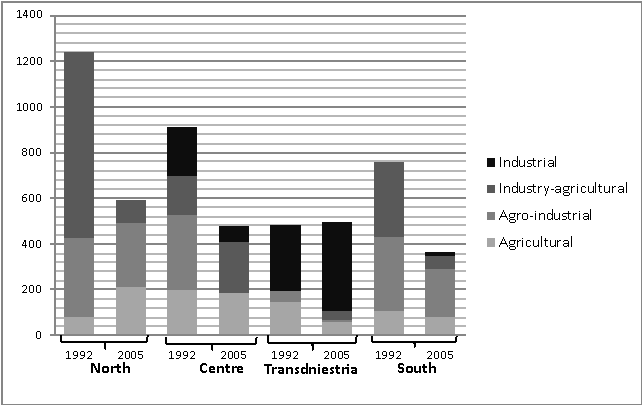 Fig. 1 The dynamics of the typological structure of the
production branch of economics in the economical regions of the Republic of
Moldova, million dollars US (in comparable prices of 2005)
Fig. 1 The dynamics of the typological structure of the
production branch of economics in the economical regions of the Republic of
Moldova, million dollars US (in comparable prices of 2005)
Source: Accomplished by the
author according to [1, 2, 3]
· The Central economical region is
characterized by «false» industrialization – increase of the share of industry,
but at the same time the decrease of its absolute indices along with an even
more acute decrease of the agriculture.
Conclusion. The
undertaken research showed that economical regions of the Republic of Moldova
in the years of restructuration faced differently directed structural changes
in the production branch of the economics. Country’s main «points of increase» (i.e. regions that managed to increase the
volume of industrial production and show a stable trend of development) are
productions directed towards export with positive links and guaranteed product
market (Ribnitza and Rezina regions in Transdniestria). A high level of
production increase is also representative for the areas adjoining to the
capital Kishinew region. Nevertheless, the two mentioned centres of the
Republic of Moldova which denote a significant increase of the production
volume are insufficient for a positive transformation of the country’s
economical under-activity. This is because the inequality of the real sector
increased twice as much during the postsoviet years. Moreover, the development
of the real sector in the mentioned advanced areas takes often place with an
acute lack of adequate social policy – according to expert evaluation, up to
500-600 thousand moldavians go annually off to different countries in search of
guaranteed income.
References.
1.
Статистический ежегодник Приднестровской Молдавской республики - 2005:
Статистический сборник (за 2000–2005гг.) / Государственная служба статистики
Министерства экономики ПМР - Тирасполь, 2006.
2.
Annual statistic al Republicii Moldova=Статистический
ежегодник
Республики
Молдова, 1992/ Depart. Statist. al Republ. Moldova. – Ch.: “Statistica”, 1993.
3.
Annual statistic al Republicii
Moldova=Статистический
ежегодник
Республики
Молдова, 2005/ Depart. Statist. al Republ. Moldova. – Ch.: “Statistica”, 2006.