Педагогические
науки / 4.Стратегические направления реформирования системы образования
Sharina E.P., Dubin
A.I., Moskalyonova N.A.
Maritime state
university named after G.I. Nevelskoy, Vladivostok
Pedagogical monitoring as toolkit of
quality education
The concept of modernization of Russian education and
recent government documents on education provide a set of priority measures to
ensure the quality of education and to create a system of tracking including
the determination of the criteria, procedures and technology assessment,
organization of pedagogical monitoring and as an integral tool of management of
quality of education.
Modern pedagogical science and practice faced with the
need to transition from the traditional ways of collecting information about
the school of pedagogical monitoring, under which we understand purposeful,
specially organized, continuous monitoring of the functioning and development
of the educational process and/or its separate elements for the purpose to
ensure timely adoption of adequate managerial decisions on the basis of the
analysis of the collected information and pedagogical forecast.
The majority of researchers understand under the quality of education the characteristics
of the education system, reflecting the degree of compliance of real achieve
the educational outcomes of regulatory requirements, social and personal
expectations [1, 4]. The main characteristics of the system of assessment of
learning outcomes (the main approaches to the development of tools, the
characteristics of verification activities, procedures, and presentation of
results) are defined main goals and objectives of. On most occasions before the
system of assessment of learning outcomes the main aim is – to receive
objective information about the functioning of the education system.
The emergence of the concept of «monitoring» is
connected with the establishment and development of the information society,
which was in need of objective and subjective information on the progress of
the condition of those or other objects and structures. Monitoring is, on the one hand, the system, and on the other hand,
is the process, representing a sequential collection of essential and versatile
information about the quality of education, its processing, systematization,
deep analysis, evaluation, interpretation, forecast of further development of
measures on correction of educational process and conditions created for him
Monitoring is polyfunctional character, reflected in
the unity of the roles: collection of necessary and sufficient information, its
analysis and the assessment, control over the realization of the social order
for a quality education, organization of motivational influence on the
participants of the educational process, forecast of further development of
education and elaboration of recommendations on the introduction of the
necessary corrections.
The essence of the pedagogical monitoring is so
complicated that all definitions of this concept reflect a different of him
angles, functions, features. Nevertheless a circle of the most significant
characteristics of pedagogical monitoring marked is: the
continuity of the study of one or another object; the duration and systematic
tracking; purposefulness of monitoring; the integrity of the monitoring
systems.
The structure of the monitoring of how the system is
composed of inter-related elements: purpose of the meeting, tracker object, the subjects of the organization and implementation of the
monitoring, complex of criteria and indicators for the evaluation, methods of
information collection, interaction of which provides for the implementation of
monitoring measurements [2].
Assessment of the quality of education (appraisal
plan) is divided into assessment of the quality of education - i.e.
the assessment of the consumers of educational services (personality,
manufacturing, government, education system) and internal evaluation of the
quality in the education system (educational authorities, education facilities,
study programs, qualified teachers, studying people). Inasmuch as subjects and
objects of the evaluation are as whole education system and elements of the
this system, evaluation can and should carry out the authorities (federal,
regional, municipal governments).In this case you get 20 possible variants of
internal evaluation and 5 variants of external evaluation of the education
system, many of which are not recorded on any of the levels (figure 1) [3].
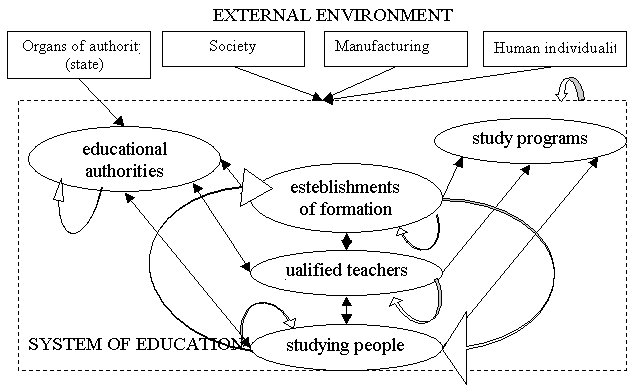

Figure 1. Subjects, objects and the process of
education evaluation
Development of a set of criteria and indicators is
problematic in connection with the multilateralism of a subject of research. In
the selection of criteria and indicators it is important to provide their
necessity and sufficiency.
For the collection of information on each indicator
are determined the methods of the study with account of the specifics of the
studied phenomena and opportunities. Methods shall ensure objectivity, the validity and
reliability of the received information, necessary for making managerial
decisions.
Consistent
orientation to the new socio-cultural situation and the personality-oriented
education has led to the deployment of other accents in the understanding of
the quality of its results, highlight the individual changes and achievements
of the students and a more clear description of the order, at the expense of
what they may be provided. To a considerable degree these requirements
correspond to criteria-based complex of the authors of the textbook «Management
of educational systems». They offer evaluate the quality of education for three
groups of criteria, on the basis of the three components of this quality aspects
[5].
Criteria of quality of
educational process are:
1.
the criterion of the quality of the
educational process, submitted by the indicators of the invariant level of
education (fundamental, integrity of, the conceptual, the activity character of
the content), varied (variety, continuance) and personal level (involvement in
the content of the educational process the experience of the students, the
consistency of such an experience with regulatory defined practice);
2.
criterion of quality of educational
technologies.
Procedural criterion finds its expression in humanity
teaching and dialogue forms of interaction between the teacher and the
students.
Процессуальный критерий находит свое выражение в
гуманистичности преподавания и диалогических формах взаимодействия учителя с
учащимися. Criteria of quality of
conditions of education are:
1.
quality of final results of control;
2.
effectiveness of the kinds of
management activity: motivational-target, informational-analytical,
planning-and-forecasting, organizational-performance, control-and-adjustment
and the estimated effective;
3.
quality of human,
scientific-methodological, psychological conditions.
In a number of criteria for the quality of the final result of education
comprises:
1.
the health of students;
2.
formation of the value of the
relationship to the surrounding reality: for their Fatherland, to yourself and
others, to the activities in them;
3.
education
level, defined:
·
personal-semantic relation of the
disciple to the material and the process of their own learning activities;
·
autonomy developed by them the ways
of the educational work (intellectual, information, research, etc.), in which
presented the lessons in the educational process methods of elaboration of
training material and the results of accumulating their own experience;
·
mastering of the vast knowledge
(knowledge of methods and means of mastering of educational material;
processing of the information, given in the word, sign-symbolic and graphical
forms);
·
ownership of the logic of the
subject knowledge.
The modern stage of modernization of the education,
complication of its functions has exacerbated the need to implement a
monitoring as a tool for monitoring and evaluating the quality of education.
Continuous tracking and adequate assessment of such a complex pedagogical
phenomenon, as the quality of education, changing not only with the passage of
time, but also depending on the type of educational institution, the
educational opportunities of students, etc. may be carried out through
monitoring.
Monitoring and evaluation of the quality of education
is not an end in itself, they are necessary for the teaching of forecasting and
making adequate managerial decisions regarding the progress and results of the
educational process. Only professionally and functionally organized monitoring able to meet
these requirements.
Bibliography
1.
Voskoboinikova
M.A., Pugacheva N.I., Chepuryshkin I.N. The quality of education as a factor of
competitiveness of the University // Higher education in Russia. - 2008. - № 5.
- P. 139-143.
2.
Girba E.Y.
Monitoring the quality of education / E.Y. Girba // Standards and monitoring in
education. - 2007. - № 6. - P. 58-60.
3.
Novikov A.M., Novikov A.A., Postaluk
N.Y. How to assess the quality of basic professional education? / Site of
academician Novikova URL: http://www.anovikov.ru/artikle/kacth_obr.htm (date of
circulation: 24.02.2012).
4.
Testov
I.A. Some of the methodological problems of determination of the quality of
education / I.A. Testov // Pedagogy. - 2008. - № 4. - P. 22-28.
5.
Shamova T.I., Tretyakov P.I.,
Kapustin N.A. Management of educational systems / ed. T.I. Shamova - M. :
VLADOS, 2002. - 320 p.