UDC
538.9:621.785.6
Mukazhanov Ye.B.1
Telebayev Ye.Ye.2
Takenova G.D.3
Tynaliev Bauyrzhan4
1 Doctoral
Student, PhD, Associate Professor, Academy of Economics and Law, Zhetysu State
University. I.Zhansugurov, Taldykorgan, Kazakhstan
Taldykorgan
Polytechnic College
2 Taldykorgan
Polytechnic College
3 PhD, Associate Professor, Taldykorgan Polytechnic College
4 Taldykorgan
Polytechnic College
Taldykorgan,
Kazakhstan
INFLUENCE OF DIFFERENT
MODES TEMPERING ON MECHANICAL PROPERTIES SPRING CR-NI ALLOY
Introduction
Dispersionhardening chromium-nickel
alloy 47HNM has high corrosion resistance, low temperature coefficient of the
modulus of elasticity nonmagnetic, low hysteresis and elastic springback, high
fatigue strength and is used in the industry, not only as a structural
material, but also as a spring alloy. For processing the alloy 47HNM recommended
modes: hardening of 1250ºC, aging at 700 - 725 ºC, 5H [1]. It is
known [1, 2], the technological properties of the alloys depends on the
heat-treatment. Therefore, for the selection of optimal processing conditions
should be aware of the dependence of the mechanical properties of the alloy
hardening behavior in a wide temperature and time interval. However, analysis
of the literature showed that almost no information about the mechanical
properties of the alloy 47HNM depending on hardening behavior and
evidence-based explanations for these changes.
Based on the foregoing, in the
objective was to investigate the influence of quenching temperature and
exposure time for hardening on the technological properties of the alloy 47HNM.
Experiment
47HNM hardened alloy samples was
carried out in water after heating at different temperatures 950-1300ºC.
Heating for quenching was carried out in a salt bath of molten BaCl2,
as well as inert gas.
Mechanical testing of samples at
room temperature uniaxial tensile carried out on the construction L.I.Vasileva
type "POLIYANI" standard procedure. The diagrams were calculated
tensile yield strength and durability, as well as determine the elongation of
the samples after the break.
Results and Discussion
Effect of quenching temperature on
the technological properties of the alloy 47HNM consider the range 950-1300
º C, because below 950 º C intermittent decay begins to develop with
the release of α-phase, and above 1300 º C is observed burnout
material.
Figure 1 shows the dependence of
ductility and resistance to deformation of the alloy 47HNM temperature
quenching. The analysis of the dependence can be seen that as the quenching
temperature ductility of the alloy is increased, and the flow stress (σ0,
1 - yield stress, σ1 - voltage residual strain of 1%, σV - strength)
decrease. Increase in ductility with temperature hardening due not only to the
dissolution, but also the processes of coalescence and sferoidezatsii excess
α-phase.
Thus, with increasing quenching
temperature increases the homogeneity of the solid solution, as the
concentration and reduction (healing) defects of the building. It should be
noted that a further increase in temperature over 1300 º C leads to a
sharp drop in plasticity. The reason for this phenomenon is caused not only by
grain growth and the formation of assorted, but fusion α-particle phase
near the grain boundaries and the spreading of the liquid phase at the grain
boundaries. It is likely that the fused areas there is penetration of
components of the furnace atmosphere, leading to the formation of oxides,
nitrides or gas bubbles, while it is possible that this may also be the cause
embrittlement of the alloy. Therefore, in order to avoid burnout material
heating temperature should not exceed 1275 º C.
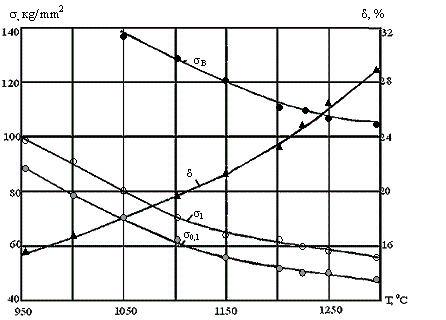
Figure 1 Dependence of ductility and
resistance to deformation of the alloy 47HNM quenching temperature
As
the temperature hardening the plastic properties of the alloy decreases,
suggesting incomplete dissolution of excess α-phase, and at 950 º C
elongation samples to divide half that at high temperature - 1300 º C, at
the same time there is a growth of the deforming stress (Fig. 1).]
Consider
the change in the technological properties of the alloy on the duration of
exposure 47HNM heating temperature before quenching. The studies were conducted
in the temperature range 1100-1300 º C, at the same time under quenching
is from 1 to 30 minutes. Nature of the change of plasticity and deforming
stresses, depending on the length of time before quenching is shown in Fig. 2 -
4.
Analysis
of the relationship of technological properties of the holding time at 1300
º C (Fig. 2) and 1250 º C (Fig. 3a) shows that with increasing
duration of heat flow stress drops, there is a growth of plasticity. Decrease
the resistance to deformation, and increased plasticity involves the
dissolution of excess α-phase based on Cr, which has a bcc lattice (Fig.
4). The process starts with the dissolution of dispersed particles, and with
increasing exposure time begin to dissolve and larger particles, enriching
alloying component solid solution matrix. Growth plasticity with increasing
time of homogenization at 1300 º C is up to 30 minutes, inclusive, after
which the curve reaches saturation.
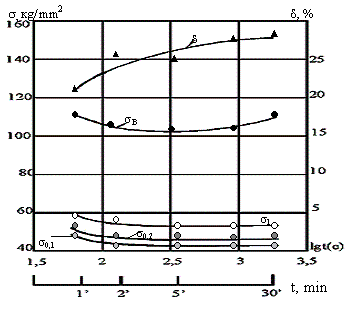
Figure 2. The dependence of the
technological properties (ductility and resistance to deformation δ
σ) alloy 47HNM the time of exposure at 1300 º C
The
nature of technological change in the properties as a function of exposure time
at 1250 º C and 1225 º C (Fig. 3a, b) subject to the same laws as at
1300 º C, but occurs at a lower intensity.
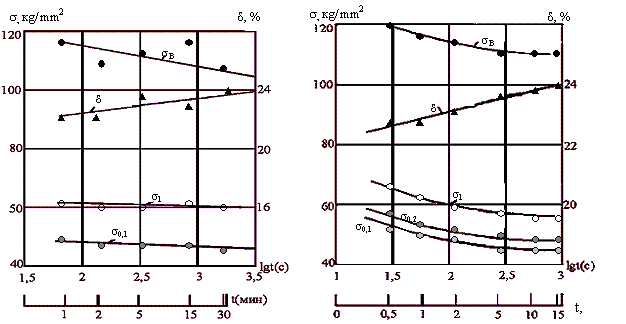
a)
b)
Figure 3 Dependence of technological
properties (ductility and resistance to deformation δ σ) alloy 47HNM
the exposure time of a - at 1250 º C; b - at 1225 º C
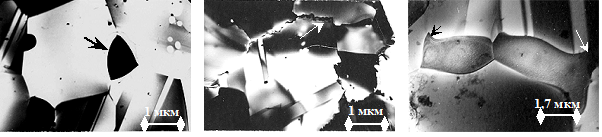
а) b) c)
Figure
4 47HNM microstructure of quenched
from 1250 º C: and -1 min, b - 5 min, c - 10 min.
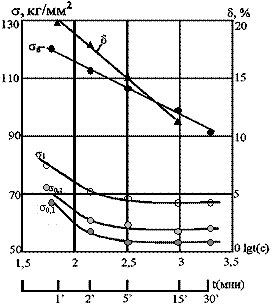
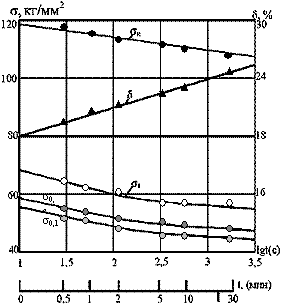
It is interesting to consider the dependence of the technological
properties of the alloy from the holding time at a temperature of 1200 º C
(Fig. 5a). The presented data show that with increasing time of homogenization
of the alloy mechanical properties fall, but to a much lesser extent, with the
yield strength and tensile strength increased by more than 10 kg/mm2 compared to
the temperature range 1300-1250 º C.
a) b)
Figure 5 The dependence of the
technological properties (ductility and resistance to deformation δ σ) alloy 47HNM the time of exposure: a - at 1200
º C; b - at 1250 º C, the pre-treated at 1100 º C, 5 hours
Nature
of the change of plasticity changes dramatically, the expected growth of
plasticity with increasing heating time observed her fall. The reason for this
phenomenon has not been established, although the nature of the structural
studies of fracture patterns in cross-section show the presence of the
so-called structure of the "slate" kink. It is considered that the
"slate" of the structure is not a marriage of heat treatment, but it
is possible that this may be one of the reasons why the ductility and toughness
of the alloy.
Creation
of a "slate" of the structure of fracture, apparently, could be due
to non-uniform distribution of particles α-phase (Stroke) that the
homogenization of the alloy leads to the dissolution of most of dispersed
particles to form microvoids. Eliminate the "slate" can be prolonged
homogenization of the alloy, but it is necessary to monitor the oven
temperature to avoid burnout.
Should
point to a rather large variations in the ductility and strength testing
samples quenched from 1200 º C. Apparently, the spread of values affects not only the heterogeneity structure,
but also the partial melting of the α-phase particles located at the grain
boundaries and the presence of non-dissolving particles, which are stress
concentrators. All these factors lead to the formation of micro-cracks,
reducing the ductility and toughness of the alloy.
Conclusions
Thus,
hardening alloy 47HNM spending below 1225 º C is not advisable, as it is
the deformation leads to the formation of micro-cracks, reducing the ductility
and toughness of the alloy.
With
the increase of quenching temperature increases homogeneity of the solid
solution, as the concentration and reduction defects of the building. The
increase in temperature over 1300 º C leads to a sharp drop in ductility,
melting due to α-phase particles on the basis of Cr and a spreading of the
liquid phase at the grain boundaries.
With
the increase of the heating time for hardening flow stress drops, there is a
growth of plasticity, which is associated with the dissolution of excess
α-phase. In samples quenched from 1200 º C, the variation of
plasticity changes dramatically, the expected growth of plasticity with
increasing heating time observed her fall. It is assumed that this is caused by
the presence in the structure of the "slate" kink.
literature
1 Molotilov BM Precision alloys. - Moscow,
Metallurgy, 1974. - 448.
2 Erbolatuly D. Features of formation of fine
structures and their influence on the superplastic properties of alloys and
40HNYU 67KN5B / / Proceedings of the Intern. Research School conference.
"Physics and chemistry of nanomaterials." - Tomsk, 2005. - P.52-55.
INFLUENCE OF DIFFERENT MODES TEMPERING ON MECHANICAL PROPERTIES SPRING
CR-NI ALLOY
The
nature of technological change and the strength of the alloy 47HNM by quenching
in a wide temperature and time interval. Shown to increase the hardening
temperature of the alloy up to 1300 º C reduces the mechanical properties
and improved ductility. Found that above 1300 º C ductility decreases
sharply, due not only to grain growth and the formation of assorted, but fusion
α-particle phase based on Cr and a spreading of the liquid phase at the
grain boundaries. With the increase of the heating time for hardening flow
stress drops, there is a growth of plasticity, which is associated with the
dissolution of excess α-phase.