Сельское
хозяйство/ 4.Технологии хранения и переработки сельскохозяйственной продукции
Doc. Tech. Sc. V. Yu. Ovsyannikov, Doc.
Tech. Sc. N.N. Lobatchyova, postgraduate student Ya.I. Kondrateva,
undergraduate student N.I. Bostynets
Voronezh State University of
Engineering Technologies, Russia
Modes of separation
of blood plasma and the frozen ice
in a centrifugal
field
Cold application in the food industry is now gaining broad prospects. Freeze
concentration consists of two main stages: crystallization and separation. At
the first stage some part of the water which was in a liquid product turns into
ice under the influence of low temperatures, and at the second stage a
concentrate and ice crystals which have different specific gravity, are
separated under the influence of the external pressure or centrifugal forces [1].
Investigation of the centrifugation process of ice frozen from plasma of
cattle was carried out on the laboratory centrifuge equipped with a special
rotor, as well as devices of registration of temperature, control and
regulation of the rotational speed of the rotor. The total solids in the
original and concentrated blood plasma of cattle were determined by
refractometry.
Before centrifugation the moisture freezing from blood plasma in the screw
crystallizer was carried out [2].
To study the effect of the separation factor and
the final dry matter content of blood plasma at a solids content in the molten
ice, after freezing and centrifugation mathematic methods of experiment
planning were applied. In this case the following main factors were chosen: x1 is the solids content of
the concentrated blood plasma, % and x2
is the centrifuge separation factor. The factors specified are consistent and
do not correlate with each other. Solids content of the ice melted Y was taken as the final evaluation
criterion.
Central composite uniform - two-factor rotatable plan of Box - Hunter
was used for the investigation.
As the result of statistical processing of the experimental data the
regression equation adequately describing the process of centrifugation of ice,
frozen from cattle blood plasma under the influence of the investigated factors
was obtained:
 ,
,
where  - the coded values of these
factors in accordance with the statistical plan.
- the coded values of these
factors in accordance with the statistical plan.
The
regression equation analysis shows that the solids content of the melted ice solution
is greatly influenced by the solids content in the concentrated blood plasma
and the smallest influence is by the separation factor.
To
determine the optimal modes of centrifugation "Ridge analysis" method
was used. Optimal content of solids in
melted ice solution equal to 0.182 % corresponds to the solids content in the
freeze-concentrated plasma equal to 22.34 % and the separation factor of
515.25. It is obvious that the suboptimal centrifugation modes are in the field
of specified values.
The obtained equation of the
solids content in the solution, received in the melting of ice, frozen DSi, %
and dry matter content in the cattle concentrated blood plasma DSb, % and the
separation factor Fr is shown in the
Figure .
In this case it is seen that
with the increase in solids content in concentrated blood plasma and the decrease
in the separation factor the dry solids content in the solution obtained by frozen
ice melting increases monotonically.
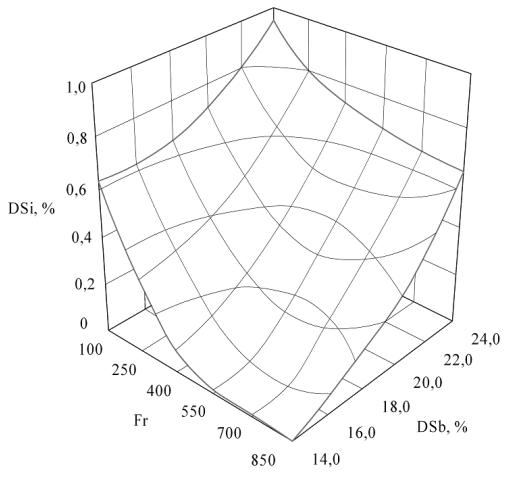
Fig. Dependence of dry matter
content in the melted ice solution DSi on dry matter content in the
concentrated cattle blood plasma DSb and the separation factor Fr
When the solids content in the concentrated blood
plasma is equal to 14.0 % and the separation factor is 850 the solids content
of the solution obtained by frozen ice melting does not practically take place
which may be explained by a slight melting of the ice
and crystals washing by the resulting water due to the error,
inevitably affecting the conditions of adiabatic centrifugation at high speeds
of the rotor rotation.
Bibliography list:
1. L. Pap, Freeze concentration. Translation.
with Hungarian, edited by O.G. Komyakova. - M.: Light and Food Industry, 1982.
- 97 p.
2. V.Yu. Ovsyannikov. Optimal
modes of blood plasma freeze concentration // Meat industry. – 2012. -№1.