Tleuzhanova
Manatzhan Ashimkulovna
Kazakh
University of Finance, Economics and International Trade
E-mail:
m_tleuzhanova@mail.ru
Satmurzaev Asan Adasbekovich
Kazakh
National Pedagogical University named after Abai, Kazakhstan
MОNITORING, EVALUATION AND ANALYSIS AS BASIS FOR DECISION-MAKING
Abstract
This article examines the modern company as an object of management. New
terms and conditions of the national economy requires fundamental changes in
the methods of company management. Economic development increases the
responsibility and autonomy of companies in the development and management
decisions to ensure their efficient operation. The basis of any management are
reasonable prediction of future development companies and supervises the
implementation of the plans in order to timely adjust them, allowing to quickly
adapt to the unpredictable and unstable market....
The modern firm as
an object of control is a very complex organization. The development of market
relations increases the responsibility and independence of firms on the
development and management decisions to ensure their efficient operation. The
new conditions of the market economy requires fundamental changes in the
methods of company management. The basis of any management are reasonable prediction
of future development firms and control over the implementation of these plans
in order to timely adjust them, allowing to quickly adapt to the unpredictable
and unstable market. Quality control is only when it is based on a systematic
and objective analysis of the economic performance of the projects.
From the
quality of the estimates, the level of objectivity, reliability and in
formativeness depends on the correctness of the conclusions and
recommendations, and ultimately develop concepts of development and enterprise
management. Put into practice methods for assessing financial performance did
not meet the requirements of modern management and often do not reflect the
depth of occurrence of many processes inherent in the period of economic transformation
are inadequate changing control tasks.
As practice
shows, well defined strategy on paper by an average of 70% are not introduced
into the life, as estimated base was insufficient and the actual conditions
were tougher than their image in the planning process. Consequently, the
question of how to generate an estimate values of parameters in a
much larger set of coherence between the complex and with giving them the role
of independent analytical procedure that can not only identify the specific
numerical characteristics, but also indicate the extent of their compliance
with the optimum level of decisions.
First you need to
clearly define the economic categories such as "estimate values
of parameters" and "analysis of indicators"
because often these concepts are perceived by economists as being equivalent.
However, in our view, these categories are not identical to each other.
The estimated
values of the indicators need to understand their specific
numeric value, but under analysis - action system, which allows to determine
the movement of the obtained values of their properties in the
information database, defined as their individual characteristics, resulting
from the economic content. The analysis is done by comparing the actual values
of the index and the base. Kazakhstan is currently the most
common form of price competition has become. It largely determines the strategic direction of the company.
Develop strategies
based on the forecast of price policies and assessment of future economic and
financial results to provide:
- Reimbursement of
invested funds from the proceeds of the sale of goods and services;
- Profit that
provides margin not less than desirable for the firm level;
- Return on
investment within a period acceptable to the Company.
Under these
conditions develop the right decisions depends entirely on the quality of the
assessments of external and internal environment of the firm, because the
definition of reality to achieve these results, strategic operations and is a
key objective assessment of the financial and economic parameters of any
prospective or existing project the future of the company.
The
assessment is always quite a complex procedure, which is due to several
factors:
- first, to determine the level of future
costs and the availability of funds for this purpose, or their sources;
- Secondly, the
results are visible immediately, but over a long period, making it difficult to
identify errors that occur;
- Thirdly, the
implementation of long-running operations leads to increased uncertainty in the
evaluation of all aspects in the future and increase the risk of error.
Proof of this
position are research scientists, showing that demand for the Kazakhstan market
at 80-90% price elastic, that is sensitive to any changes in it. Consequently,
the gain or loss in the application of a strategy depends on how competitive
prices affect the costs, which can be determined only by a complete analysis.
Improving financial
analysis and evaluation of the results of management is currently not only
relevant, but vital process improvement at all levels of management. This is
due to the fact that the manager should not only assess how management
decisions affect the financial condition of the company as a whole and whether
the decision strategy of the company, but also what impact the results of the
individual business units (responsibility centers) in the process of
implementing the strategy.
The cost analysis
is considered as a process of assessing the financial impact of alternative
management decisions on the internal efficiency of the organization. The
external environment into account almost not accepted or its impact is
predicted on the basis of extrapolation methods with sufficient accuracy.
However, the external environment has become increasingly unstable,
unpredictable, escalating competition. In such a situation, the company is
required to change the traditional approach to management accounting and
analysis: it is not enough analysis, "in fact", and to a comparison
of planned (standard) units with enclosed with the actual outcome and results
to the modern concept of strategic management. Improving financial analysis and
evaluation of the results of management is currently not only relevant, but
vital process improvement at all levels of management. This is due to the fact
that the manager should not only assess how management decisions affect the
financial condition of the company as a whole and whether the decision strategy
of the company, but also what impact the results of the individual business
units (responsibility centers) in the process of implementing the strategy.
The cost analysis
is considered as a process of assessing the financial impact of alternative
management decisions on the internal efficiency of the organization. The
external environment into account almost not accepted or its impact is
predicted on the basis of extrapolation methods with sufficient accuracy.
However, the external environment has become increasingly unstable,
unpredictable, escalating competition. In such a situation, the company is
required to change the traditional approach to management accounting and
analysis: it is not enough analysis, "in fact", and to a comparison
of planned (standard) units with enclosed with the actual outcome and results
to the modern concept of strategic management.
Under the strategic
cost management refers to the resulting correlation analysis system of
accounting information with the company strategy and development on this basis
of specific organizational management activities designed to achieve the best
results. Cost data used to develop a strategy focused on the creation and
implementation of a sustainable competitive advantage. In strategic management
accounting and management analysis act as an information system serving the
managerial decision making process (Fig. 1)....
Impact Business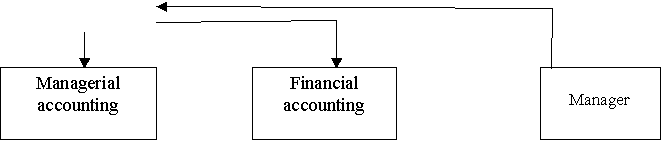


 Accounting

Данные Information Information

The need for information
Fig. 1 Information
System - the basis for decision-making
Thus, the system of evaluation and
analysis process provides management decisions, and if they are carried out
correctly, or not fully, the poor quality of information is almost always
virtually laid the wrong management decision. Unfortunately, experience shows
that in most business information is not unity between the financial and
management accounting, there is no special organs on the analysis of prices,
costs, price competition and processing accounting information. Such
information should be formed not only by the joint efforts of the accountant
and the director, but you need a specialist, analyzing prices and price
competition.
In a market firms need to have a common
accounting system with the strategic orientation (Fig. 2). Only in this case,
the account information will facilitate the process of developing and
implementing the business strategy of the organization, and the tools of
accounting will be entered into the process of strategic management. The
transition from the administrative cost analysis to strategic cost management
is a major challenge in the development of strategic management. The success of
this transition should boost the value of management accounting. Estimate of
the accounting system will be in its influence on the implementation of the
strategy developed
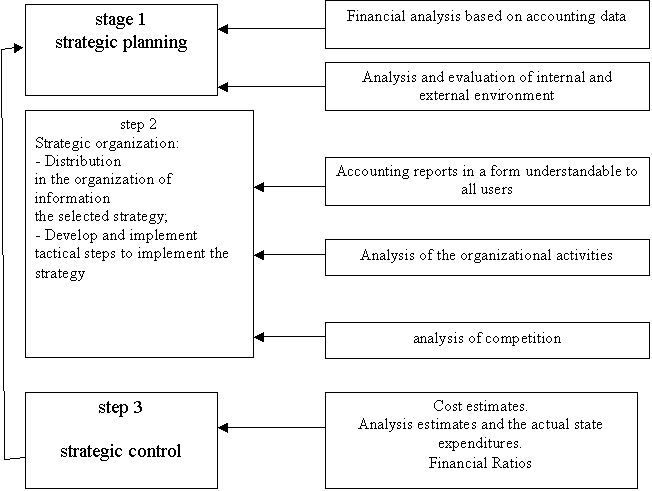
Fig. 2. The necessary information, providing strategic management process
From Fig. 2 shows that strategic management is a continuous cyclic
process is constantly based on a rating system of analytical information, which
can be divided into three stages: 1. Strategic planning. 2. Strategic
organization. 3. Strategic control.
It is often perceived only as a strategy for the strategic planning
process. However, this is not enough for a full portfolio formation strategies
to comprehend and process of the organization and the process of control that
most often provide the necessary evaluation information.
In the strategic planning process of any assessment of initial
information to determine the mission, goals and objectives of the firm. Without
an analysis of the accounting and financial information is difficult to
understand the level of performance of all activities. Without an analysis of
the external environment is impossible to analyze the strategic position, to
assess the level of achievement, retention, development and capitalization of
competitive advantage. At this stage, the accounting information - the basis
for the financial analysis, which, on the one hand, provides information on the
financial component of the strategic potential, and on the other - to evaluate
strategic alternatives.
Strategies that are not financially justified or not lead to an
adequate financial return can not be considered successful. At the same stage
in the process of analyzing the internal environment of the organization held a
strategic cost analysis. Attention is focused on the comparison of costs of the
firm and its competitors. Analysis tool is, in particular, value chain, which
determines the activities, functions and processes of development, production,
marketing, delivery and support of products or services. Traditionally,
accounting costs are calculated on the basis of a wide range of costs.
Identifying the costs by type of activity performed by means of the correlation
of costs to specific species analyzed to solve the same problems that arise in
business. To do this, you want to convert accounting data on the costs of firms
in the cost of performing certain operations performed in the value chains of
the company, with its relationships with suppliers and customers.
Literature
1. Audit: textbook for high
schools / VI Podolsky, G. B. Polak, A. Savin, L. Sotnikov and others, ed. prof.
VI Podolsky. - 4 - ed. rev. and add. - Moscow: UNITY-DANA, Audit, 2007. - 583.
2. Audit: textbook / I. N. Rich,
NT Labyntsev, NN Khakhonova. - 4 - ed., Rev. and add. - Rostov N / A, Phoenix,
2007. - 506.
3. Savitskaya GV Analysis of
economic activity: Tutorial. - 3rd Ed. , Revised. and add. - Moscow: INFRA-M,
2006. - 425 sec.
4. Savitsky, Theory analysis of
economic activities: the manual. - Moscow: INFRA-M, 2006. - 281 p.