Abdraimova Nurila Ondirisovna, Bainiyazova Akmaral
Taskaraevna, Demeuova Akmaral Bahitbekovna
Kyzylorda state university named after Korkyt – Ata
E-mail: Akmabay@mail.ru
Automation and control system tank farm
Abstract
This article
comprises data for Delta V visualization system software to control process
parameters of the Tank farm using operator workstation. This article shall be
used as the operation guide.
This article
describes the visualization systems purpose, its capability and function,
general rules for operation, operator and other engineers guide to realize
various functions.
Introduction
The technology of
process instrumentation continues to grow in both application and sophistication.
The various control equipment components that may be used to regulate a process
and certain aspects of process behavior will be discussed in this article.
Automation consists
in the realization of oil storage plant measuring information control system
and is based on Fisher-Rosemount HTG oil hydrometer, gagging and record system in
tanks. Control system is provided by Delta V full-service distribution system. Field
devices, controllers and workstation operate simultaneously consisting of the
system, provided each management each on its level.
Insulated Ethernet
provides data communication between controllers and workstation is the managing
network of Delta V system.
Main Automation
Solutions
Tank field site
equipped with automation and control system. Two – level hierarchical structural
system controls the process. Process variable measurement, transformation of
physical magnitude in signals transferring to upper level, characteristics
recording, signaling, indication, object positioning, stat using and other
operations are fulfilled at the lower level.
HTG system (Fisher-Rosemount) is used for
commercial records of oil in PBC-7, PBC-8, PBC-11, PBC-12, PBC-13, PBC-14
tanks. HTG system controls oil weight, volume, density, level and temperature. HTG
measurement method is fundamentally differed from other tank hydrometer
methods. HTG provides exceptional exact records providing each tank data.
Material weight-to
measure directly (total error +/- 0.05%)
Material density –
to measure directly(total error +/- 0.11%)
Material
temperature– to measure directly(total error +/- 0.11%)
Material level –
calculation (total error +/- 0.11%)
Material volume –
calculation
Material specific
volume +/- 0.11%
Specific density
Weght=(Pbottom-PTap)*square
Density=
Volume =
Level = 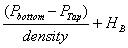
In addition the
system provides all necessary diagnostic information and full signaling (both
local and remote for each tank), possible leakage signaling, continuous quality
and homogeneity control, allowed load/unload material, field characteristics
read etc. altogether 250 characteristics per tank.
The present system
is fully automatic one (excluding manual operations and need for density
laboratory test), flexible one (has modular construction), open (HART protocol
for communication of all intellectual devices, MODBUS RUT protocol for central
process unit control by means RS-485 interfaces, PC and FIX MMI package)
russified operator interface for Windows NT4.0 communications (factory computer
network) and free format report printing, operative one (every second data
updating), service-able (no problems w. encapsulation and pollution and no need
to be on tank roof), reliable one (lack of moving parts, calibration sensor
technology, all system parts error-free running time more than 50 years),
mountable (not required to stop tank operation, to empty and air a tank, to
take 220V supply for each tank, possibility of daisy chain)
Hydrostatic
pressure sensors heating (lower and middle 12 areas in all) is specified for
operability assurance in oil tanks during winter by means of self-regulating
heating cable Chromatrace. Self-regulating effect lies in the following the
lower oil temperature in fitting pipe the larger heat comes from cable and in
case of rise in temperature cable ,s heat-evolution is decreased. One
area power input is 17 watt. Maker supplies full outfit kit including
termination kit, joints, termination seal and mounting boxes.
«Oil-water» phase
division signaling in oil tanks PBC-7, PBC-8, PBC-11-PBC-14 is carried out by
level sensors «Zircon» maker Sensall, installed at the level more than 60mm –
tank bottom water upper level while tank unloading. Gagging principle is to
gage sensor-level permittivity. Sensor sends active part wet-dry signals and
self-control sensor signals in two-wire circuit 20mA.
Oil overflow upper
level alarm in tanks PBC-7, PBC-8, PBC-11-PBC-14 shall be done by level sensors
«Sapphire» maker Sensall, installed at limit filling level. Gagging principle
is to change propagation of ultrasound between sensor detectors. It sends
active part wet-dry signals and self-control sensor signals in two-wire circuit
4-20mA.
For water level
control in water tanks PBC-9, PBC-10 the following system is provided.
-
in water tank PBC-10 for water overflow level maker Sensall are applied
-
in water tank PBC-9 maker Krohne reflexive action radar oil level sensor
is applied owing to trapped oil
-
PBC-9, PBC-10 water tank temperature control is carried out by thermo
elements with unified output signal and are provided water temperature
measurement. The supplier is Metran product group.
Controller fulfills
all I/O signal pickup logical operations and process management operations in case of need. Fiber optic cable connects
controller with Delta V work station through Ethernet. Field instrumentations
installed on oil and water tanks directly. Delta V system work station
installed in control room.
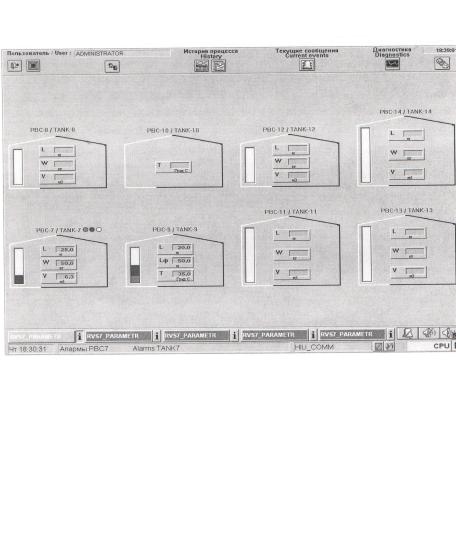
Figure 1. Tank Farm
Instrumentation.
Summary
The
typical process plant contains many tanks, vessels, and reservoirs. Their
function is to store or process materials. Accurate measurement of the contents
of these containers is vital. The material in the tanks is usually liquid, but
occasionally it may consist of solids.
Initially,
level measurement appears to present a simple problem. However, a closer look
soon reveals a variety of problems that must be resolved. The material may be
very corrosive; it
may tend to solidify;
it may tend to vaporize;
it may create other difficulties.
Bibliography
1. Norman A. Anderson. Instrumentation for Process Measurement and
Control. Radnor, PA: Chilton, 1989.
2. Shinskey, F.G. Process control systems. New York:
McGraw-Hill Book Company, 1979.
3. Liptak, B.G.
Instrument Engineers Handbook, vols. I and II. Radnor, PA: Chilton Book
Company, 1970.
4.
Едигаров. М. Нефтебазы и газохранилища.
5.
Коршак А.А., Шаммазов А.М.Основы нефтегазового дела. Уфа, 2007.