D.R. Turarov1, M.N. Sultanova2
1c.e.s., senior lecturer in the department of Economics
1Master of Al-Farabi Kazakh National University, Kazakhstan, Almaty
dauren.83@mail.ru
Application of tools for the performance evaluation of
the Single Accumulative Pension Fund
Abstract. The current stage of the
Republic of Kazakhstan pension system development is characterized by a number
of peculiarities and problems. Today, many alternative ways of development are proposed for the further
improvement of pension system. Given the demographic and macroeconomic
prospects for the next decades, reliance on a full-capitalization system is
unnecessary and problematic, as the experience since 1998 has demonstrated.I
propose a method of system dynamics to predict changes in pension savings and
pension payments, to analyze their dynamics and for decision-making in the
pension policy and to check with the help of System Dynamics is the introduction of the 5% notional component positively affect on the pension system.
The set of
simulation models of the pension system helps to investigate the pension system
as an integrated dynamic system, study the synergistic effect of the
interaction of its elements, influencing factors and control solutions,
including elements of social behavior of people as for selecting the method of
forming a funded pension.
Keywords. Pension System, Single
Accumulative Pension Fund, System Dynamics, Simulation Model, Kazakhstan.
Тhe modern pension system of Kazakhstan dates
back to 1997 when the Kazakh Government approved the Concept of reforming the
country’s pension security system and the “Kazakhstan Pension Security Act” was
adopted. The innovation consisted in developing the basics of a cumulative
pension system and gradually abandoning the old, distributive, pension system [1].
The pension
security of Kazakhstan is currently a three-level system combining mechanisms
of pay-as-you-go system and accumulative system.
Level
One is a pay-as-you-go pension system inherited by
Kazakhstan from the USSR after its collapse where the state budget provided
pension payment source at the expense of tax liabilities of working population
and other receipts. The amount of pension payments is based on the years of
work. Pension payments for those whose period of work by the retirement date as
of January 1, 1998 made at least six months are currently formed within the
frameworks of such level.
Level
Two is a mandatory accumulative pension system with fixed
10% amount of mandatory pension contributions of monthly income for Kazakhstan
residents, foreign nationals and stateless persons who have permanent residence
in Kazakhstan and 5% of mandatory occupational pension contributions at the
employer’s expense of employees’ monthly income and in favour of those
employees whose jobs are provided in the list of activities, jobs and
professions as determined by the Government of the Republic of Kazakhstan
Level
Three is an accumulative system based on voluntary pension
contributions (VPC). VPC amount, payment procedure and further payment shall be
as agreed by the parties to the agreement for pension security at the expense
of VPC [2].
Therefore, the population of the Republic of
Kazakhstan engaged in the pension system shall be responsible for their income
level after retirement as savings generated on their individual pension
accounts will become the source of pension payments.
Every citizen is offered a possibility of increasing
their savings at the expense of voluntary pension contributions and thereby of
providing a higher income after retirement.
The current stage of the Republic of Kazakhstan pension system development
is characterized by a number of peculiarities and problems. Today, many
alternative ways of development are
proposed for the further improvement of pension system. Given the demographic
and macroeconomic prospects for the next decades, reliance on a
full-capitalization system is unnecessary and problematic, as the experience
since 1998 has demonstrated. Making use of a set of simulations that compare
full-capitalization, pay-as-you-go and notional account systems, it is argued
that a system of notional accounts should be the basis of the pension system,
and that the conditions are ripe for adopting it. Individual accounts would
continue, with their returns determined not by market interest rates, but by a
notional rate of return consistent with financial sustainability of the system
over the long term. The notional accounts system would be complemented with a
citizen (universal) pension for all Kazakhs in retirement age. Our task is to
propose a method of system dynamics to predict changes in pension savings and
pension payments, to analyze their dynamics and for decision-making in the pension
policy and to check with the help of System Dynamics is the introduction of the notional component
positively affect on the pension
system.
The set of simulation models of the pension system helps to investigate the
pension system as an integrated dynamic system, study the synergistic effect of
the interaction of its elements, influencing factors and control solutions,
including elements of social behavior of people as for selecting the method of
forming a funded pension. The simulation models’ parameterization is based on
the results of socio-economic processes monitoring.
The developed set of the pension system models can be used by the government to analyze functioning and
formation of a long-term development strategy of the pension system, especially
when justifying the development programs. A final caveat must be kept in mind:
the results presented in this work are subject to biases due to incomplete data
and to the simplified nature of the simulations.
-System dynamics was created during the mid-1950s[3]
by Professor Jay Forrester of the Massachusetts Institute of Technology. His
seminal book Industrial Dynamics (Forrester 1961) is still a significant
statement of philosophy and methodology in the field. Within ten years of its publication, the span of applications
grew from corporate and industrial problems to include the management of
research and development, urban stagnation and decay, commodity cycles, and the
dynamics of growth in a finite world.
It is now applied in economics, public policy, environmental studies,
defense, theory-building in social science, and other areas, as well as its
home field, management. The name
industrial dynamics no longer does justice to the breadth of the field, so it
has become generalized to system dynamics.
The modern name suggests links to other systems methodologies, but the
links are weak and misleading. System
dynamics emerges out of servomechanisms engineering, not general systems theory
or cybernetics (Richardson 1991).
The system dynamics
approach involves:
• Defining problems dynamically, in terms of
graphs over time.
• Striving for an endogenous, behavioral view
of the significant dynamics of a system, a focus inward on the characteristics
of a system that themselves generate or exacerbate the perceived problem.
• Thinking of all concepts in the real system
as continuous quantities interconnected in loops of information feedback and
circular causality.
• Identifying independent stocks or
accumulations (levels) in the system and their inflows and outflows (rates).
• Formulating a behavioral model capable of
reproducing, by itself, the dynamic problem of concern. The model is usually a computer simulation
model expressed in nonlinear equations, but is occasionally left unquantified
as a diagram capturing the stock-and-flow/causal feedback structure of the
system.
• Deriving understandings and applicable policy
insights from the resulting model.
• Implementing changes resulting from
model-based understandings and insights.
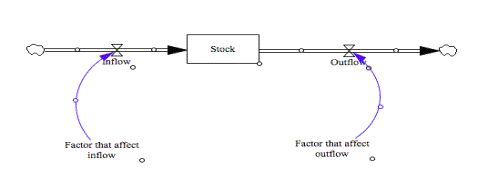
Figure 1. Major elements
in System Dynamics model [from the program Vensim]
The method of System
Dynamics is widely used in different fields such as Physics, Medicine,
Economics, Transport Modeling, Risk Management and etc. System dynamics also
successfully has been applied to some problems of the pension system in several
countries. For example, Dynamics Simulation Approach in Analyzing Pension
Expenditure
of
Malaysian Pension Fund by Hasimah Sapiri, Dynamic Simulation Of Russian Pension
System Development Processes by Lychkina, Dynamic Stochasticity in the control
of liquidity in Asset and Liability Management (ALM) for pension funds by
Ricardo Matos Chaim, Study on China's Pension Gap Based on System Dynamics by
Wei Shao.
After analysis of the pension system, we have defined the factors having an
impact on the pension income and expenditure. Also we have identified the
relationship between factors and the degree of influence on each other. And in
the end, all the data have been
translated into a computer model using the program Vensim. Statistical data
necessary to calculate the equations are taken from the Single Accumulation
Pension Fund.
This model mainly involves the structure of involving
population on-the-job, pay level, the age structure of pensioner population and
wages. Balance of pension fund is a very important variable, and pension income
and expenditure is the key to the research. Therefore, two subsystems of the
pension income and expenditure are analyzed in the study.
Pension income mainly comes from enterprises payment and individual payment
and the investment income of pension fund. The relationship between them and
their respective are as follows: Firstly when payment rate is set, higher
worker average wage and more of involving workers on-the-job, the more
enterprice payment and individual payment. Secondly, it is positive to the
relationship between the total population
and the involving workers, the larger the total population, the more
involving workers. Thirdly, the higher the return on investment, the higher the
income, investment income and pension income is positive correlation between.
Retiree pension is mainly used to join the pension treatment, mainly
influenced by the worker average wage and factors as pension replacement rate.
The relationship between them and their respective are as follows: Firstly, the
higher the replacement rate, the more pensions, pension replacement rate and
pension spending is positive correlation. Secondly, when the replacement is
set, pensions are positive to the relationship between worker average wage and
the insured number of retired. The higher the retired worker average wage, the
more insured workers, the more pensions.
Now directly about the model itself. Our model will examine the dynamics of
income and expenditure of SAPF. As we mentioned above to build the model, we
used the method of system dynamics. Software Vensim was a tool to build. The model
is designed to support decision-making related to the reform of the pension
system, to the changes in economic factors that have an impact on costs and
revenues of the pension system in the long run.
In the model of
the dinamics of income and expenditure of SAPF the next factors should be
described:
= Conditions for
retirement:
- The rate of
pension contributions,
- Mechanism for
calculating pensions.
= Performance
indicators of SAPF;
- Accumulated balance
- Fund's investment activity
= Population,
namely those who have the need for provision of pensions (pensioners) and the
resources for it (the working population), the level of fertility, mortality;
components of the
pension system: contribution rate, rate of the notional component;
= The level of
wages, which are directly related to pension income.
Let us examine
each component of the model. The Balance of the Pension System is the most
important indicator, and receipts and payments for pension system are the key
factors of the model. Let us consider
them separately.
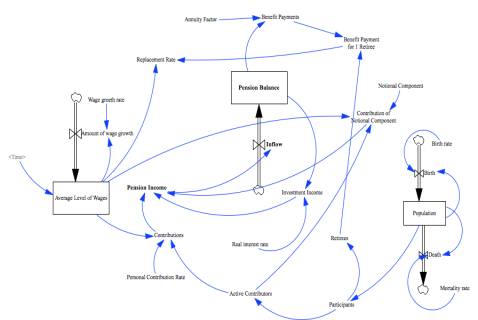
Figure 2. Model in Vensim
[from the program Vensim]
This article addressed the issue of applying
system dynamics in pension system of Kazakhstan with the aim of developing a
system. To achieve this purpose, the project sets three objectives that
constitute its scope.
Firstly, it covers the current pension situation
in Kazakhstan. Starting from 2013 all pension funds combined to one
accumulative single pension fund. In our research we are viewing two factors of
pension fund: mandatory accumulative pension system with fixed 10% amount and
engage notional component with fixed 5%.
Secondly, in order to to build the model, we
found factors influenced on the pension system, and in the model we viewed 9
scenarios in comparison with the baseline scenario.
Third, in order to know effectively apply system dynamics in the pension
system, and whether it really play. We simply test how the relative indictors,
factors like replacement ratio will be influence by the introduction of nominal
notional component. Of the above scenarios can be seen that it is necessary to
engage national component, because it is a good effect on the overall pension
balance, average level of wages, investment income and etc. We have seen that
the Vensim software facilitates a realistic assessment of the pension system in
all parameters.
Finally, all the objectives were achieved and
the diploma project came to conclusion that the simulation model was tested.
Figures:
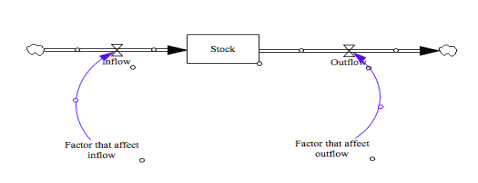
Figure 1. Major elements
in System Dynamics model (from the program Vensim)
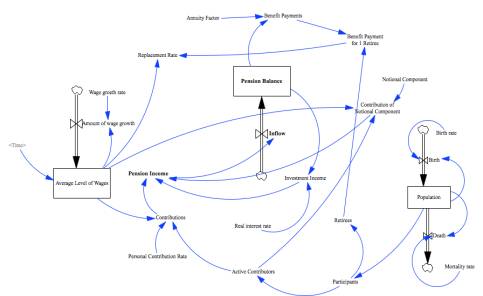
Figure 2. Model in Vensim
[from the program Vensim]
REFERENCES:
1. http://www.pnhz.kz/ru/?id=1560;
01.02.2016 11:28
2. Official website ENPF - www.enpf.kz;
01.02.2016 12:06
3. System dynamics; Articles of the experts and employees of the TORUS
Center; http://bigc.ru/publications/other/metodology/system_dinamic.php
4. Lychkina N.N., Morozova Y.A., Shults
D.N. Stratification of Socioeconomic Systems Based on the Principles of the
Multi-modeling in a Heterogeneous Information-analytical Environment // 2nd.
International Multi-Conference on Complexity, Informatics and Cybernetics,
Orlando, Florida, USA: International Institute of Informatics and Cybernetics,
March 27th - 30th, 2011. pp. 97-100.
5.
These Official Site of the National Bank of the Republic of Kazakhstan,
http://www.nationalbank.kz, 02.02.2016 18:40
Application
form
|
Surname |
Sultanova |
Turarov |
|
Name |
Muldir |
Dauren |
|
Scientific
degree |
Bachelor |
Candidate of
Economic Sciences |
|
Academic
rank |
- |
Senior
teacher |
|
Position
and Department |
Master
|
Senior
teacher ofEconomic department |
|
The official
name of the workplace |
Al-Farabi Kazakh National University Kazakhstan Republic, 050040, Almaty, al-Farabi
St.,71 t: +77077333038 |
Al-Farabi Kazakh National University Kazakhstan Republic, 050040, Almaty, al-Farabi St., 71 t: +77074939951 |