Pil E.A.
Academic of the RANH, Dr.S. (eng.).
Professor,
Options
OF CALCULATING VOLUME OF THE ECONOMIC SHELL
This article describes an economic
shell that can be presented in the form of volume of a sphere. This volume can
be presented as the gross domestic product (GDP) of a country. The types of
sphere deformation are shown under the effect of external and internal
pressure.
Previously, the author showed in his articles that GDP
of any country can be presented as a spherical shell or, more precisely, as the
area of its surface [1, 2, 3].
Gross
domestic product is a macroeconomic indicator that reflects the market value of
all final goods and services produced for consumption, export and accumulation
in all economic sectors within the borders of a country during a year irrespective
of a national identity of the used production factors. That is, it can be
presented as a package of final goods and services of enterprises (companies)
and, consequently, each enterprise (company) constitutes its separate part of
the sphere volume.
For this purpose, the volume of an economic sphere can
be categorized into two classes (Figure 1):
1. the first class - the volume of the economic
sphere is a closed sphere without cracks Vsc;
2. the second class – the volume of
the economic sphere is an open sphere Vso
where at least two sides of two pyramids are out of contact with each other,
that is, there is a crack.
Each class is
further divided into the following ten equal subclasses:
1. The plotted volume of the
economic sphere Vs is an
aggregate of separate identical pyramids of the same volume Vpi and radius Rpi;
2. The plotted volume of the economic sphere Vs is an aggregate of
separate identical pyramids of different volume Vpi and with the same radius Rsi;
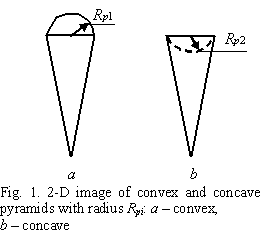
3. The plotted volume of the economic sphere Vs is an aggregate of
separate, convex and concave identical pyramids of the same volume Vpi and with constant
radiuses Rpi for convex Rp1 and concave Rp2
pyramids. Figure 1 represents two flat images of a convex pyramid and a concave
pyramid.
4. The plotted volume of the economic sphere Vs is aggregate of separate a convex and concave
identical pyramids of the same volume Vpi
and with constant and varying radiuses Rpi (constant radius Rp1 is for convex pyramids and varying radiuses Rp2 are for concave pyramids).
5. The plotted volume of the economic sphere Vs is an aggregate of separate convex and concave
identical pyramids of the same volume Vpi
and with constant and varying radiuses Rpi (varying radiuses Rp1
are for convex pyramids and constant radius Rp2
is for concave pyramids).
6. The plotted volume of the economic sphere Vs is an aggregate of
separate convex and concave identical pyramids of the same volume Vpi and with varying radiuses Rpi (varying radiuses Rp1 are for pyramids and constant radius Rs2 is for concave
pyramids).
7. The plotted volume of the economic sphere Vs is an aggregate of
separate convex and concave identical pyramids of varying volumes Vpi and with the same
radiuses Rpi (radius Rp1 is for convex
pyramids and radius Rp2
is for concave pyramids).
8. The plotted volume of the economic sphere Vs is an aggregate of
separate convex and concave identical pyramids of varying volumes Vpi and with different radiuses
Rpi (constant radius Rp1 is for convex
pyramids and varying radius Rp2
is for concave pyramids).
9. The plotted volume of the economic sphere Vs is an aggregate of
separate convex and concave identical pyramids of varying volumes Vpi and with
different radiuses Rpi (varying radius Rp1 is for convex pyramids and constant radius Rp2 is
for concave pyramids).
10. The plotted volume of the economic sphere Vs is an aggregate of
separate convex and concave identical pyramids of varying volumes Vpi and with varying
radiuses Rpi (varying radiuses Rp1 and Rp2 for
convex and concave pyramids).
Let us consider
the above stated subclasses individually:
Subclasses without cracks:
1. The plotted volume of the economic sphere Vs is an aggregate of separate identical pyramids of the
same volume Vpi and same
radius Rpi.
This subclass represents an ordinary sphere plotted
from identical pyramids. The minimum number of sides of a pyramid is equal to
three, i.e. nfmin
= 3, and the maximum number is equal to nfmax,
i.e. nf = nfmax. As we
calculate the volume of a pyramid, then the number of its faces shall
correspond to the number of the variables nGDP
used when calculating GDP of a country. Thus, it is possible to record the
following boundaries for the number of faces of pyramid within which they can
exist 3 £ nf £ nGDP. It should be noted that the
volumes of pyramids are equal among themselves Vp1 = Vp2…=
Vpi.
2. The plotted volume of the
economic sphere Vs is an
aggregate of separate identical pyramids of different volume Vpi and with the same radius Rpi. Thus, it is possible to
records Vp1 ¹ Vp2…¹ Vpi for
volumes. And the following derivation Rp1
is possible to record as the radiuses for the convex Rp1 and concave Rp2 pyramids are the same.
3. The plotted volume of the
economic sphere Vs is an
aggregate of separate convex and concave identical pyramids of the same volume Vpi and with constant radiuses
Rpi for convex Rp1 and concave Rp2
pyramids. In view of this, for
this case it is possible to record Vp1 = Vp2…= Vpi for volumes of pyramids and Rp1 = Rp2 for
their radiuses.
4. The plotted volume of the economic
sphere Vs is an aggregate
of separate convex and concave identical pyramids of the same volume Vpi and with constant and
varying radiuses Rpi
(constant radius Rp1
is for convex pyramids and varying radiuses Rp2
are for concave pyramids). So, it is possible to record Vp1 = Vp2,
Rp11 = Rp12 =…Rp1i = const and Rp21 ¹ Rp22.
5. The plotted
volume of the economic sphere Vs
is an aggregate of separate convex and concave identical pyramids with the same
volumes Vpi and with
constant and varying radiuses Rpi
(varying radiuses Rp1
are for convex pyramids and constant radius Rp2
is for concave pyramids). In this subclass Vp1 = Vp2, Rp11 ¹ Rp12, а Rp21 = Rp22 =…Rp2i = const.
6. The plotted
volume of the economic sphere Vs
is an aggregate of separate convex and concave identical pyramids of the same
volume Vpi and with
varying radiuses Rpi (varying radiuses Rp1 are for convex pyramids and varying radiuses Rp2 are for
concave pyramids). Thus, Vp1 = Vp2, Rp11 ¹ Rp12, Rp21 ¹ Rp22.
7. The plotted
volume of the economic sphere Vs
is an aggregate of separate convex and concave identical pyramids of varying
volumes Vpi and with the
same radiuses Rpi (radius Rp1 is for convex
pyramids and radius Rp2
is for concave pyramids).
Here the
radiuses for convex Rp1 and for concave Rp2 of pyramids can be divided into the following
two groups:
·
all
radiuses of convex Rp1
and concave Rp2
pyramids are equal among them, that is Rp11 = Rp12 =…Rp1i = Rp21 = Rp22 =…Rp2j;
·
all
radiuses of convex Rp1 and concave Rp2 pyramids are equal among themselves only in
their groups, that is Rp11 = Rp12 =…Rp1i, and Rp21 = Rp22 =…Rp2j consequently Rp1i
¹ Rp2j i.
8. The plotted
volume of the economic sphere Vs
is an aggregate of separate convex and concave identical pyramids of varying
volumes Vpi and with
different radiuses Rpi
(constant radius Rp1
is for convex pyramids and varying radius Rp2
is for concave pyramids). In this subclass Vs1
¹ Vs2, Rp11
= Rp12 =…Rs1i = const and Rp21 ¹ Rp22.
9. The plotted volume of the
economic sphere Vs is an
aggregate of separate convex and concave identical pyramids of varying volumes Vpi and different
radiuses Rpi (varying radius Rp1 is for convex pyramids and constant radius Rp2 is for concave
pyramids). In this case Vp1 ¹ Vp2, Rp11 ¹ Rp12 and Rp21 = Rp21 =…Rp2j = const.
10. The plotted volume of the
economic sphere Vs is an
aggregate of separate convex and concave identical pyramids of varying volumes Vpi and with
varying radiuses Rpi
(varying radiuses Rp1
and Rp2 are for
convex and concave pyramids). In this case, it is possible to record Vp1 ¹ Vp2, Rp11 ¹ Rp12, Rp21 ¹ Rp22.
Three formulae
are acceptable for calculation of the volume of the above described 10 variants
of close economic sphere
1. Formula (1)
is applied for the first two variants when the economic sphere is an aggregate
of volumes of separated pyramids with a flat base

where: Vp1, Vp1…Vpi means the volume of separate pyramids, unit3.
The volume for convex and concave
pyramids of radius Rpi is
calculated under formulae 2 and 3 (Figure 2);
For convex pyramids
Vp1 = Vp11 + Vp12, (2)
where: Vp11 is the volume of the convex segment of
the considered pyramid, unit3;
Vp12 is the volume of a pyramid, unit3.
For concave pyramids
Vp2 = Vp22 - Vp21, (3)
where: Vp21 is the volume of the convex segment of
the considered pyramid, unit3.
Vp22 is the volume of a pyramid, unit3;

Similar descriptions are also applied
to the subclass of open spheres having even one crack, that is when two faces
of two pyramids are out of contact against each other.
If it is
necessary to change any economic sphere from an open one, that is with a crack
(cracks), into a close one, then it can be done in the following way. It is
necessary to base on an equilateral single economic pyramid where its base side
length lsp is equal to one
(lsp1 = 1) and
which area we indicate as Spht1.
The length of the lateral face lf of this pyramid is also equal to
unity (lf = 1) .
On this basis,
here, we will introduce a concept of “unit theoretical volume” of an economic
pyramid Vpht where the
length of each base side of this pyramid
lsp and the length of its lateral face lf is equal to one, unit3. In this case, it
is supposed that this pyramid has not been influenced by pressure.
Now we will
perform the following transformation, we will increase (decrease) all sides of
the considered pyramid depending on their sizes in such a way so that the
lengths of base sides and faces are to be equal to one. Thus, we reduce all
pyramids of economic shell to the unit theoretical volume Vpht1. In this case, we will receive a
theoretical economic shell Vpht
consisting of a set of volume units of economic pyramids Vpht1n.
From this perspective, the volume of theoretical economic shell Vpht can be calculated under
formula (4)

After that, we
will introduce a coefficient of increase (decrease) for a base side of a
pyramid lsp and indicate
it as Ksp. The application
of this coefficient gives us a possibility to reduce any base side of a pyramid
lsp to be equal to unity,
i.e. lsp1 = 1,
that is to equilateral polyhedron. The similar coefficient Kspb is applied for the faces of a pyramid. Thus, the
values lsp1, lf1 and hsp1 can be calculated under formulae 5 and
6 respectively, that means to reduce all variables of a pyramid to unity.


The value of
these coefficients is always greater than zero (Ksp > 0, Kspb
> 0). In this case, if the values of coefficients Ksp and Kspb
are within the following boundaries 0 < Ksp
< 1 and 0 < Ksbp
< 1, then, consequently, the considered base side lsp and face lf
of a pyramid are decreased as their values are more than one. If the values of
coefficient Ksp and Kspb are more than one, that
is Ksp > 1 and Kspb > 1, it means that a
base side of a pyramid lsp
and a face lf are within
the boundaries 0 < lsp
< 1 and 0 < lf < 1. When Ksp = Kspb
= 1, it means that a base side lsp
and a face lf of a pyramid
are equal to one (lsp = lf = 1). In this case,
definitely, there are alternatives when these coefficients have different
values, for example, Ksp
> 1, and Kspb < 1 or
Ksp = 1 and Kspb > 1.
Since there can
be a great number of pyramids in a spherical economic shell if the GDP of a
country is calculated, then it is necessary to use the corresponding table
which example is represented below.
|
Table 1. Reduction of values of all side lengths lsp and faces lf
of a triangular pyramid to unity |
||||||||||||
|
№ п/п |
lsp |
Ksp |
lsp |
Ksp |
lsp |
Ksp |
lf |
Kspb |
lf |
Kspb |
lf |
Kspb |
|
1 |
lsp11 |
Ksp11 |
lsp12 |
Ksp12 |
lsp13 |
Ksp13 |
lf11 |
Kspb11 |
lf12 |
Kspb12 |
lf13 |
Kspb13 |
|
2 |
lsp21 |
Ksp21 |
lsp22 |
Ksp22 |
lsp23 |
Ksp23 |
lf21 |
Kspb12 |
lf22 |
Kspb22 |
lf23 |
Kspb23 |
|
|
… |
… |
… |
… |
… |
… |
… |
… |
… |
… |
… |
… |
|
i |
lspi1 |
Kspi1 |
lspi2 |
Kspi2 |
lspi3 |
Kspi3 |
lfi1 |
Kspbi |
lfi2 |
Kspbi |
lfi3 |
Kspbi |
Table 1
represents an example of values reduction of all three variables in a pyramid lsp and lf to unity except when their values are equal to unity as
in this case the coefficients will be the following: Ksp = 1 and Kspb
= 1. Here a line number (serial number) (item No.) corresponds to the
number of a considered pyramid.
While calculating the volume of
spherical economic shell, it is expedient to represent it in the form of a set
of plane pyramids as it was done in Figure 3, than in the form of convex or
concave pyramids represented in Figure 4. And in this case, as appears from
Figures 3 and 4, these pyramids are open as pyramids 2 and 3 are out of contact
against each other.
|
|
|


REFERENCES
1. Pil E.A. Types
of deformation of economic shell under influence of various forces // Bulletin
of St. Petersburg State University of engineering and economics. Series
“Economy” №. 14(17), 2007 – P.226-231.
2. Pil E.A. Application of
theory and shells for the purpose of description of processes taking place in
economy // Almanac of modern science and education. 2009. No.3. P. 137-139.
3. Pil
E.A. Influence of different variables onto economic shell of a country // Almanac
of modern science and education. 2012. №. 12(67). P. 123-126.