Медицина/7.
Клиническая медицина
PhD Kobtseva O.A.
Donetsk
National Medical University named after M. Gorky, Liman,
Ukraine
The study of the first
upper molars inclination
in their use as orthodontic anchorage
Introduction. Crowding of teeth is one of the most common
teeth anomalies. The
treatment of this pathology during permanent occlusion more often is carried out with bracket
system with removal of the first premolars [1]. The orthodontic process of
spaces closing after extraction of teeth is determined a number of different
factors. One of which is the creation and control of orthodontic support [2]. With this kind of orthodontic
treatment the first permanent
molars often are used as the
supporting teeth. Most scientific studies on this issue are
considering the loss of anchorage solely as a bodily shift of supporting teeth in the direction
of reactive force [3, 4]. The question of the study of the supporting first upper molars
inclination, in our opinion, not enough attention is paid.
The
aim of the study. To assess the vestibular-oral slope of the
first upper permanent molars crowns for their use as orthodontic support before
and after fixed orthodontic treatment with the
removal of the first upper premolars.
The
object and methods. The first study group was the 17
supporting first upper molars; adults 18-25 years (M±m=21,6±0,8
years). The second group consisted
of the 20 first upper molars; children 11-16 years (M±m=13,0±0,3 years).The
position stabilization of the supporting teeth in the patients was performed using the ligature binding of the first molars and
second premolars brackets. The determination of the inclination of the upper first molars crowns were carried out before and
after orthodontic treatment with photo of the patients plaster models of
the upper dental arch through the rapid analysis method proposed by V.S. Gubanova [5]. In the
photos intertubercular middle distances were marked: for vestibular and
palatal tubercles respectively. The distances from these points to the median
palatal suture were
measured (Photo 1).
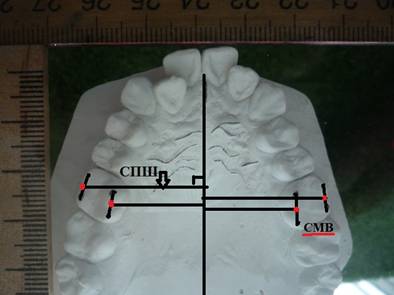
Photo 1. The measuring points for
determining the vestibular-oral position of the upper
first molars.
The photos obtained measurements were used
for calculating of the vestibular-oral
slope index of the molars crowns. The reduction of the index at the end of
treatment showed a vestibular slope of the first upper molars. With increasing of the
index at the end of treatment concluded a tendency to palatal inclination of the upper first molars.
Results
and discussion. The research data of the 1 group showed that the
average value of the inclination index of the upper molars were 1,3±0,02 before
treatment and 1,3±0,03 after treatment
(p>0,05). The results of the study in children group 2 indicated that the mean value
of the index were 1,2±0,2 before treatment and 1,2±0,3 after treatment
(p>0,05). The analysis of the study results revealed no statistically
significant differences between the indices of vestibular-oral
slope of the first upper
molars in both children 11-16 years and as well as in patients 18-25 years of age
(p>0,05).
Conclusions. Proceeding from the above
and given the lack of statistical significance
of differences between the average values of vestibular-oral slope indices
before and after orthodontic treatment in both age groups, we can assume that the change of inclination
of the support first molars
crowns is not pathognomonic symptom of anchorage loss of the supporting upper teeth with using
ligature binding during fixed orthodontic treatment with the removal of
the first upper premolars.
REFERENCES
1.
Лихота К. М.
Сучасне бачення на тактику комплексного лікування скупченого положення зубів /
К. М. Лихота, О. В. Кочин,
А. Я. Сеник // Дентальные технологии. – 2010. –
№ 3-4. – С. 75-80.
2.
Нанда Р. Биомеханика
и эстетика в клинической
ортодонтии / Р. Нанда. – М.: Медпресс,
2009. – 399 с.
3.
Duration and Anchorage Management
of Canine Retraction with Bodily Versus Tipping
Mechanics / N. Shpack, M. Davidovitch,
O. Sarne [et al.] // The Angle Orthodontist. – 2008. – Vol. 78, N 1. – P. 95-100.
4.
Feldmann I. Anchorage capacity of osseointegrated
and conventional anchorage systems: a randomized controlled trial / I. Feldmann, L. Bondemark
// American Journal of Orthodontics
and Dentofacial Orthopedics. – 2008.
– Vol. 133. – P. 19-28.
5.
Губанова В. С.
Диагностика положения моляров в трех
взаимно перпендикулярных
плоскостях при зубочелюстных аномалиях: автореф. дис. на здобуття наук. ступеня канд.
мед. наук: спец. 14.01.14
«Стоматология» / В. С. Губанова. – Москва, 2011. – 26 с.