Современные информационные технологии/ 1.Компьютерная инженерия.
Михайлов М.К.
Відкритий
міжнародний університет розвитку людини "Україна", аспірант
Android system and applications architecture trends
The analysis of the current state of the
computer systems market makes it possible to identify an important direction
for the development of operating systems for mobile devices. One of the leaders
in this market segment is the Android operating system. In 2018, the release of
Android 9 is expected. The annual update of the operating system for a large
number of devices leads to significant resource and time costs. The way out of
this situation is the development of the architecture of the operating system
in the direction of its modularity [1].
Android 8 operating system implement the
architectural solution called Project Treble, and this operating system must be
preinstalled on the mobile device. Earlier versions of this OS, even if updated
to Android 8, do not support Project Treble. The main idea of this solution is
separating the core of the OS from it’s low-level implementation (see figure
1).
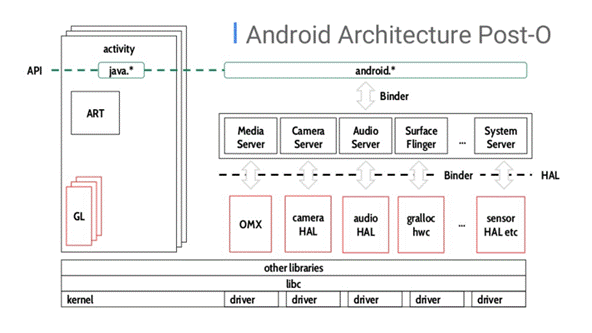
Figure 1. Android OS modular architecture
Implementation
of this architecture allows to update independently both core level and low
level of Android OS. This approach will provide the decrease of time costs for
updating OS components, and, as a result, the faster releasing of new mobile
devices. In addition to architectural changes, Android 9 will differ from
previous operating systems by the following features [2], [3]:
●
more
flexible settings;
●
increased
operating system stability;
●
improved
widgets;
●
complete support of split screen
feature for most of the applications;
●
ability to install the official
Pixel Launcher;
●
security patches integration, and
their regular updating.
Mobile
application architectures
Clean
Architecture is implemented as three disjoint and independent layers: Data
Layer, Domain Layer and Presentation Layer.
MVC
Model-View-Controller
- architectural solution, that allows separating the UI from business logic,
and the business logic from data.
MVP
Model-View-Presenter
- UI pattern that allows simplifying automatic modular testing and improves the
separation of responsibilities in presentation logic.
MVVM
Model-View-View
Model – this architecture separates the model and it’s presentation, which is
required for changing these components separately. For example, developer can
implement the data interaction logic, and the designer can work with user
interface.
Choosing the
technologies and instruments for Android application development
A complex issue when designing
mobile applications is the choice of technology and design tools, which should
take into account different factors [4]. Each alternative tool is characterized
by several private criteria. To select the best tool and technology for
designing an Android application, the following criteria are proposed: the
programming language, the available debugger, the available emulator, the
available integrated development environment, 3D support, the development
platform, the installation package, the permanent connection to the server, the
cost of tools for development [5].
Conclusion.
The analysis of Android system architecture and application architecture
development trends allows clarifying the criteria of choosing tools of mobile
system development and designing.
Литература:
1.
https://www.androidauthority.com/project-treble-818225/
2.
https://setphone.ru/stati/android-9/
3.
http://xiaomishka.ru/android-9-0-pi-i-smartfony-xiaomi
4.
Михайлов
М.К. Выбор технологий и инструментария разработки приложений под ОС
ANDROID/ Михайлов М.К.
//Комп’ютерні технології: наука і освіта: тези доповідей. IX
Всеукраїнська науково-практична конференція– К.: Університет «Україна», 2015. –
С. 8 –10.
5.
Михайлов
М.К. Методи порівняльного аналізу для інженерії програмного забезпечення/
Михайлов М.К. //Вісник університету «Україна», Серія «Інформатика,
обчислювальна техніка та кібернетика». – К.: Університет «Україна», 2015. –
№1(17). С. 40 –45.