Экономические
науки/2. Финансы и банковское дело
Sarmad
Kawkab Al-Jamel
Prof
Department of Banking and
Finance Sciences ;College of
Administration and Economic; University of Mosul Iraq
Mohammed Fawzi
Mohammed
Assistant
Lecturer ; Ph .D student; Department of
Banking and Finance Sciences ;College of Administration and Economic;University of Mosul Iraq
EARNINGS QUALITY APPROACH TO THE ANALYSIS OF FINANCIAL
STATEMENT : EVIDENCE FROM JORDAN
Introduction
The focus on the
earnings quality by financial analysts is one of the objectives of financial
analysis. It is the evaluation current performance, which is an indicator of future performance of
the company. From this perspective, High-quality earnings Explains the current
operational performance of the company, At the same time, a good indicator of operating
performance in the future,
and the measure summarizes the value of
the company. Consistent with
this idea ,we most measure earnings quality by attributes of earnings on a sample of
corporations listed in Amman stock exchange.
What
Is Earnings Quality ?
The researchers used several definitions of quality
of earnings According to their perceptions of the special nature of the objectives to be achieved from the use of financial statements,Such
objectives on the use of financial statements to evaluate the financial performance of the company, as well
as, its ability to continue
to predict and achieve future earnings.
Richardson (2003) referred to quality of earnings through the ability of current
earnings to continue in future periods, Whenever earnings become more Persistence,
it refers to the high level of earnings
quality in future [9,p.50]. Consistent with the above
definition was defined Penman(2003)
earnings high-quality as
the earnings that contain a good
indicator for future returns, and
reflect well on the economic substance of operations [8,p.80-81].The
quality of earnings as an indicator summarizes the quality of financial reporting
which in turn determines the quality of
financial disclosure [3,p.14] .
Defined the
quality of earnings by Dechow& Dichev (2002) in the form of accruals related to cash
flow [1,p.39].Sloan finds
earnings of cash
flows more Persistence of the accruals earnings, By linking the between the quality of earnings
and size of accruals,and From a
scientific point of the quality of earnings must distinguish
it as the difference between
net income and cash
flows from operating activities [10,p.289] . We believe
that, the quality of earnings means avoid earnings management practices, In other
words, quality of earnings means the degree of trust
in achieving income, As a reflection of
the degree of deviation of the actual income of the company for the income reported, Also, earnings with poor quality Means that,the earnings reported Contains non-reality earnings.
Earnings Attributes Measures
Accruals quality
Several
measures to assess earnings quality indicate that earnings which maps more
closely into cash is more desirable ( e.g.[4,p.972] ; [5,p.302] ). The gap
between earnings and cash is from accruals. One role of accruals is to shift or
adjust the recognition of cash flows over time so that the adjusted numbers
(earnings) better measure firm performance. However, accruals require
assumptions and estimates of future cash flows. Thus, accruals are the product
of judgments, estimates, and allocations. Dechow and Dichev (2002) (hereafter,
DD) develop a measure of accruals quality and argue that the quality of
accruals and earnings is decreasing in the magnitude of estimation error in
accruals. The DD model uses firm-specific regressions of changes in working
capital on last year, present, and one-year ahead cash flows from operations
and defines accruals quality as a standard deviation of the residual from this
firm-specific regression [1,p.40]. However, McNichols (2002) proposes a modified
Dechow and Dichev (2002) model, arguing that the changes in sales revenue and
property, plant, and equipment are important in forming expectations about
current accruals, over and above the effects of operating cash flows [7,p.65]. She shows
that applying variables from the Jones (1991) model and modified Jones model [2,p.199]. into the cross-sectional DD model
significantly increases its explanatory power and thus reduces measurement
error. The accrual estimation errors using a residual (ε t ) is
measured from the following equation:
 (1)
(1)
Where:
|
TCA j ,t |
= |
Firm j’s total current accruals in year t. |
|
|
= |
ΔCA j ,t – ΔCL
j ,t
– Δ cash j ,t + Δ
STDEBT j ,t |
|
CA j ,t |
= |
Firm j’s current assets in year t. |
|
CL j ,t |
= |
Firm j’s current liabilities in year t. |
|
cash j ,t |
= |
Firm j’s cash in year t. |
|
STDEBT
j ,t |
= |
Firm j’s debt in current liabilities in year t. |
|
CFO j ,t |
= |
Firm j’s cash flow from operations in year t. |
|
|
= |
NIBE j ,t - TA
j ,t |
|
NIBE j ,t |
= |
Firm j’s net income before extraordinary items in year t. |
|
TA j ,t |
= |
Firm j’s total accruals in year t. |
|
|
= |
ΔCA j ,t – ΔCL
j ,t
– Δ cash j ,t + Δ
STDEBT j ,t - DEPN
j ,t |
|
DEPN j ,t |
= |
Firm j’s depreciation and amortization expenses in year t. |
All
the equation (1) variables divided by total
assets. Using the
cross-section analysis
For
each year, we estimate Equation (1) using data for (103) companies. The measure
of accruals quality is based on this standard deviation of estimated residual (
s (ε j, t) ) from equation (1) as
it refers to the extent to which working capital accruals map into operating
cash flow realizations. Large (small) values of standard deviation of estimated
correspond to lower (higher) accruals quality and lower (higher) earnings
quality.
Earnings Persistence
Persistence of earnings mean high quality earnings,
This study employs the measure in [4,p.980], we measure earnings persistence as the slope
coefficient estimate (Ø1) from the
following equation:

Where:
|
Earn j ,t |
= |
Net income
before extraordinary items in year t divided by the weighted average number
of outstanding shares during year t . |
Using the
cross-section analysis
For
each year, we estimate Equation (2) using data for (103) companies. The measure
capturing earnings persistence is based on the slope coefficient Estimate (Ø1) from equations (2). Values of (Ø1) close to one indicate highly persistent
earnings while values close to zero imply highly transitory earnings.
Persistent earnings are viewed as higher quality, while transitory earnings are
viewed as lower quality.
Earnings Predictability
Lipe (1990) provides
a measure of earnings predictability as it is reflected in the variance of the
earnings shocks (as variance increases, the predictability decreases) [4,p.980]. also follow his
study by measuring earnings predictability using the square root of the estimated error variance from the earnings
persistence equation. In this study, earnings
predictability is calculated using the square root of the error variance from equation (2). Predictability is:

Where:
|
Predictability t, j |
= |
Firm j’s
earnings predictability in year t, captured by the square root of the error
variance from equation (2). |
|
|
= |
Estimated
error variance of firm j in year t, calculated from equation (2). |

Large (small) values of Predictability imply less (more) predictable earnings. More predictable earnings
are viewed as higher quality, while less predictable earnings are viewed as lower quality.
(Francis et al. 2004) defined smoothness
as the ratio of firm j standard deviation of net income before extraordinary
items divided by beginning total assets, to its standard deviation of cash
flows from operations divided by beginning total assets [4,p.980]. This
measure is also similar to the one found in [6,p.30], from the
following equation:
 (4)
(4)
large
(small) values of Smooth indicate more (less) earnings smoothness and low
(high)
earnings quality.
Sample, Data, and Hypothesis
Sample and Data
The research sample included 103 company listed on the Amman Stock
Exchange, (53) companies in the industrial sector, (29)
companies in the
service sector, and21)
companies in the
financial sector. Our sample covers the 9 years, t = 2005-2013. Search requests provides
data covering the years
before the measurement period
(2005) and The year after a
period of measurement
(2013) to calculate some models, Therefore,
included the measurement period (2006-2012).
Hypothesis
The earnings shown in the
financial statements published is not real, but rather the product of accounting principles, Accordingly, can formulate the following hypothesis :
H1: There is a relationship between
earnings quality attributes and analysis of financia statements
.
Test the Earnings Attributes
Table (1) shows
the results of the attributes of earnings During the period (2006-2012), Shows
a low the standard
deviation of the residuals values
(Accruals
quality) In the years
(2006-2007-2008-2010-2012) from the mean (1.084) percent, and the standard deviation was (0.093)
percent , Which indicates the high quality
of the accruals Amman
Stock Exchange during
those years. As can be seen in the high coefficient estimate for years (2006 2007, 2009.2010) from
the mean (0.856) percent, and the standard
deviation was (0.360) percent, Indicating a high
Persistence of earnings Amman
Stock Exchange, And poor Persistence in the past (2008 2011.2012). And
indicated the Predictability test results,
poor quality, In the past (2006.2007, 2009) because of the high values of the square root of the variance estimation
error, The mean of these values (1.103) percent, and standard
deviation ability (0.099) percent .
Thus, the earnings
of Predictability of a medium in the past (2008
2010.2011, 2012). indicated the Earnings Smoothness test results, It is observed during
the study period, It
is observed during the study period increased Smoothness, Recorded a year (2008),
the highest percentage of Smoothness
, and Recorded in the year
(2012) the lowest percentage of Smoothness, And Figure 1 illustrates the
quality of earnings Amman Stock Exchange from 2006 to 2012.
TABLE (1 )
Results of
the attributes of earnings During the period (2006-2012)
ــــــــــــــــــــــــــــــــــــــــــــــــــــــــــــــــــــــــــــــــــــــــــــــــــــــــــــــــــــــــــــــــــــــــــــــــــــــــــــــــــــــــــــ
|
Attributes |
Accruals quality |
Persistence |
Predictability |
Smoothness |
|
2006 |
1.007 |
1.16 |
1.123 |
1.151 |
|
2007 |
1.036 |
1.07 |
1.155 |
1.686 |
|
2008 |
1.063 |
0.66 |
1.000 |
2.173 |
|
2009 |
1.160 |
1.12 |
1.291 |
1.804 |
|
2010 |
1.065 |
1.17 |
1.083 |
1.386 |
|
2011 |
1.259 |
0.29 |
1.022 |
1.301 |
|
2012 |
1.001 |
0.52 |
1.047 |
0.940 |
|
mean |
1.084 |
0.856 |
1.103 |
1.492 |
|
Std. Dev. |
0.093 |
0.360 |
0.099 |
0.422 |
|
Lowest |
1.001 |
0.290 |
1.000 |
0.940 |
|
Higher |
1.259 |
1.170 |
1.291 |
2.173 |
ــــــــــــــــــــــــــــــــــــــــــــــــــــــــــــــــــــــــــــــــــــــــــــــــــــــــــــــــــــــــــــــــــــــــــــــــــــــــــــــــــــــــــــ
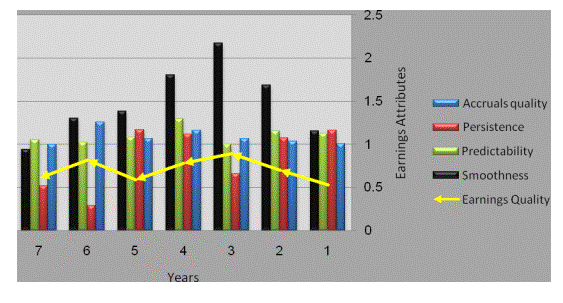
Figure (1) illustrates the quality of earnings Amman Stock
Exchange from (2006-2012)
In
order to assess the quality of earnings form aggregate, We use
the mean of the group's
four attributes values, Thus,
the quality of the earnings are high whenever
the value of the attributes of earnings decreased
aggregate formula for the mean, and the quality of
the earnings are poor
whenever the value of the attributes of earnings
increased aggregate formula for
the mean.
Conclusions
The test results
indicate the high quality of the attributes for the majority of companies, and that corporate earnings research sample temporary
rather than a permanent, low Persistence earnings, As a result, Predictability of these
earnings is poor as intertwined with the concept of Persistence.
As we pointed out the
results tests of Smoothness in accounting earnings, high smoothing,
and this result indicate that
net income has been subjected to manipulation by management in order to make it
more stable.
References
|
1. |
Dechow, P.,
Dichev, I., 2002. The quality of accruals and earnings :The role of accrual
estimation errors .The Accounting Review, Vol 77, 35-59. |
|
2. |
Dechow, P., Sloan, R., Sweeney, A.,
1995. Detecting earnings management, The Accounting Review, vol 70, No2,
193-225. |
|
3. |
Francis,
J., LaFond, R., Olsson, P., Schipper, K., 2006, Earnings Quality, Foundation
and Trends in Accounting , vol.1, Issue.4 |
|
4. |
Francis,
J., R. LaFond, P. Olsson, and K. Schipper., 2004, Costs of equity and
earnings attributes . The Accounting Review 79, 967–1010. |
|
5. |
Francis,
J., R. LaFond, P. Olsson, and K. Schipper., 2005, The market pricing of
accruals quality . Journal of Accounting and Economics 39, 295–327. |
|
6. |
Leuz,C., Nanda, D., Wysocki. D., 2003, Investor Protection and Earnings
Management: An International Comparison, Working paper, University
of Pennsylvania. |
|
7. |
McNichols, M.F., 2002, Discussion of
The Quality of Accruals and Earnings: The Role of Accrual Estimation Errors.,
Accounting Review (American Accounting Association). |
|
8. |
Penman, S.,
2003, The quality of financial statements: Perspectives from the recent stock
market bubble. Accounting Horizons, vol 17,
77-96. |
|
9. |
Richardson,
S., 2003, Earnings quality and short sellers. Accounting Horizons, vol 17,
49-61. |
|
10. |
Sloan, R.,
1996. Do stock prices fully reflect information in accruals and cash flows
about future earnings?. The Accounting Review, vol 71, 289-315. |