The senior teacher of
Economics Chair, N.Ch. Kuliev
Amur State University (Birobidzhan Branch), Russia
The role of the State in formation
of external prices on the timber market: the case of the Jewish Autonomous
Region
The world economy is based on
the world market, the material basis of which is scientific and technological
progress and stimulated by it the social division of labour. Almost all
national economies are integrated into the international division of labour and
economic relations.
The State policy of the Russian
Federation in the field of foreign trade is concerted actions of the State and
its authorities to determine the regulatory regime of foreign economic
relations and optimize the country's participation in the international
division of labour. Realization of national interests in the international
economy, support of the competitiveness of economy is one of the important
functions of the State in this field.
Major features of foreign
economic policy are foreign trade policy (including export and import policy),
the policy in the field of attracting foreign investments and regulation of
national investments abroad, currency policy, contribute to the balance of
foreign trade transactions with individual States and regions and are an
important tool in ensuring the economic security of the country.
The State in its foreign
economic policy is guided by national public interests, within taking into
account the standards of international law, obligations, international
environment, the general state of the world economy and the embracing market,
domestic and foreign policies of other countries.
The main objectives of foreign
economic activity regulation are:
-the use of external economic
connections to speed the creation of a developed market economy in Russia;
-assistance to improve labour
productivity and the quality of national products through the acquisition of
licenses and patents, purchasing new technologies, high-quality components, raw
materials and materials, including Russian enterprises in the world competition;
-arrangement of conditions for
Russian businessmen to access the world markets by providing public
organizational financial information assistance;
-protection of national
foreign economic interests and domestic market protection;
-the establishment and
maintenance of an international regime in relations with various countries and
international organizations [7, p. 296].
The regulation of Foreign
Economic Activities in Russia in conditions of market economy must be conducted
in accordance with the following basic principles:
-the unity of foreign economic
policy and domestic economic policy;
-the unity of State and
non-State regulation systems and monitoring its implementation;
-the shift of Foreign Economic
Activities regulation from administrative methods to economic ones;
-a clear discrimination of the
rights and responsibilities of the Federation and its constituent entities in
the field of Foreign Economic Activities management;
-ensuring the equality of all
participants of Foreign Economic Activities [5, p. 214].
The Customs policy of the
State plays an important role in the development of economic relations between
Russia and other countries. A competently constructed system of price
regulation in the sphere of foreign-economic activity, its structure,
objectives greatly influence the functioning of the economy as a whole, and all
macroeconomic indicators of the country development, and the entrepreneurial
activity of legal entities and persons and the formation of foreign trade
prices. Therefore, tariff regulation is one of the most important components of
the external economic policy of the State.
The State policy in the field
of foreign trade is carried out by customs-tariff and non-tariff methods of
regulation.
The tools of tariff regulation
of foreign trade activities are:
-the value added tax (VAT);
-excise duty;
-export and import customs
duties.
The collection of these duties
is necessary measures to protect the internal market and stimulate structural
changes. Adjusting the size of these duties, the State thus has an impact on
import and export of goods in the economic interests of the State.
The forest sector of Russia
has an enormous potential. The activity of timber industry because of a low
degree of added-value wood processing at present does not accord with the
economic interests of the State as the owner of the forest fund. The problems
in the development of the forestry complex, depressanting the economic growth
of forestry production and an efficient use of forest resources are
insufficient development of high-tech industries by added-value wood processing
and raw material and the imperfection of the tariff policy of the State. In
2010, the volume of logging in the world stands at 4 billion of which approximately
a third part (1.2 billion square meters) of timber is harvested in the
developed countries, which occupy leading positions. The tendency of recent
years is the increase of the share of the developing countries. According to
this indicator the United States, Russia, Canada, India, Brazil, Indonesia,
Nigeria, China, Sweden have irresistible proportions in logging. The largest
exporters of wood are the United States (15% of world exports), India and
Brazil (8%), and Indonesia (6%), Canada [9, p. 164].
The mechanical and chemical
processing of wood is mostly the lot of the developed countries. It is represented in Figure 1 [9, p. 233].
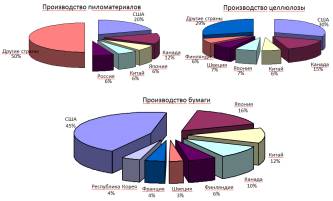
Figure 1. The geographic
structure of added-value wood processing in 2011.
Governmental forest management
and forestry in Russia have never been particularly stable, at least compared
to the most other branches of national economy. However, the period from 2000
to the present time is the most unstable in the history of the Russian forest
management. Since May 2000, when by the presidential decree the Federal service
of forest management and the State Committee for environmental protection have
been eliminated, there is almost a continuous reform of the authorities of the
forests management. In parallel with this, numerous changes often having no
specific focus are being contributed to the forest laws. In addition, the
number of departments having some attitudes to the forest management is rising
steadily, interagency conflicts are enhancing. An obvious growth of disorder in
forests and forestry attracts the State top leaders’ attention more and more,
resulting in numerous directions to put to rights. In terms of legislative and
administrative chaos firm top directions mainly lead to “simulate great
activity” which compound problems of the forest industry rather than to solve
them.
The grounds for new
initiatives to reform the Russian forest sector are enormous forest wealth of
Russia, constantly fed by poor quality forest statistics. Because of the fact
that Russia accounts for nearly a quarter of the world's forests, it is often
concluded that for produced forest products and the income from the forests
Russia now can occupy a comparable place in the world, only some obstructing forest
utilization restrictions should be removed [3, p. 151].
However, due to the lack of
clear ideas concerning what exactly prevents full development of the forest
industry, a weak coordination between different authorities, and the resistance
on the part of the majority of the employees of the forest (rightly feared for
their future), most of the reforms is chaotic and virtually never brought to a
logical conclusion.
The new forest code in theory
serves as a basis for reforms in the sphere of forest management in Russia. It
includes many important innovations in the system of forest management.
However, the new code is so vague and internally inconsistent, that without the
adoption of numerous additional documents it cannot work at different levels.
Therefore, only the code sets the general direction of the forestry reform and
concrete implementation of this reform is determined not by the code but by the
enlightening documents and administrative decisions of the code [9, p. 160].
Legally enforceable enactments
in regard to formation of prices for timber and fees per unit area of forest
are Government decrees of the Russian Federation and orders of the Federal
Agency for Forestry Affairs. A rate is the price of one cubic meter of wood
sold on the vine as of felling of main and intermediate usage and other logging
[2].
Rates are used for a specific
forest fee area as the basis for calculating the rent of plots of the forest
fund for the purpose of harvesting of wood as primary forest prices at auctions. The Government of the Russian Federation
also provides indexing of rates per volume of forest resources and charges per
unit area of forest for forest leases in the federal property.
At the World Forestry market
there is evaluation and sale of different varieties and types of woods,
resulting in the inevitable multitude of prices and, as a consequence, the
emergence of problems in selecting the world prices.
The system of payments for the
use of the forest is covered by “The Principles of Forest Legislation of the
Russian Federation”, adopted by the Decree of the Supreme Soviet of the Russian
Federation on March 6, 1993.
Before the adoption of the
document charges for forest resources determined by fixed forest fees. “The
Principles” provide three types of payments: payments for reproduction, and
protection of forests; forest taxes and rents.
Except rents of the forest
fund, there is also sale of forest resources at trades (forest trades).
Depending on the importance of
trades (auctions) they are conducted as an oral competition (oral auctions) or
by examining written claims, sealed in envelopes (sealed bids) or both ways
together (joint trading sessions). Joint trading sessions are primarily
assigned. Oral auctions are held in areas for local consumers. In case of selling
large quantities of timber on the stump sealed bids are assigned, execution of
operations is carried out by the Trade Commission [4, p. 111].
Public authorities, depending
on the position of the national economy, volumes of exports and imports regulate
prices or have a significant influence on prices due to the use of tools of
tariff policy. For the vast majority of goods the State also defines the
General rules and principles of pricing, sometimes sets limit levels of
profitability or prices and thus carries out its management functions.
The pricing mechanism in the
conditions of market relations is formed by the influence of such factors as
resource potential, operating environment, market demand, and the need of
international partners in some timber (for example, in China, which is one of
the world's largest consumers of wood, at present forest shortage is
particularly acute) [10, p. 177].
However, in the modern market
economy conditions there is a very noticeable trend towards a significantly
increasing role in pricing of private and public nature-oriented organizations
among the countries that produce and sell timber. Nowadays in a growing number
of countries quotas on the volume of felling and sale of timber are imposed.
Because of this, prices of round timber became higher. Another factor
influencing the prices is associated with protection of the environment, and
these are attempts to introduce ecologically clean and wasteless technologies
of wood processing. Development of new technologies, in turn, is a set of very
costly events, as the wood-processing industry is quite large in its volume, in
this way the introduction of any new technologies requires large investments,
and this affects the price of round timber [3, p. 249].
The foreign trade tariff
policy regulating forestry exports needs to be adjusted and must be aimed at
improving the efficiency of forest exports and concentration of manufacturing
activity in its territory. This is especially important in Japanese and
Chinese, as the markets of China and Japan will continue to be promising export
markets for the products of the Russian timber industry [6, p. 180].
A customs duty, as a tool of
tariff policy of the State, is an important element in the formation of foreign
trade prices. To explore the impact of higher rates of a customs duty it is
necessary to watch the dynamics of customs value of forest products (according
to the customs statistics of the Jewish Autonomous Region) [8]. The dynamics of
customs value of one sq.m of timber raw from ash is displayed in Figure 2, from
aspen in Figure 3, from soft wood in Figure 4, and the dynamics of the customs
value of one sq.m of timber treated pine is displayed in Figure 5.
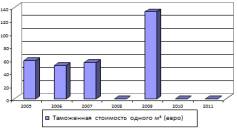
Figure 2 – The dynamics of customs value of one sq.m of
raw timber from ash, exported from the Jewish Autonomous Region.
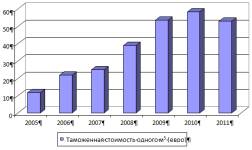
Figure 3 – The dynamics of customs value of one sq.m of raw timber
from aspen, exported from the Jewish Autonomous Region.
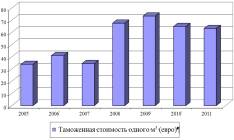
Figure 4 – The dynamics of customs value of one sq.m of raw timber from softwood, exported from the Jewish Autonomous Region.
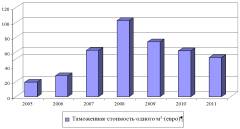
Figure 5 – The dynamics of
customs value of one sq.m of treated pine timber exported from the
Jewish Autonomous Region.
The important and final element for exploration of
tariff policy of the State on foreign trade prices is to the study of the
dynamics of contract prices.
Timber Market is characterized by a multiplicity of
prices. To study the effects of tariff policy of the State on foreign trade
prices, it is necessary to know the basic sources of information concerning
prices, a pricing mechanism of supply and demand analysis, projection of
prices, based on the market situation, and the formation of the contract price.
Currently, the forest industry
is experiencing considerable difficulties, but Russia remains the world's
largest exporter of raw wood. The main objective of Russia's policy in foreign
trade activities is to create favourable conditions in the world market for
Russian exporters and to enhance the effective foreign economic relations for
Russia, including by skillful tariff policy.
The analysis of the dynamics
of export volumes of wood from the Jewish Autonomous Region and from Russia
shows that raising the rates of export customs duties has significantly reduced
the export of unprocessed timber.
To size up the impact of the
tariff policy on exported timber is more difficult than for other commodities,
as the world forest industry is highly fragmented and opaque. The foreign trade
tariff policy of forest exports regulation needs to be adjusted and must be
aimed at improving the efficiency of forest exports and concentration of
manufacturing activity in its territory.
The tariff policy of Russia in
the foreign trade has an important meaning for an economic growth and
development in the dynamic world economy. But this should not become the only
tool in the regulation of external trade and the formation of foreign trade
prices in particular.
1. Customs Code of the
Custom Union: adopted by the Interstate Council of the Eurasian Economic
Community November 27, 2009: as at April 16, 2010 г. – М.: Prospect, 2010. - 192
p.
3. Panov A. I. Strategic
management: study guide / А.I. Panov. - М.: Unity - Dana, 2002. – 374 p.
4. Panskov V.G. Customs
regulation of foreign trade activity in Russia / V.G. Panskov, V.V. Fedotkin. –
М.: Finance and statistics,
2008. – 756 p.
5. Prokushev E.F. Foreign
trade activity / E.F. Prokushev – М: Dashkov and C, 2009. – 500 p.
6. Russia is in the world
economy / G.B. Polyak. - М.: Unity, 2011. – 703 p.
7. Svinukhov V.G. Customs: study
guide / V.G. Svinukhov. – М.: Economist, 2009. – 478 p.
8. Annual of Statistics of
the Jewish Autonomous Region: Annual Abstract of Statistics – Birobidzhan:
Eurostat, 2010. – 456 p.
9. Economic geography of
Russia: Study guide – Publication revised and added/ Under the general
editorship the member of the Academy of Sciences V.I. Vidyanin, Dr.sc.oec,
Prof. М. V. Stepanov. – М.: INFRA – М: Russian economic academy, 2005. – 568 p. – (Higher Education).
10. Economic systems of countries
worldwide / А.Ya. Suharev. – М.: Norm, 2008. – 990 p.
11. Official site [electronic resource]. – Access
mode: -http://www.customsonline.ru/l 719-asdasd.html. – 15.09.2012