Математика /4. Прикладная математика/
Ryaboshtan O.F., Milenin A.M., PhD, Skofenko S.M., PhD
Kharkiv Petro Vasylenko National Technical University
of Agriculture
About surfaces of gas turbines and
their corresponding differential equations
As is
known, the design surface with the use of differential equations with partial
derivatives is based on the close relationship of the equation, the
characteristic of its lines and the integrated surface. This equation
corresponds to a unique set of characteristic lines, of which the surface is
constructed. But it is one and the same surface can be formed by another set of
lines, and this corresponds to a different set of differential equation with
partial derivatives.
Of
course the problem of finding the whole set of differential equations,
respectively, of the surface, is not easy.
Consider
some of the issues of inter-differential equations, characteristics of surfaces
and their properties.
It is
known that the same surface can have the set of differential equations, each of
which reflects one a law of its formation.
For the
surface
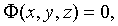 (1)
(1)
regular in the
domain of the independent variables, there corresponds an infinite set of
differential equations I order depending on the type of the function F:
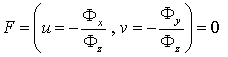 (2)
(2)
Differential
equation  corresponds to an infinite set of integral
surfaces, depending on the type of the initial curve and the complex formed
from the characteristic lines.
corresponds to an infinite set of integral
surfaces, depending on the type of the initial curve and the complex formed
from the characteristic lines.
Fix
ation level of the set (2) allocates a given surface  a one-parameter set of
characteristic lines. On the other hand, the allocation of the surface characteristics
of the one-parameter set is not uniquely determine the appropriate set of
differential equation.
a one-parameter set of
characteristic lines. On the other hand, the allocation of the surface characteristics
of the one-parameter set is not uniquely determine the appropriate set of
differential equation.
If
multiple lines are specified as
 (3)
(3)
then it corresponds
to a linear differential equation with partial derivatives, an exemption from a and b (3) equation
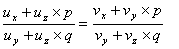 (4)
(4)
Between
the surface and its corresponding differential equation there is some
relationship.
This
relationship allows:
a) where equipment lines belonging to a given surface by its projection
on the Oxy
 (5)
(5)
determining
equipment curve normal vector of the surface.
b) to find the point on the surface with the given parameters u and v, or, conversely, the values of u and v for a given point
 .
.
Surface
 induces normal map x, y plane to
the surface u, v.
induces normal map x, y plane to
the surface u, v.
Analytical
form of this correspondence is established, subject to:
 (6)
(6)
Regular
surface  permits in the neighborhood of
  , where
 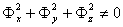 regular parameterization, which allows
her to get the equation in the form
regular parameterization, which allows
her to get the equation in the form

 , (7)
, (7)
Whence
the equation of the normal mapping is obtained by differentiating (7)
 ,
,  (8)
(8)
Actually,
except for z, we will check the same
transformations in the proposal that the requirements of regularity, are
fulfilled.
For a
first order differential equation, obtained exclusive of any two of the three
variables x, y, z, this surface  is integral.
There
are three types of equations  , and the equation of the same species may not be unique.